Sudden episodes of severe, colicky abdominal pain cause the infant to draw the knees up and cry, alternating with calm periods.
Before you read
Test yourself first: 2 questions
Question 1 of 2
A nurse is caring for an infant with suspected intussusception. Which finding is most characteristic of this condition?
Answer: A. Intussusception classically produces sudden episodic abdominal pain with drawing up of the knees, a sausage-shaped abdominal mass, and stools that look like currant jelly (blood and mucus). Painless rectal bleeding suggests a Meckel diverticulum; ribbon-like stools and chronic constipation suggest Hirschsprung disease.
Question 2 of 2
A 4-week-old infant is brought to the clinic with progressive, forceful, nonbilious vomiting after feedings and is hungry immediately afterward. The nurse suspects which disorder?
Answer: B. Hypertrophic pyloric stenosis classically presents at 3 to 6 weeks of age with projectile, nonbilious vomiting, persistent hunger, and a palpable olive-shaped mass in the right upper quadrant. Intussusception causes currant-jelly stools, GERD causes effortless spitting up, and gastroenteritis causes diarrhea and bilious vomiting.
Keep the streak going with more questions like these, each with a full rationale.
What is intussusception?
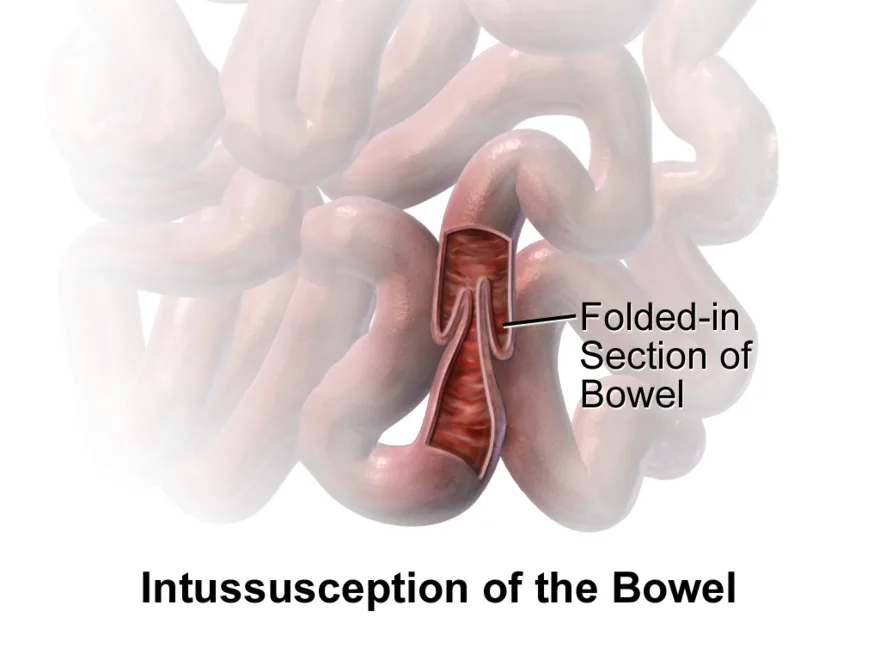
The invagination cuts off blood supply, leading to ischemia, edema, and possible bowel necrosis and perforation if untreated. The classic triad is sudden colicky abdominal pain, a sausage-shaped abdominal mass, and currant jelly stools.
Intussusception illustrated
Key points to remember
- Sudden episodes of severe, colicky abdominal pain cause the infant to draw the knees up and cry, alternating with calm periods.
- Currant jelly stools (a mix of blood and mucus) are a classic late sign from intestinal ischemia.
- A sausage-shaped mass may be palpable in the right upper quadrant.
- Vomiting, often bile-stained, and abdominal distension develop as obstruction progresses.
- The infant may appear lethargic and pull the legs toward the chest during pain episodes.
- Passage of a normal brown stool may indicate the intussusception has spontaneously reduced.
Common causes
- Bowel telescopes into itself
- Infants 3mo–3yr, sudden onset
Signs & symptoms
- Currant-jelly (bloody) stool
- Sudden colicky pain, draws up legs
- Sausage-shaped abd mass, vomiting
Nursing priorities
- Keep the child NPO and maintain IV fluids to treat and prevent dehydration and shock.
- Monitor for signs of bowel perforation: fever, increasing distension, tachycardia, and peritoneal signs.
- Prepare the child for an air or hydrostatic (contrast) enema, which is both diagnostic and often therapeutic.
- Monitor stools carefully; report passage of normal brown stool, which may signal reduction.
- Provide preoperative care if surgical reduction is required and support the family.
Labs & values
Patient teaching
- Sudden severe crying with knees drawn up, vomiting, and bloody mucousy stools needs immediate medical evaluation.
- After an enema reduction, watch for recurrence of pain, vomiting, or abnormal stools and return promptly.
- Report any return of symptoms after treatment, since intussusception can recur.
Red flags: report now
- Fever, rapidly worsening abdominal distension, rigidity, and signs of shock suggest perforation or peritonitis.
- Bile-stained or fecal vomiting and increasing lethargy require immediate provider notification.
- Sudden passage of a normal stool must be reported, as it changes the plan of care.
- Never delay treatment, because untreated intussusception can progress to bowel necrosis.
References
Clinical references for this topic