
A high fever lasting 5 or more days that is unresponsive to antipyretics is the hallmark.
Before you read
Test yourself first: 4 questions
Question 1 of 4
A nurse is assessing a child suspected of having Kawasaki disease. Which finding is consistent with this diagnosis?
Answer: A. Kawasaki disease features prolonged high fever, bilateral conjunctival injection without exudate, a strawberry tongue with cracked lips, cervical lymphadenopathy, rash, and erythema and later peeling of the hands and feet. A petechial rash with a stiff neck suggests meningococcemia, not Kawasaki disease.
Question 2 of 4
The nurse is assessing a newborn for Hirschsprung disease. Which finding in the first 48 hours of life is most suggestive of this disorder?
Answer: A. Failure to pass meconium within 24 to 48 hours of birth is a hallmark of Hirschsprung disease, caused by absence of ganglion cells in a segment of the distal colon. Frequent loose stools, projectile vomiting, and excessive meconium passage are not characteristic.
Question 3 of 4
A child is diagnosed with hand-foot-and-mouth disease. The nurse expects to find which characteristic lesions?
Answer: A. Hand-foot-and-mouth disease, caused by coxsackievirus, produces painful vesicular lesions in the mouth and on the palms and soles. It is usually self-limiting, and care focuses on hydration and comfort.
Question 4 of 4
A nurse is assessing a 78-year-old client. Which finding is a normal age-related change rather than a sign of disease?
Answer: A. Decreased skin elasticity and turgor is an expected aging change due to loss of subcutaneous tissue and collagen. Resting tachycardia, productive cough, and a new confusion onset are not normal aging and warrant evaluation.
Keep the streak going with more questions like these, each with a full rationale.
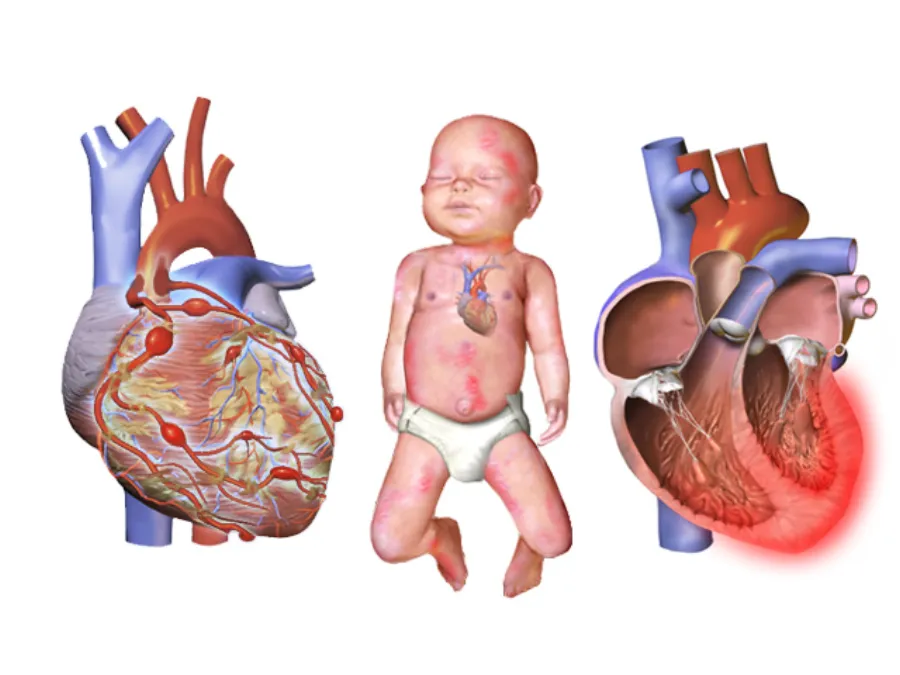
What is kawasaki disease?
Untreated, it can damage the coronary arteries and cause aneurysms, making early recognition and treatment critical. It is diagnosed clinically by a prolonged high fever plus characteristic mucocutaneous findings.
Kawasaki Disease illustrated
Key points to remember
- A high fever lasting 5 or more days that is unresponsive to antipyretics is the hallmark.
- Bilateral nonexudative conjunctivitis (red eyes without drainage) is characteristic.
- Oral changes include a strawberry tongue and red, cracked, fissured lips.
- A polymorphous rash appears mainly on the trunk and in the groin.
- Hands and feet show erythema and edema, followed by peeling (desquamation) of the fingertips and toes during recovery.
- Cervical lymphadenopathy and extreme irritability are common; coronary artery aneurysm is the most serious complication.
Signs & symptoms
- Fever > 5 days, unresponsive
- Strawberry tongue, cracked lips
- Conjunctivitis, rash, peeling palms
- Cervical lymphadenopathy, edema
Nursing priorities
- Administer high-dose IV immunoglobulin (IVIG) as ordered to reduce the risk of coronary artery aneurysm.
- Give aspirin as ordered for its anti-inflammatory and later antiplatelet effects, monitoring for bleeding.
- Monitor cardiac status, temperature, intake and output, and fluid balance closely.
- Provide comfort measures for irritability, oral care for cracked lips, and skin care for the rash and peeling.
- Promote rest, monitor for IVIG reactions, and prepare for echocardiography to evaluate the coronary arteries.
Labs & values
Patient teaching
- Give aspirin exactly as prescribed and report any unusual bruising or bleeding.
- Skin peeling on the hands and feet is expected during recovery and is not harmful.
- Avoid live vaccines (such as MMR and varicella) for about 11 months after IVIG, and keep all cardiology follow-up visits.
- Report return of fever, chest pain, irritability, or signs of a viral illness while on aspirin.
Red flags: report now
- Signs of coronary involvement (chest pain, dysrhythmias, signs of myocardial infarction) require immediate action.
- Watch for and report any bleeding while the child is on aspirin therapy.
- Because of aspirin use, watch for signs of Reye syndrome if the child develops a viral illness such as flu or varicella.
- Persistent fever after IVIG may indicate the need for retreatment and must be reported.
References
Clinical references for this topic

