Smoking is the leading risk factor; other risks include radon, asbestos, and secondhand smoke exposure.
Before you read
Test yourself first: 3 questions
Question 1 of 3
A nurse percusses a client's chest and hears a hyperresonant sound over the lung fields. This finding is most consistent with which condition?
Answer: C. Hyperresonance is a louder, lower-pitched percussion note than normal resonance and indicates trapped air, as in a pneumothorax or the hyperinflated lungs of emphysema. Dullness, by contrast, suggests fluid or consolidation.
Question 2 of 3
A client with bladder cancer has undergone creation of an ileal conduit (urinary diversion). Which finding in the stoma should the nurse report immediately?
Answer: A. A healthy urostomy/ileal conduit stoma is pink to beefy red and moist. A dusky, dark, purple, or black stoma indicates ischemia or necrosis from compromised blood supply and must be reported immediately. Mucus in the urine is expected because the conduit is made from bowel, and a small amount of urine draining continuously is normal.
Question 3 of 3
A nurse observes the fluid in the water-seal chamber of a chest drainage system rising and falling with the client's respirations. How does the nurse interpret this finding?
Answer: A. Tidaling, the rise and fall of fluid in the water-seal chamber with respiration, is an expected normal finding that reflects pressure changes in the pleural space. Absence of tidaling may mean the lung has reexpanded or the tubing is obstructed or kinked.
Keep the streak going with more questions like these, each with a full rationale.
What is lung cancer?
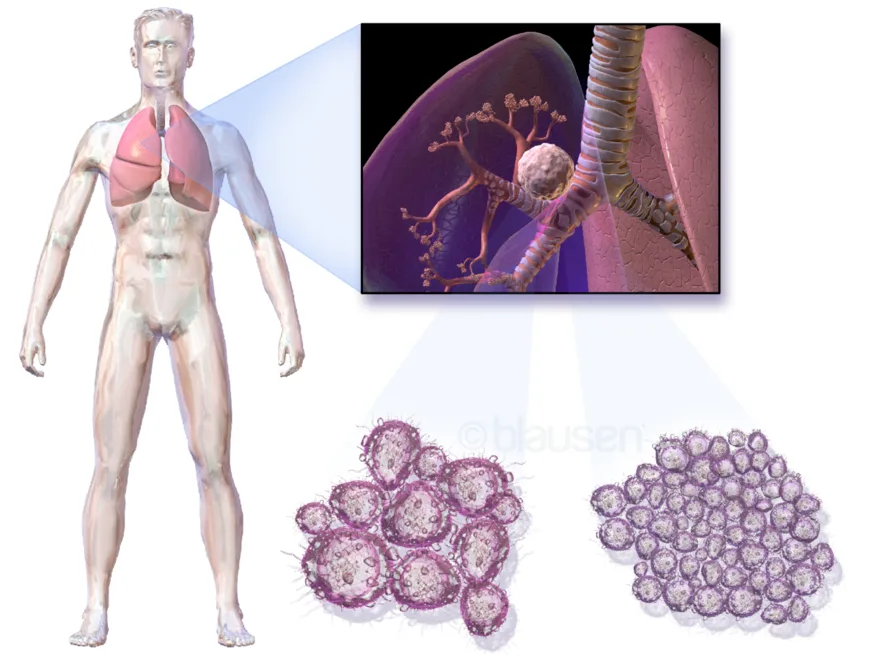
It is broadly classified as small cell (SCLC, aggressive, strongly smoking-related) or non-small cell (NSCLC, most common). The leading risk factor by far is cigarette smoking. Symptoms often appear late, so prognosis is frequently poor at diagnosis.
Lung Cancer illustrated
Key points to remember
- Smoking is the leading risk factor; other risks include radon, asbestos, and secondhand smoke exposure.
- Early disease is often asymptomatic; a persistent cough, hemoptysis, dyspnea, hoarseness, and chest pain are common signs.
- Small cell lung cancer is aggressive, metastasizes early, and is associated with paraneoplastic syndromes (e.g., SIADH, Cushing's).
- It is a common cause of superior vena cava syndrome and malignant pleural effusion.
- Diagnosis uses chest imaging and biopsy/bronchoscopy; treatment includes surgery, chemotherapy, radiation, and targeted/immunotherapy.
- Low-dose CT screening is recommended for high-risk current/former heavy smokers.
Signs & symptoms
- Persistent cough, hemoptysis, hoarseness
- Weight loss, dyspnea, chest pain
- Cough change in chronic smoker
Nursing priorities
- Maintain a patent airway and optimize oxygenation; position upright and provide oxygen as prescribed.
- Assess respiratory status, breath sounds, and effectiveness of breathing; monitor for worsening dyspnea.
- Manage pain and energy conservation; cluster care to reduce fatigue and oxygen demand.
- Support effective coughing and secretion clearance; monitor sputum for hemoptysis.
- Provide emotional support, smoking cessation resources, and end-of-life/palliative discussions as appropriate.
Labs & values
Patient teaching
- Stop smoking and avoid secondhand smoke; provide cessation resources and support.
- Report persistent cough, blood in sputum, worsening shortness of breath, hoarseness, or unexplained weight loss.
- Conserve energy by pacing activities and resting between tasks.
- Use prescribed oxygen safely (no smoking or open flames near oxygen).
- High-risk heavy smokers should discuss low-dose CT lung cancer screening with their provider.
Red flags: report now
- Sudden severe dyspnea, increasing hemoptysis, or signs of airway obstruction require immediate intervention.
- Facial/neck swelling, distended neck veins (superior vena cava syndrome) need prompt reporting.
- Acute chest pain with shortness of breath may indicate pleural effusion, pneumothorax, or pulmonary embolism.
References
Clinical references for this topic