Joint pain worsens with activity and weight-bearing and is relieved by rest.
Before you read
Test yourself first: 1 question
Question 1 of 1
The nurse is caring for a client with osteoarthritis of the knees. Which characteristic of the joint pain helps distinguish osteoarthritis from rheumatoid arthritis?
Answer: B. Osteoarthritis is a degenerative joint disease in which pain typically worsens with activity and weight bearing and improves with rest, and morning stiffness is brief (usually under 30 minutes). Rheumatoid arthritis features prolonged morning stiffness and symmetric inflammatory joint involvement.
Keep the streak going with more questions like these, each with a full rationale.
What is osteoarthritis?
It is the most common form of arthritis, typically asymmetric, and worsens with age, obesity, and joint overuse. It affects weight-bearing joints like the hips and knees most.
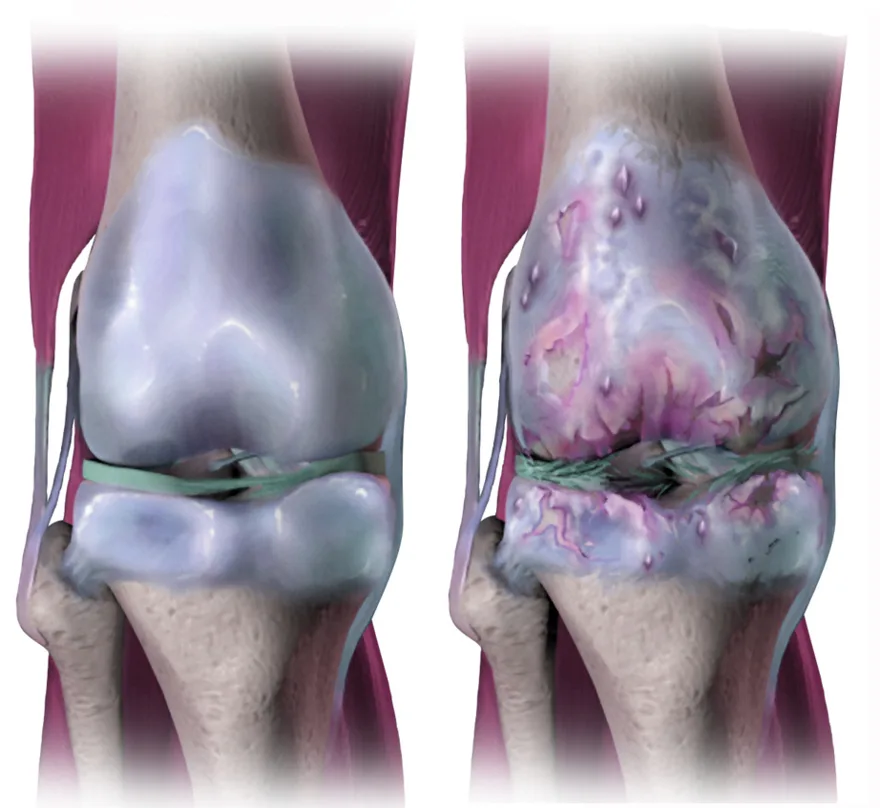
Osteoarthritis illustrated
Key points to remember
- Joint pain worsens with activity and weight-bearing and is relieved by rest.
- Morning stiffness is brief, usually lasting less than 30 minutes.
- Joint involvement is typically asymmetric, affecting hips, knees, spine, and hands.
- Heberden's nodes (distal finger joints) and Bouchard's nodes (proximal joints) are characteristic.
- Crepitus, a grating sensation, is felt with joint movement.
- Unlike rheumatoid arthritis, it lacks systemic symptoms such as fever and fatigue.
Signs & symptoms
- Asymmetric weight-bearing joints
- Pain worse w/ activity, better rest
- Stiffness < 30 min, crepitus
Nursing priorities
- Encourage weight loss to reduce stress on weight-bearing joints.
- Apply heat to relieve stiffness and promote low-impact exercise like swimming or walking.
- Administer acetaminophen as first-line and NSAIDs as ordered for pain.
- Balance activity with rest and teach joint protection and proper body mechanics.
- Promote use of assistive devices such as canes and supportive footwear.
Labs & values
Patient teaching
- Lose excess weight and perform low-impact exercise to protect and strengthen joints.
- Apply heat for stiffness, take acetaminophen as directed, and take NSAIDs with food.
- Use assistive devices, supportive shoes, and good body mechanics, and rest painful joints.
Red flags: report now
- Sudden joint swelling, redness, warmth, and fever may indicate infection rather than osteoarthritis.
- Report GI bleeding signs (black stools, abdominal pain) in patients taking long-term NSAIDs.
References
Clinical references for this topic