Sudden relief of ear pain with purulent drainage may indicate a ruptured tympanic membrane; report it.
Before you read
Test yourself first: 3 questions
Question 1 of 3
A nurse is reviewing the onset of action of insulins. Which insulin has the most rapid onset and should be given with food immediately available?
Answer: A. Rapid-acting insulins such as lispro have an onset of about 15 minutes, so they must be administered immediately before or with a meal to prevent hypoglycemia. Regular insulin onset is about 30 minutes; NPH and glargine are intermediate and long acting.
Question 2 of 3
A client with bladder cancer has undergone creation of an ileal conduit (urinary diversion). Which finding in the stoma should the nurse report immediately?
Answer: A. A healthy urostomy/ileal conduit stoma is pink to beefy red and moist. A dusky, dark, purple, or black stoma indicates ischemia or necrosis from compromised blood supply and must be reported immediately. Mucus in the urine is expected because the conduit is made from bowel, and a small amount of urine draining continuously is normal.
Question 3 of 3
A client suddenly develops a regular narrow-complex tachycardia at a rate of 180 beats per minute and is alert with a stable blood pressure. The provider orders adenosine. Which nursing action is essential when administering this drug?
Answer: B. Adenosine has an extremely short half-life of less than 10 seconds, so it must be given as a rapid IV push over 1 to 2 seconds at a port closest to the client and followed immediately by a rapid saline flush. A brief period of asystole or a flat-line pause is expected after administration. Giving it slowly, over several minutes, or as a slow drip would render it ineffective.
Keep the streak going with more questions like these, each with a full rationale.
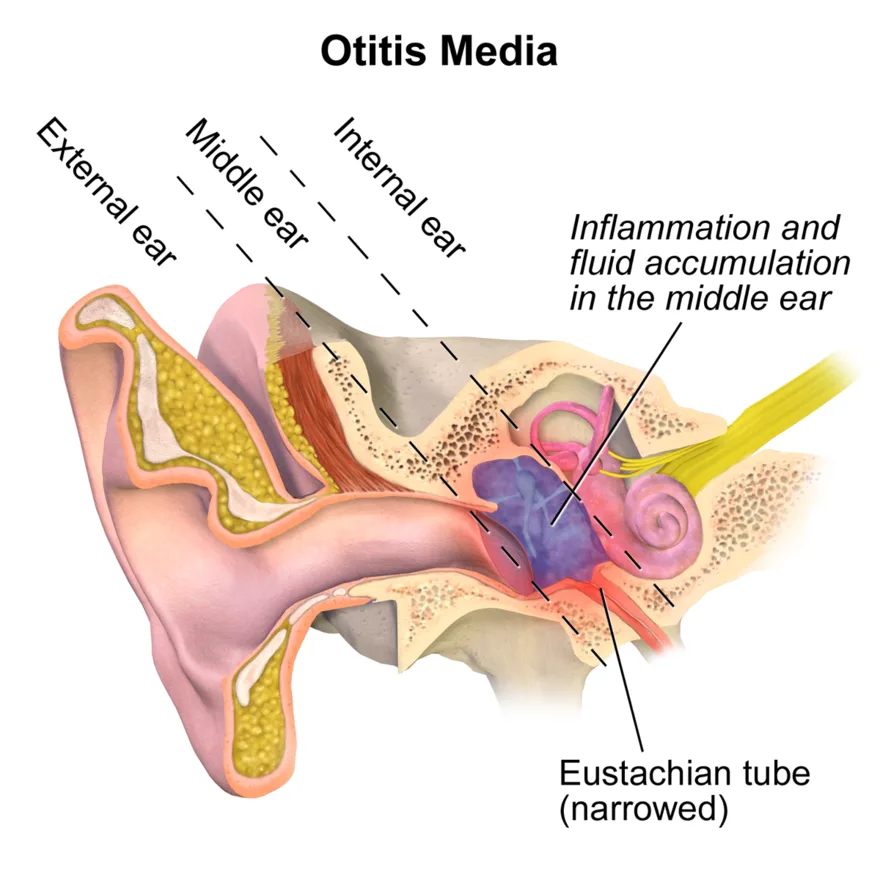
What is otitis media?
Acute otitis media (AOM) involves infection, while otitis media with effusion (OME) is fluid without active infection. Key principle: many cases of AOM resolve without antibiotics, and prevention plus pain control are central.
Otitis Media illustrated
Key points to remember
- Children are prone to otitis media due to short, horizontal eustachian tubes that drain poorly.
- AOM signs include ear pain, fever, irritability, tugging at the ear, and a red, bulging, immobile tympanic membrane.
- Risk factors include bottle-feeding while lying flat, secondhand smoke, daycare attendance, and pacifier use.
- Pneumococcal and influenza vaccines reduce the incidence of otitis media.
- Observation without antibiotics is appropriate for many mild cases in children over 6 months.
- Recurrent OME with hearing loss may require tympanostomy (pressure-equalizing) tubes.
Common causes
- Short, flat eustachian tube
- Bottle-prop, smoke, daycare
Signs & symptoms
- Ear pain, tugging, irritable
- Fever, red bulging TM
- ↓ hearing, fluid behind drum
Nursing priorities
- Assess pain and provide weight-based acetaminophen or ibuprofen for comfort and fever.
- Administer prescribed antibiotics (often amoxicillin) and stress completing the full course.
- Apply warmth to the affected ear and position the child with the affected ear down to aid drainage.
- Assess hearing and developmental/speech milestones, especially with recurrent infections.
- Educate caregivers on feeding position and smoke avoidance to prevent recurrence.
Patient teaching
- Feed infants upright, never propping a bottle while the baby lies flat.
- Avoid exposure to secondhand smoke, which increases ear infections.
- Finish the entire antibiotic course even after symptoms improve.
- After ear tubes, follow the provider's guidance on water precautions and keep follow-up appointments.
Red flags: report now
- Sudden relief of ear pain with purulent drainage may indicate a ruptured tympanic membrane; report it.
- High fever, stiff neck, severe headache, or swelling/redness behind the ear (mastoiditis) requires urgent evaluation.
- Persistent fluid with hearing loss can delay speech and language and needs follow-up.
References
Clinical references for this topic