
Difficulty swallowing with choking or coughing on food signals aspiration risk, report and reassess the diet.
Before you read
Test yourself first: 5 questions
Question 1 of 5
A nurse assesses a client newly diagnosed with Parkinson disease. Which classic finding does the nurse expect to observe?
Answer: B. The cardinal motor features of Parkinson disease are tremor (often a pill-rolling resting tremor), rigidity, bradykinesia, and postural instability. A resting tremor that diminishes with purposeful movement is classic. Intention tremor is seen in cerebellar disease, hyperreflexia points to upper motor neuron lesions, and ascending flaccid paralysis suggests Guillain-Barre.
Question 2 of 5
A client with Parkinson's disease has bradykinesia and a shuffling gait. A priority safety intervention is to:
Answer: B. Reduce fall risk: clear pathways, allow extra time, encourage assistive devices and deliberate stepping, and provide a safe environment. Rushing the client increases falls.
Question 3 of 5
The nurse is assessing a newborn for Hirschsprung disease. Which finding in the first 48 hours of life is most suggestive of this disorder?
Answer: A. Failure to pass meconium within 24 to 48 hours of birth is a hallmark of Hirschsprung disease, caused by absence of ganglion cells in a segment of the distal colon. Frequent loose stools, projectile vomiting, and excessive meconium passage are not characteristic.
Question 4 of 5
A child is diagnosed with hand-foot-and-mouth disease. The nurse expects to find which characteristic lesions?
Answer: A. Hand-foot-and-mouth disease, caused by coxsackievirus, produces painful vesicular lesions in the mouth and on the palms and soles. It is usually self-limiting, and care focuses on hydration and comfort.
Question 5 of 5
A nurse is assessing a 78-year-old client. Which finding is a normal age-related change rather than a sign of disease?
Answer: A. Decreased skin elasticity and turgor is an expected aging change due to loss of subcutaneous tissue and collagen. Resting tachycardia, productive cough, and a new confusion onset are not normal aging and warrant evaluation.
Keep the streak going with more questions like these, each with a full rationale.
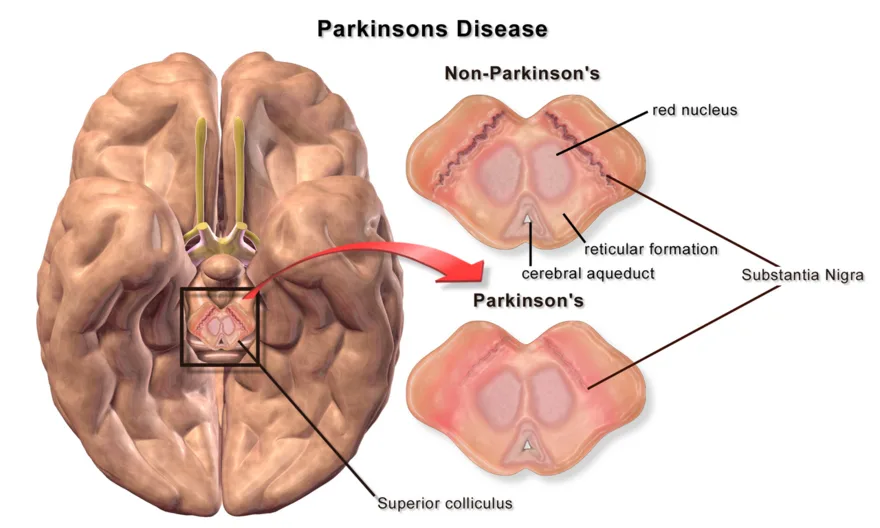
What is parkinson disease?
The dopamine deficiency produces the classic triad of tremor, rigidity, and bradykinesia. It mainly affects older adults and worsens over time. Remember TRAP: Tremor, Rigidity, Akinesia/bradykinesia, Postural instability.
Parkinson Disease illustrated
Key points to remember
- A resting 'pill-rolling' tremor that decreases with purposeful movement is the hallmark sign.
- Cogwheel rigidity, bradykinesia (slow movement), and a stooped, shuffling, festinating gait are characteristic.
- A masklike facial expression, soft monotone speech, drooling, and small handwriting (micrographia) are common.
- Postural instability increases the risk of falls as the disease progresses.
- Levodopa-carbidopa is the cornerstone drug; it replenishes dopamine and improves motor symptoms.
Signs & symptoms
- Tremor: pill-rolling at rest
- Rigidity, akinesia, postural instab.
- Shuffling gait, mask face, drool
Nursing priorities
- Implement fall precautions and promote a safe environment, since postural instability and shuffling gait raise fall risk.
- Administer antiparkinsonian medications on time to maintain consistent motor control.
- Provide small, frequent, high-calorie soft meals and allow extra time to eat to prevent aspiration and weight loss.
- Encourage active and passive range of motion, daily exercise, and ambulation to maintain mobility.
- Teach techniques to initiate movement, such as rocking and consciously lifting the feet, to overcome freezing.
Patient teaching
- Take levodopa-carbidopa exactly as scheduled; effects may take weeks, and avoid high-protein meals at dose time as protein can reduce absorption.
- Change positions slowly to prevent dizziness from orthostatic hypotension, and that urine/sweat may darken on levodopa.
- Use assistive devices, perform daily exercise and stretching, and prevent constipation with fluids and fiber.
Red flags: report now
- Difficulty swallowing with choking or coughing on food signals aspiration risk, report and reassess the diet.
- Sudden severe rigidity, high fever, and altered mentation may indicate neuroleptic malignant-like syndrome from abrupt medication withdrawal.
- Significant orthostatic hypotension from medications increases fall and injury risk.
References
Clinical references for this topic

