Chest pain is sharp and pleuritic, worsening with deep breathing, coughing, and lying flat and relieved by sitting forward.
Before you read
Test yourself first: 1 question
Question 1 of 1
A nurse is caring for a client who developed acute pericarditis after a viral illness. Which finding is MOST characteristic of this condition?
Answer: A. A pericardial friction rub, a scratchy or grating sound best heard at the left sternal border with the client leaning forward, is the hallmark of pericarditis. Pleuritic, sharp chest pain that worsens lying down and improves sitting up is also typical. Painless edema, a continuous machine-like murmur, and clubbing are not characteristic.
Keep the streak going with more questions like these, each with a full rationale.
What is pericarditis?
The hallmark is sharp chest pain that worsens with inspiration and lying flat and improves when sitting up and leaning forward. The main complication to watch for is a pericardial effusion that can progress to cardiac tamponade.
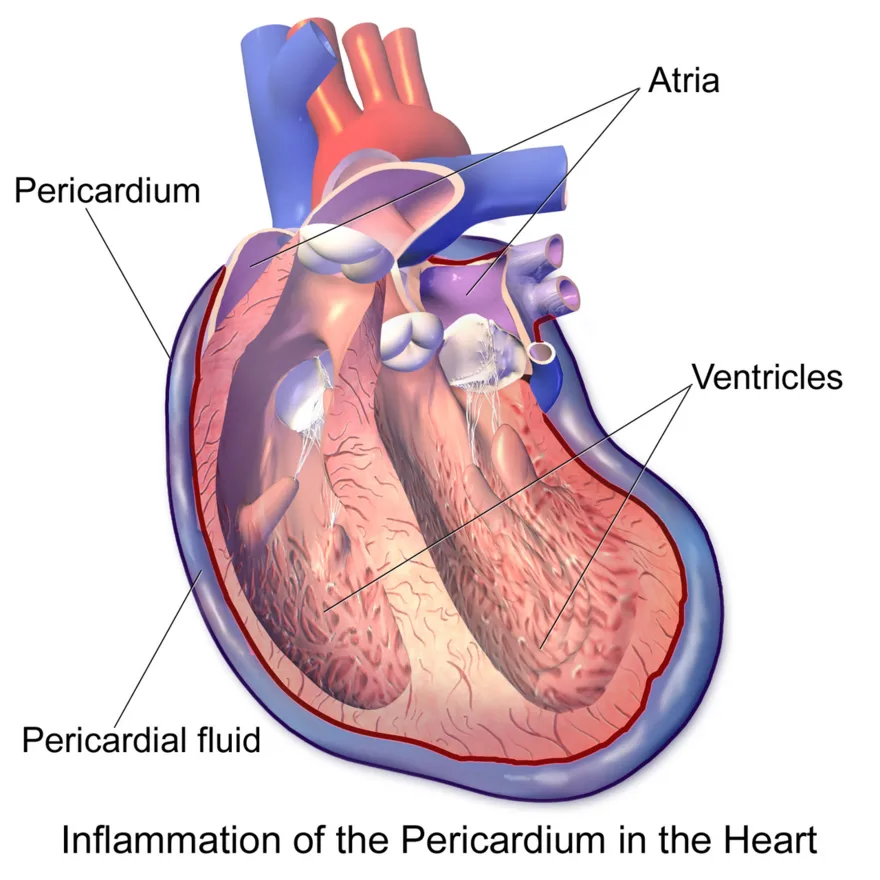
Pericarditis illustrated
Key points to remember
- Chest pain is sharp and pleuritic, worsening with deep breathing, coughing, and lying flat and relieved by sitting forward.
- A pericardial friction rub is a classic scratchy sound heard on auscultation at the left sternal border.
- ECG often shows diffuse ST-segment elevation across multiple leads.
- Common causes include viral infection, recent MI (Dressler syndrome), uremia, and autoimmune disorders.
- Pericardial effusion can develop and progress to life-threatening cardiac tamponade.
Signs & symptoms
- Sharp pain, worse supine/inspire
- Relieved leaning forward
- Pericardial friction rub
- Fever, ST elevation diffuse
Nursing priorities
- Position the patient upright and leaning forward to relieve pain and ease breathing.
- Administer NSAIDs or colchicine and corticosteroids as ordered to reduce inflammation.
- Auscultate for a pericardial friction rub and monitor for muffled heart sounds.
- Monitor closely for signs of pericardial effusion and cardiac tamponade.
- Assess and document pain characteristics and relief measures.
Labs & values
Patient teaching
- Take anti-inflammatory medications with food to prevent stomach upset and complete the full course.
- Sit upright and lean forward to ease chest pain, and rest during the recovery period.
- Report worsening shortness of breath, dizziness, or a feeling of pressure, which could mean fluid is building around the heart.
Red flags: report now
- Muffled or distant heart sounds, jugular vein distention, and hypotension signal cardiac tamponade and require emergency intervention.
- A narrowing pulse pressure or pulsus paradoxus indicates developing tamponade and must be escalated now.
- Sudden worsening dyspnea or hemodynamic instability requires immediate provider notification.
References
Clinical references for this topic