
Report new or worsening neurologic deficits, which can become irreversible without prompt B12 replacement.
Before you read
Test yourself first: 5 questions
Question 1 of 5
A client with pernicious anemia asks why lifelong vitamin B12 injections are needed. Which explanation is correct?
Answer: A. Pernicious anemia results from a lack of intrinsic factor, which is required to absorb vitamin B12 in the terminal ileum. Because oral B12 cannot be absorbed without intrinsic factor, parenteral (or high-dose intranasal) replacement is required for life.
Question 2 of 5
A client with pernicious anemia asks why lifelong treatment is needed. Which explanation by the nurse is correct?
Answer: A. Pernicious anemia results from a lack of intrinsic factor, which is required to absorb vitamin B12 in the ileum. Because oral B12 cannot be absorbed without intrinsic factor, the client needs lifelong vitamin B12 (cyanocobalamin) by injection or high-dose intranasal route. The deficiency is of B12 absorption, not iron, folate, or erythropoietin.
Question 3 of 5
A client with cancer has anemia (hemoglobin 8.2 g/dL) and reports shortness of breath on exertion. Which findings does the nurse expect with anemia?
Answer: A. Anemia reduces oxygen-carrying capacity, producing pallor, fatigue, weakness, dyspnea on exertion, and tachycardia as the heart compensates. Bradycardia and a flushed, ruddy complexion are not expected with anemia; the heart rate typically increases and the skin is pale.
Question 4 of 5
A client is diagnosed with aplastic anemia. The nurse understands this disorder involves what underlying problem?
Answer: A. Aplastic anemia is bone marrow failure in which the marrow stops producing all blood cell lines, causing pancytopenia: anemia, leukopenia, and thrombocytopenia. This places the client at risk for fatigue, infection, and bleeding simultaneously.
Question 5 of 5
A client with aplastic anemia has a critically low neutrophil count. Which finding requires the most immediate nursing attention?
Answer: A. Aplastic anemia causes pancytopenia, including neutropenia, which leaves the client severely immunocompromised. A temperature of 100.9 degrees F (38.3 degrees C) in a neutropenic client is a medical emergency (neutropenic fever) because the usual signs of infection are blunted and sepsis can develop rapidly. It must be reported and treated immediately with cultures and antibiotics.
Keep the streak going with more questions like these, each with a full rationale.
What is pernicious anemia?
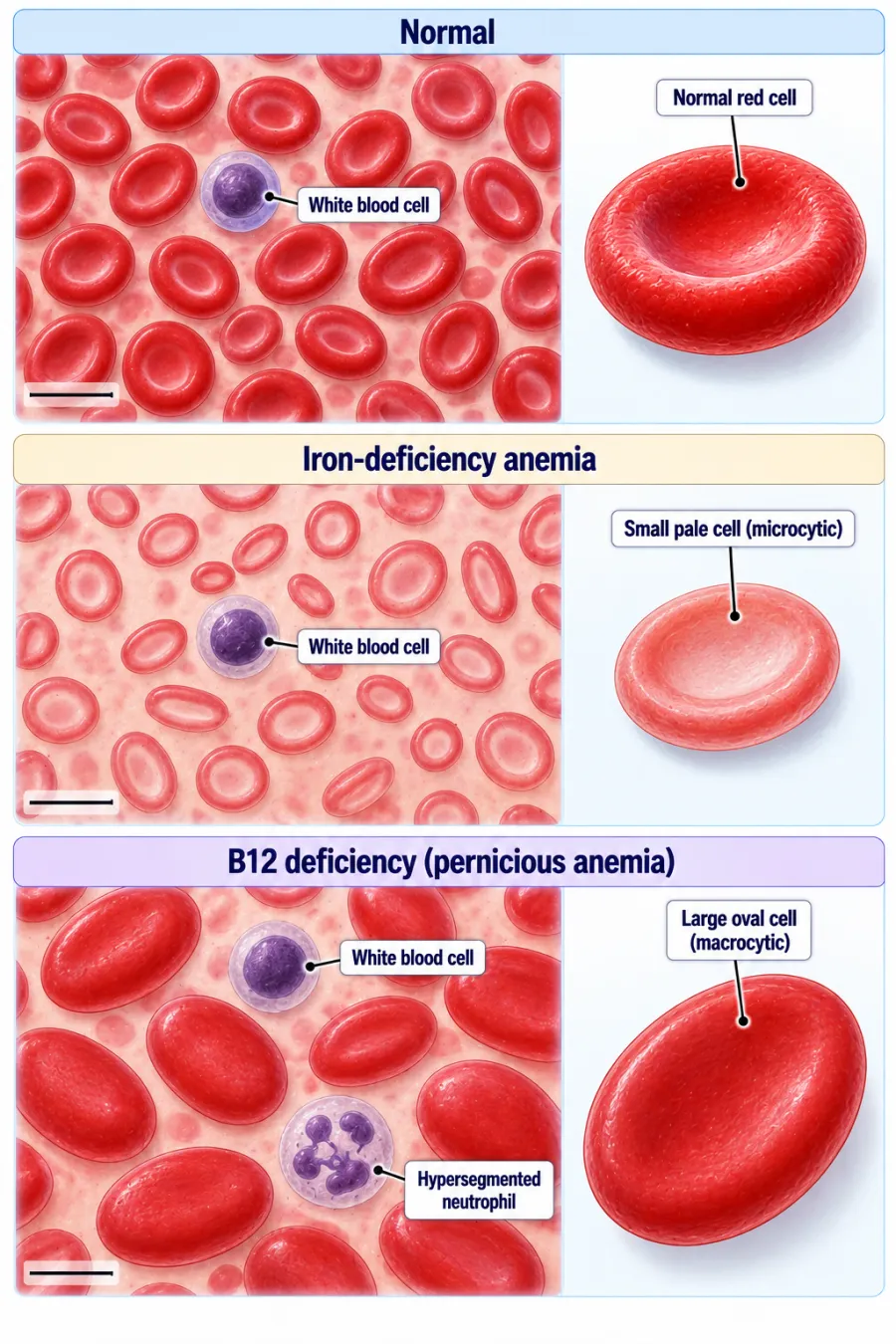
B12 is required for red cell maturation and nerve myelin, so deficiency causes large immature cells and neurologic damage. It matters because neurologic effects can become permanent if untreated.
Pernicious Anemia illustrated
Key points to remember
- Red cells are macrocytic (large) and the anemia is megaloblastic.
- Neurologic signs are the hallmark: paresthesias (tingling) of hands and feet, ataxia, and loss of balance/proprioception.
- A smooth, beefy-red, sore tongue (glossitis) is a classic finding.
- Lack of intrinsic factor, not lack of dietary B12, is the usual cause.
- Pallor, jaundice, fatigue, and weakness occur as the anemia worsens.
- The Schilling test historically confirmed impaired B12 absorption.
Signs & symptoms
- pallor, fatigue, beefy red tongue
- NEURO: paresthesia, ataxia
- numbness hands/feet, confusion
Nursing priorities
- Administer lifelong intramuscular (or high-dose) vitamin B12 as prescribed; oral B12 alone fails when intrinsic factor is absent.
- Assess neurologic status, gait, and balance to track and prevent injury.
- Implement fall precautions due to impaired proprioception and ataxia.
- Provide a soft, bland diet and gentle oral care for the sore inflamed tongue.
- Monitor reticulocyte response and potassium during early treatment.
Labs & values
Patient teaching
- Treatment is lifelong; B12 injections must continue even after symptoms improve.
- Report any return of numbness, tingling, or balance problems promptly.
- Eat B12-rich foods (meat, eggs, dairy, fortified cereals), though diet alone will not correct absorption-based deficiency.
Red flags: report now
- Report new or worsening neurologic deficits, which can become irreversible without prompt B12 replacement.
- Report confusion, severe gait instability, or signs of injury from falls.
- Watch for hypokalemia during the first days of B12 therapy as new cells take up potassium.
References
Clinical references for this topic

