Report any vaginal bleeding immediately, even if it stops, as it can recur and worsen.
Before you read
Test yourself first: 5 questions
Question 1 of 5
A nurse is differentiating placenta previa from placental abruption. Which finding is most characteristic of placenta previa?
Answer: A. Placenta previa classically presents with painless, bright red vaginal bleeding in the second half of pregnancy, because the placenta covers or lies near the cervical os. Abruption is typically painful with dark red bleeding and a rigid uterus.
Question 2 of 5
A client at 32 weeks gestation reports sudden onset of painless, bright red vaginal bleeding. Which condition does the nurse suspect, and what action is contraindicated?
Answer: A. Painless, bright red bleeding in the third trimester suggests placenta previa, where the placenta covers or lies near the cervical os. A vaginal or digital cervical examination is contraindicated because it can dislodge the placenta and cause severe hemorrhage. Abruptio placentae typically presents with painful, dark bleeding and a rigid uterus.
Question 3 of 5
A client at 34 weeks gestation arrives with dark red vaginal bleeding, sharp constant abdominal pain, and a board-like rigid uterus. Which complication is the nurse's priority concern?
Answer: B. Abruptio placentae (premature separation of the placenta) presents with painful dark red bleeding, a rigid tender uterus, and possible signs of hypovolemic shock and fetal distress. It is an emergency because of maternal hemorrhage and DIC risk. Placenta previa is painless; the other options do not match.
Question 4 of 5
A client at 39 weeks gestation presents with sudden, painless, bright-red vaginal bleeding. Which action is contraindicated until placenta previa is ruled out?
Answer: B. With suspected placenta previa, a digital or vaginal examination is contraindicated because it can perforate the placenta and cause severe hemorrhage. Assessing fetal heart tones, monitoring vital signs, and establishing IV access are all appropriate. Diagnosis is confirmed with ultrasound, not manual exam.
Question 5 of 5
A nurse is in the third stage of labor with a client. Which finding is a sign that the placenta has separated and is ready to be delivered?
Answer: B. Signs of placental separation include a sudden gush of blood, lengthening of the umbilical cord at the introitus, and the uterus rising upward and becoming firm and globular. These indicate the placenta has detached.
Keep the streak going with more questions like these, each with a full rationale.
What is placenta previa?
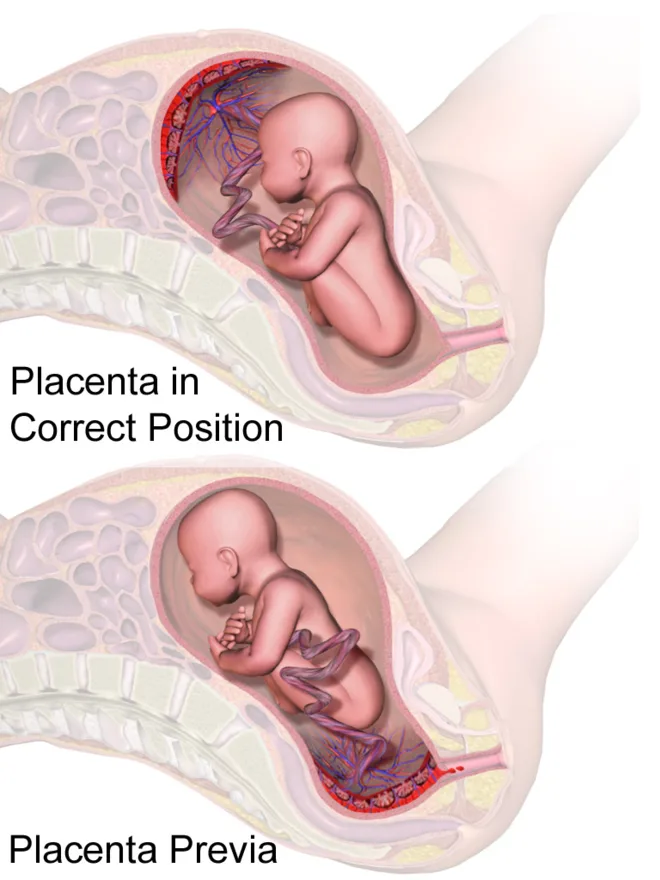
As the lower uterine segment thins and the cervix dilates in late pregnancy, the placental vessels tear and bleed. The hallmark is painless, bright-red vaginal bleeding in the second or third trimester. Memory aid: Previa = Painless bleeding.
Placenta Previa illustrated
Key points to remember
- Bleeding is painless, bright red, and often sudden, typically after 20 weeks.
- The uterus remains soft and non-tender between bleeding episodes.
- Risk factors include prior cesarean or uterine surgery, multiparity, advanced maternal age, and multiple gestation.
- Fetal malpresentation (breech or transverse) is common because the placenta occupies the lower segment.
- Diagnosis is confirmed by transabdominal or transvaginal ultrasound, not by digital exam.
Nursing priorities
- Never perform a vaginal or digital cervical exam, as it can dislodge the placenta and cause massive hemorrhage.
- Monitor the amount and character of bleeding (pad counts, weights) and assess maternal vital signs for hypovolemia.
- Continuously monitor fetal heart rate and maintain the mother on bed rest as ordered.
- Establish IV access and have type-and-crossmatched blood available for possible transfusion.
- Prepare for cesarean birth, which is the planned delivery route for complete previa.
Labs & values
Patient teaching
- Report any vaginal bleeding right away and avoid intercourse and tampons.
- Follow activity restrictions and avoid heavy lifting and strenuous exercise.
- Understand that a cesarean birth is likely if the placenta covers the cervix.
Red flags: report now
- Report any vaginal bleeding immediately, even if it stops, as it can recur and worsen.
- Report signs of maternal shock (tachycardia, hypotension, pallor) or fetal distress.
- Never insert anything into the vagina, including exams, enemas, or intercourse, with a known previa.
References
Clinical references for this topic