Sudden sharp pleuritic chest pain, dyspnea, and decreased or absent breath sounds on the affected side are classic.
Before you read
Test yourself first: 5 questions
Question 1 of 5
Which clinical finding distinguishes a tension pneumothorax from a simple pneumothorax?
Answer: B. Tracheal deviation away from the affected side, along with hypotension and jugular vein distension, signals a tension pneumothorax in which trapped air shifts mediastinal structures and impairs venous return. A simple pneumothorax does not cause tracheal shift or hemodynamic collapse.
Question 2 of 5
A nurse assesses a client with a suspected pneumothorax. Which assessment finding is expected over the affected lung field?
Answer: B. A pneumothorax produces diminished or absent breath sounds with hyperresonance to percussion over the affected side because air, not lung tissue, occupies the pleural space. Crackles and dullness suggest fluid or consolidation, not air.
Question 3 of 5
A client with a tension pneumothorax develops hypotension, distended neck veins, and tracheal deviation. The nurse recognizes this as which category of shock?
Answer: A. Obstructive shock occurs when a mechanical obstruction impairs cardiac filling or output. A tension pneumothorax compresses the heart and great vessels, reducing venous return and producing hypotension, jugular venous distention, and tracheal deviation. The cause is mechanical, not loss of volume or pump muscle failure.
Question 4 of 5
A nurse is assessing a client and notes that the trachea is deviated to the left. The client has decreased breath sounds and hyperresonance on the right. The nurse suspects which life-threatening condition?
Answer: A. A tension pneumothorax causes air to accumulate under pressure in the pleural space, collapsing the lung on the affected side and pushing the mediastinum and trachea toward the opposite (unaffected) side. Decreased breath sounds and hyperresonance occur on the affected side. This is an emergency requiring immediate intervention.
Question 5 of 5
A client with ARDS on positive end-expiratory pressure (PEEP) suddenly develops a drop in blood pressure and decreased breath sounds on one side. Which complication should the nurse suspect?
Answer: A. High levels of PEEP can cause barotrauma leading to a tension pneumothorax, which presents with sudden hypotension, unilateral absent breath sounds, and decreased venous return. This is an emergency requiring immediate intervention.
Keep the streak going with more questions like these, each with a full rationale.
What is pneumothorax?
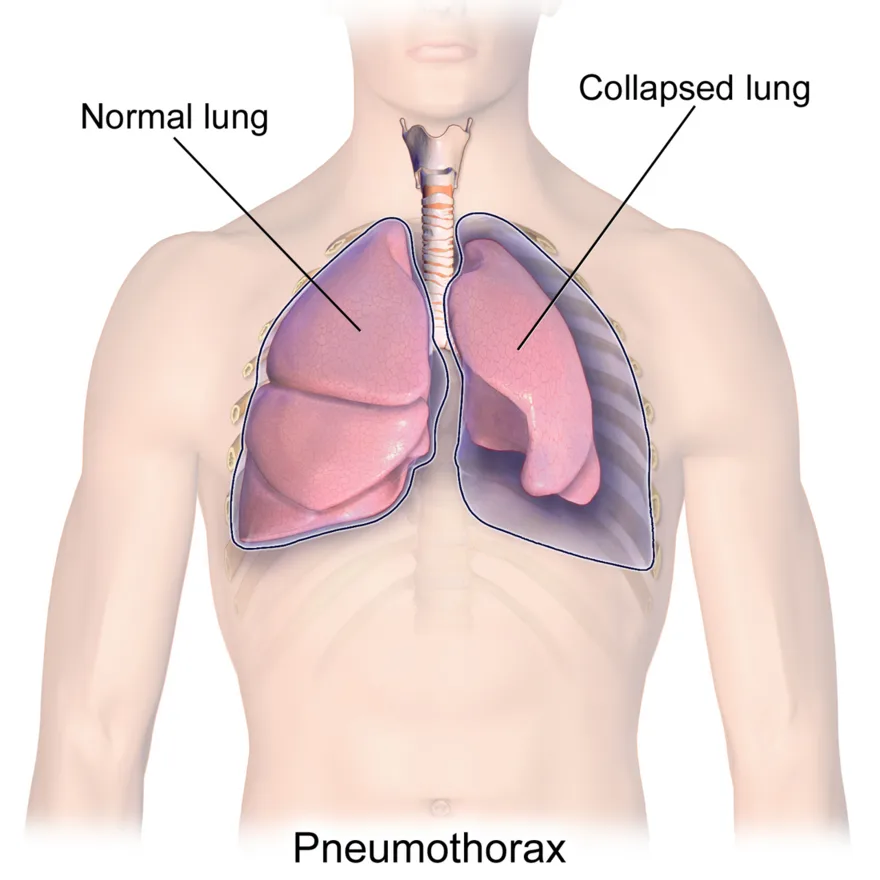
It may be spontaneous, traumatic, or iatrogenic (after central line placement or thoracentesis). A tension pneumothorax is a life-threatening emergency in which trapped air shifts the mediastinum and compresses the heart and great vessels.
Pneumothorax illustrated
Key points to remember
- Sudden sharp pleuritic chest pain, dyspnea, and decreased or absent breath sounds on the affected side are classic.
- The affected side shows reduced chest movement and hyperresonance to percussion.
- Tachycardia, tachypnea, and hypoxemia accompany significant collapse.
- Tension pneumothorax produces tracheal deviation away from the affected side, jugular vein distention, and severe hypotension.
- A chest x-ray confirms the diagnosis by showing the collapsed lung and pleural air.
- Subcutaneous emphysema (crepitus under the skin) may be palpable around the chest and neck.
Common causes
- Trauma, central line, COPD
Signs & symptoms
- Sudden sharp pain, dyspnea
- ↓/absent breath sounds 1 side
- ↓ chest movement, hyperresonance
Nursing priorities
- Administer high-flow oxygen and position the patient in high Fowler's.
- Prepare for emergency needle decompression for tension pneumothorax, followed by chest tube insertion.
- Assist with chest tube placement to re-expand the lung and restore negative pressure.
- Monitor respiratory status, breath sounds, oxygen saturation, and the chest drainage system.
- Notify the provider immediately of any tracheal deviation or rapid deterioration.
Labs & values
Patient teaching
- Avoid air travel, scuba diving, and high altitudes until cleared by the provider after a spontaneous pneumothorax.
- Stop smoking, which increases the risk of recurrence.
- Report sudden chest pain or shortness of breath immediately as it may signal recurrence.
Red flags: report now
- Tracheal deviation, severe hypotension, and distended neck veins indicate a tension pneumothorax requiring immediate needle decompression.
- Rapidly worsening dyspnea, absent breath sounds, and falling oxygen saturation are emergencies.
- Sudden onset after a procedure such as central line placement or thoracentesis must be reported at once.
References
Clinical references for this topic