Report sudden severe headache, vision changes, or neurologic deficits (possible ruptured cerebral aneurysm).
Before you read
Test yourself first: 3 questions
Question 1 of 3
The nurse is assessing a newborn for Hirschsprung disease. Which finding in the first 48 hours of life is most suggestive of this disorder?
Answer: A. Failure to pass meconium within 24 to 48 hours of birth is a hallmark of Hirschsprung disease, caused by absence of ganglion cells in a segment of the distal colon. Frequent loose stools, projectile vomiting, and excessive meconium passage are not characteristic.
Question 2 of 3
A child is diagnosed with hand-foot-and-mouth disease. The nurse expects to find which characteristic lesions?
Answer: A. Hand-foot-and-mouth disease, caused by coxsackievirus, produces painful vesicular lesions in the mouth and on the palms and soles. It is usually self-limiting, and care focuses on hydration and comfort.
Question 3 of 3
A nurse is assessing a 78-year-old client. Which finding is a normal age-related change rather than a sign of disease?
Answer: A. Decreased skin elasticity and turgor is an expected aging change due to loss of subcutaneous tissue and collagen. Resting tachycardia, productive cough, and a new confusion onset are not normal aging and warrant evaluation.
Keep the streak going with more questions like these, each with a full rationale.
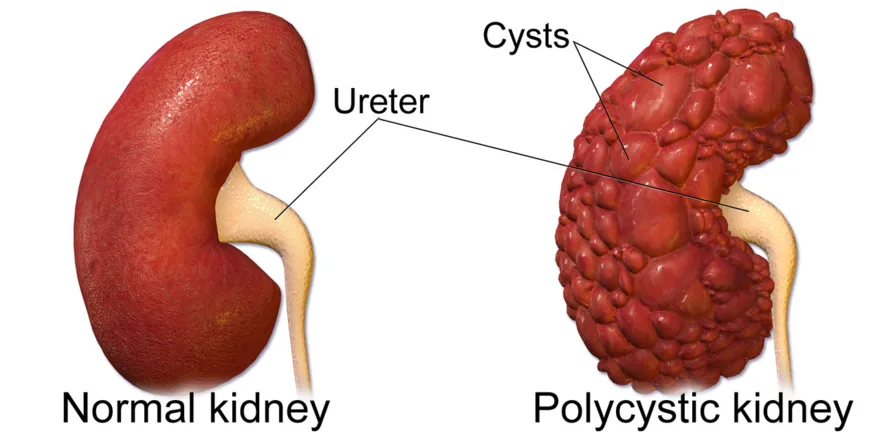
What is polycystic kidney disease?
The common adult form is autosomal dominant. Flank pain, hypertension, hematuria, and enlarged palpable kidneys are characteristic.
Polycystic Kidney Disease illustrated
Key points to remember
- Autosomal dominant PKD usually presents in adulthood; a positive family history is common because each child of an affected parent has a 50% risk.
- Hypertension is an early and prominent finding and accelerates kidney damage, so blood pressure control is central.
- Patients develop flank/abdominal pain, hematuria, recurrent UTIs and kidney stones, and progressive loss of kidney function.
- Extrarenal manifestations include cerebral (berry) aneurysms, hepatic cysts, and cardiac valve abnormalities.
- There is no cure; management slows progression (BP control, hydration, treating infections) until dialysis or transplant is needed.
- Tolvaptan may be used to slow cyst growth in select rapidly progressing patients.
Signs & symptoms
- Flank pain, hematuria
- HTN (early sign), palpable kidneys
- Recurrent UTIs, kidney stones
Nursing priorities
- Monitor and aggressively control blood pressure with prescribed agents (often ACE inhibitors/ARBs).
- Monitor renal function (BUN, creatinine, GFR), urine output, and for signs of infection or bleeding.
- Promote adequate fluid intake (unless restricted) and prompt treatment of UTIs and stones.
- Provide pain management and emotional/genetic counseling support.
- Teach about disease progression, dietary sodium and protein adjustments, and avoidance of nephrotoxins.
Labs & values
Patient teaching
- Take blood pressure medication consistently and monitor BP at home, since control slows kidney damage.
- Limit sodium, and follow protein and fluid recommendations from your provider.
- Avoid nephrotoxic drugs such as NSAIDs and report any UTI symptoms promptly.
- Seek genetic counseling, since first-degree relatives may also be affected.
Red flags: report now
- Report sudden severe headache, vision changes, or neurologic deficits (possible ruptured cerebral aneurysm).
- Report gross hematuria that does not resolve, severe flank pain, or signs of infection (fever, cloudy urine).
- Report rapidly worsening hypertension or signs of renal failure (decreased urine, edema, confusion).
References
Clinical references for this topic