
Bright red blood or large clots and decreasing/obstructed catheter output after prostatectomy require immediate reporting.
Before you read
Test yourself first: 3 questions
Question 1 of 3
A client with metastatic prostate cancer reports sudden, severe back pain with new leg weakness and difficulty voiding. The nurse recognizes the priority concern as which oncologic emergency?
Answer: A. These findings suggest spinal cord compression from metastatic disease, an oncologic emergency. New or worsening back pain with motor weakness, sensory changes, or bowel and bladder dysfunction requires immediate evaluation and treatment (corticosteroids, radiation) to prevent permanent paralysis.
Question 2 of 3
A client with bladder cancer has undergone creation of an ileal conduit (urinary diversion). Which finding in the stoma should the nurse report immediately?
Answer: A. A healthy urostomy/ileal conduit stoma is pink to beefy red and moist. A dusky, dark, purple, or black stoma indicates ischemia or necrosis from compromised blood supply and must be reported immediately. Mucus in the urine is expected because the conduit is made from bowel, and a small amount of urine draining continuously is normal.
Question 3 of 3
A client receiving radiation therapy to the abdomen for cancer reports several loose stools per day. Which dietary instruction is most appropriate for the nurse to provide?
Answer: A. Radiation enteritis causes diarrhea. A low-residue, low-fiber diet reduces stool bulk and bowel irritation. High-fiber foods, raw vegetables, and whole grains increase peristalsis and worsen diarrhea, so they should be limited during treatment.
Keep the streak going with more questions like these, each with a full rationale.
What is prostate cancer?
It is usually slow-growing and often asymptomatic early, with many cases found through PSA testing or digital rectal exam. Advanced disease commonly spreads to bone, causing pain. Risk rises with age, African American ancestry, and family history.
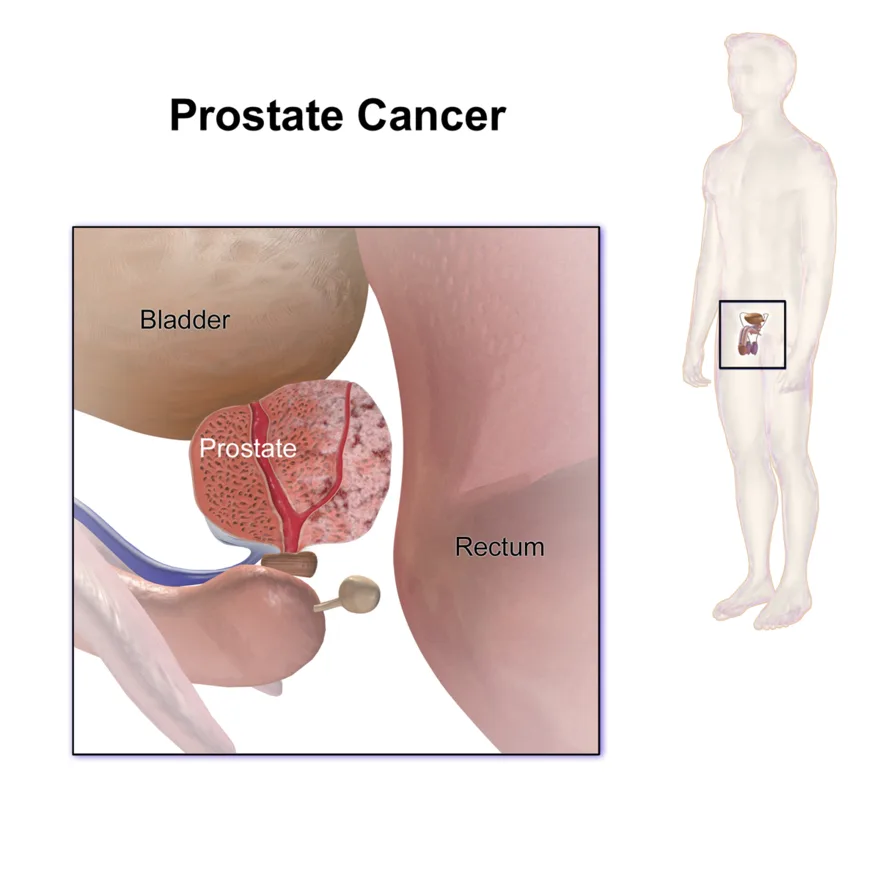
Prostate Cancer illustrated
Key points to remember
- Often asymptomatic early; later it may cause urinary obstruction symptoms similar to BPH (weak stream, hesitancy, frequency, nocturia).
- A hard, irregular, fixed nodule on digital rectal exam is suspicious for malignancy.
- PSA may be elevated but is not specific; it is also raised by BPH, prostatitis, and recent manipulation.
- Risk factors include increasing age, African American race, family history, and high-fat diet.
- Bone is the most common site of metastasis, producing bone pain and pathologic fractures.
- Treatment options include active surveillance, prostatectomy, radiation, and hormonal (androgen-deprivation) therapy; erectile dysfunction and incontinence are common effects.
Signs & symptoms
- Often asymptomatic early
- Urinary hesitancy, weak stream, nocturia
- Late → bone pain (mets to bone)
Nursing priorities
- Monitor urinary function and patency; assess for retention and provide catheter care after prostatectomy.
- Manage post-surgical bleeding and, with continuous bladder irrigation, keep outflow draining and titrate to keep it light pink.
- Assess and manage bone pain in metastatic disease; promote safety to prevent pathologic fractures.
- Support coping with incontinence and erectile dysfunction; teach pelvic floor (Kegel) exercises.
- Educate about and support choice among treatment options.
Labs & values
Patient teaching
- Discuss PSA testing and screening decisions with the provider, especially after age 50 (earlier if high risk).
- Perform Kegel pelvic floor exercises to improve urinary control after surgery.
- Report blood in urine, inability to void, or worsening bone pain.
- Understand that hormonal therapy may cause hot flashes, decreased libido, and bone thinning.
- Maintain a healthy diet and follow up regularly for PSA monitoring.
Red flags: report now
- Bright red blood or large clots and decreasing/obstructed catheter output after prostatectomy require immediate reporting.
- New severe back/bone pain or inability to move limbs may indicate metastasis or spinal cord compression; report urgently.
- Signs of urinary retention with no output despite urge need prompt intervention.
References
Clinical references for this topic

