Severe dyspnea, orthopnea, and pink frothy sputum are the classic signs.
Before you read
Test yourself first: 4 questions
Question 1 of 4
A nurse auscultates the posterior chest of an adult and hears high-pitched, discontinuous popping sounds at the lung bases that do not clear with coughing. How should the nurse document this finding?
Answer: B. Fine crackles (rales) are high-pitched, discontinuous popping sounds heard most often at the bases, caused by the sudden opening of small airways and alveoli. They are associated with fluid, as in pulmonary edema or pneumonia, and typically do not clear with coughing.
Question 2 of 4
A nurse is reviewing congenital heart defects. Which defect is classified as an acyanotic defect with increased pulmonary blood flow?
Answer: A. A ventricular septal defect (VSD) causes left-to-right shunting, increasing pulmonary blood flow without cyanosis. Tetralogy of Fallot, transposition of the great arteries, and tricuspid atresia are cyanotic defects.
Question 3 of 4
A nurse auscultates a continuous machine-like murmur in an infant. This finding is most characteristic of which congenital heart defect?
Answer: A. A continuous machine-like murmur heard throughout systole and diastole is the classic finding of a patent ductus arteriosus, caused by continuous blood flow from the aorta to the pulmonary artery.
Question 4 of 4
An infant with a ductal-dependent cyanotic heart lesion is awaiting surgery. The nurse understands that prostaglandin E1 is being infused to:
Answer: B. In ductal-dependent lesions, prostaglandin E1 is infused to keep the ductus arteriosus open, maintaining blood flow between the pulmonary and systemic circulations until corrective surgery can be performed.
Keep the streak going with more questions like these, each with a full rationale.
What is pulmonary edema?
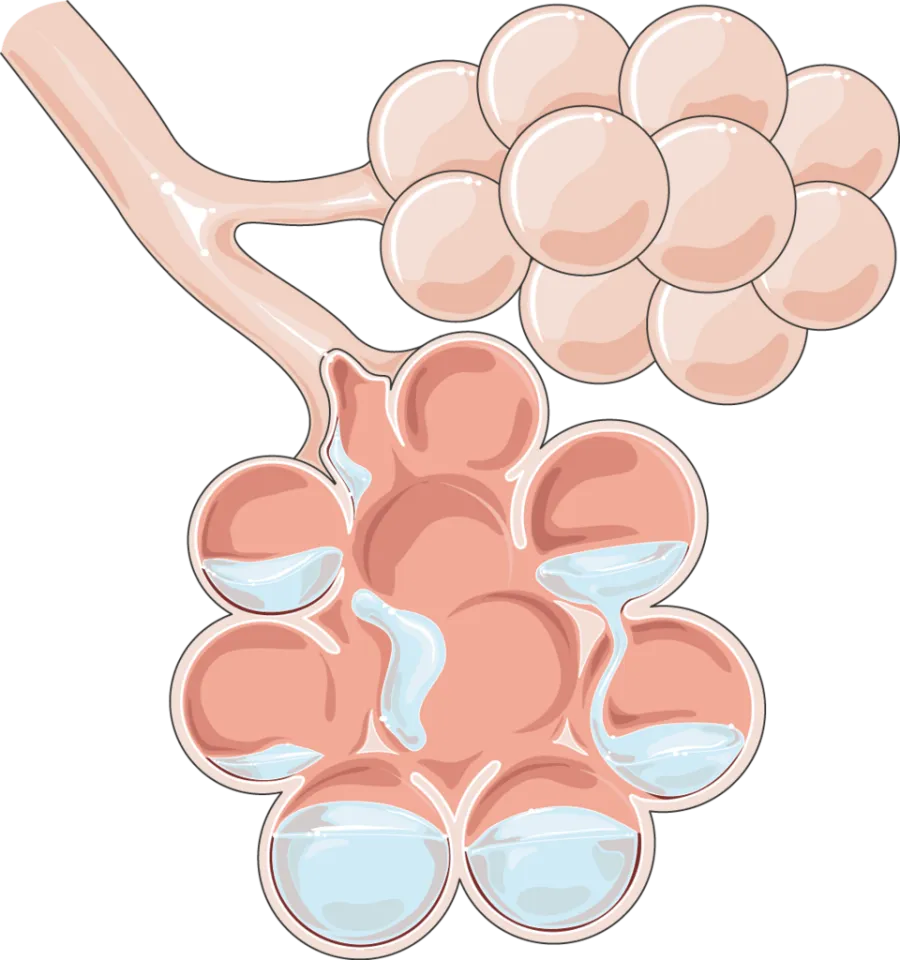
It is an acute life-threatening emergency. The hallmark is pink, frothy sputum with severe dyspnea and a sense of suffocation.
Pulmonary Edema illustrated
Key points to remember
- Severe dyspnea, orthopnea, and pink frothy sputum are the classic signs.
- Coarse crackles heard throughout the lung fields and tachypnea reflect alveolar flooding.
- Anxiety, restlessness, a feeling of suffocation, and tachycardia are common.
- Cool clammy skin, cyanosis, and hypoxemia develop as gas exchange fails.
- The patient often sits bolt upright and gasping, and may have an S3 heart sound with cardiogenic causes.
- It progresses rapidly and can lead to respiratory failure without prompt treatment.
Common causes
- Left-sided HF #1 cause
- Fluid overload, MI, valve disease
Signs & symptoms
- Pink frothy sputum = classic
- Crackles, dyspnea, orthopnea
- Anxiety, restless, ↓ SpO2
Nursing priorities
- Place the patient in high Fowler's with legs dependent to decrease venous return (preload).
- Administer high-flow oxygen and prepare for noninvasive ventilation or intubation.
- Give IV loop diuretics (furosemide) to reduce fluid volume as ordered.
- Administer vasodilators (nitroglycerin) and morphine as ordered to reduce preload and anxiety.
- Monitor oxygen saturation, vital signs, urine output, and lung sounds continuously.
Labs & values
Patient teaching
- Weigh daily at the same time and report a gain of 2 to 3 pounds in a day or 5 pounds in a week.
- Follow a low-sodium diet and any prescribed fluid restriction.
- Take diuretics and heart medications as prescribed and report increasing shortness of breath or swelling.
Red flags: report now
- Pink frothy sputum with severe respiratory distress is an emergency requiring immediate intervention.
- Falling oxygen saturation, decreasing level of consciousness, or hypotension signal decompensation.
- Worsening crackles and rising respiratory rate despite treatment require rapid escalation.
References
Clinical references for this topic