Hypotension, tachycardia, and high fever - signs of urosepsis/septic shock; escalate immediately.
Before you read
Test yourself first: 1 question
Question 1 of 1
A client is admitted with suspected pyelonephritis. Which clinical manifestation does the nurse expect that distinguishes it from a simple lower UTI?
Answer: A. Pyelonephritis is an upper urinary tract (kidney) infection and presents with flank pain, costovertebral angle (CVA) tenderness, high fever, chills, and systemic illness. A simple lower UTI (cystitis) usually causes dysuria and frequency without high fever or flank pain. Painless hematuria and polyuria are not the distinguishing features.
Keep the streak going with more questions like these, each with a full rationale.
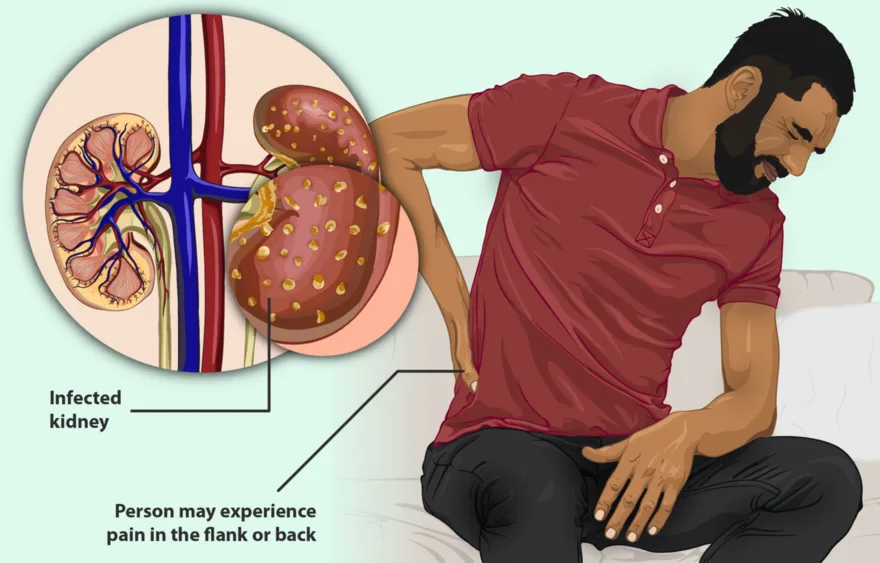
What is pyelonephritis?
It is more severe than cystitis and can lead to renal scarring, abscess, or urosepsis. Common causes include untreated UTIs, urinary obstruction, reflux, and pregnancy. Prompt treatment is important to prevent kidney damage and sepsis.
Pyelonephritis illustrated
Key points to remember
- Hallmark signs are costovertebral angle (flank) tenderness, high fever, and chills.
- Patients also have classic UTI symptoms: dysuria, frequency, urgency, and cloudy/foul urine.
- Nausea, vomiting, and malaise commonly accompany the infection.
- Urinalysis shows WBC casts, pyuria, bacteria, and possibly hematuria.
- Obstruction (stones, BPH) and vesicoureteral reflux predispose to ascending infection.
- Untreated infection can progress to bacteremia and septic shock.
Signs & symptoms
- FLANK pain, CVA tenderness
- HIGH fever, chills, N/V
- dysuria, frequency, cloudy urine
Nursing priorities
- Obtain urine and blood cultures before initiating antibiotics.
- Administer IV antibiotics, antipyretics, and IV fluids as ordered.
- Encourage oral fluid intake (up to 3 L/day) to flush the urinary tract unless contraindicated.
- Monitor temperature, vital signs, intake/output, and pain.
- Assess for and relieve any urinary obstruction contributing to the infection.
Labs & values
Patient teaching
- Complete the full course of antibiotics even after symptoms resolve.
- Drink plenty of fluids and empty the bladder regularly and completely.
- Treat lower UTIs promptly and report flank pain or fever right away.
Red flags: report now
- Hypotension, tachycardia, and high fever - signs of urosepsis/septic shock; escalate immediately.
- Decreasing urine output or worsening flank pain - possible obstruction or kidney damage; report.
- Persistent high fever despite antibiotics may indicate abscess - notify provider.
- Confusion or altered mental status, especially in older adults - report.
References
Clinical references for this topic