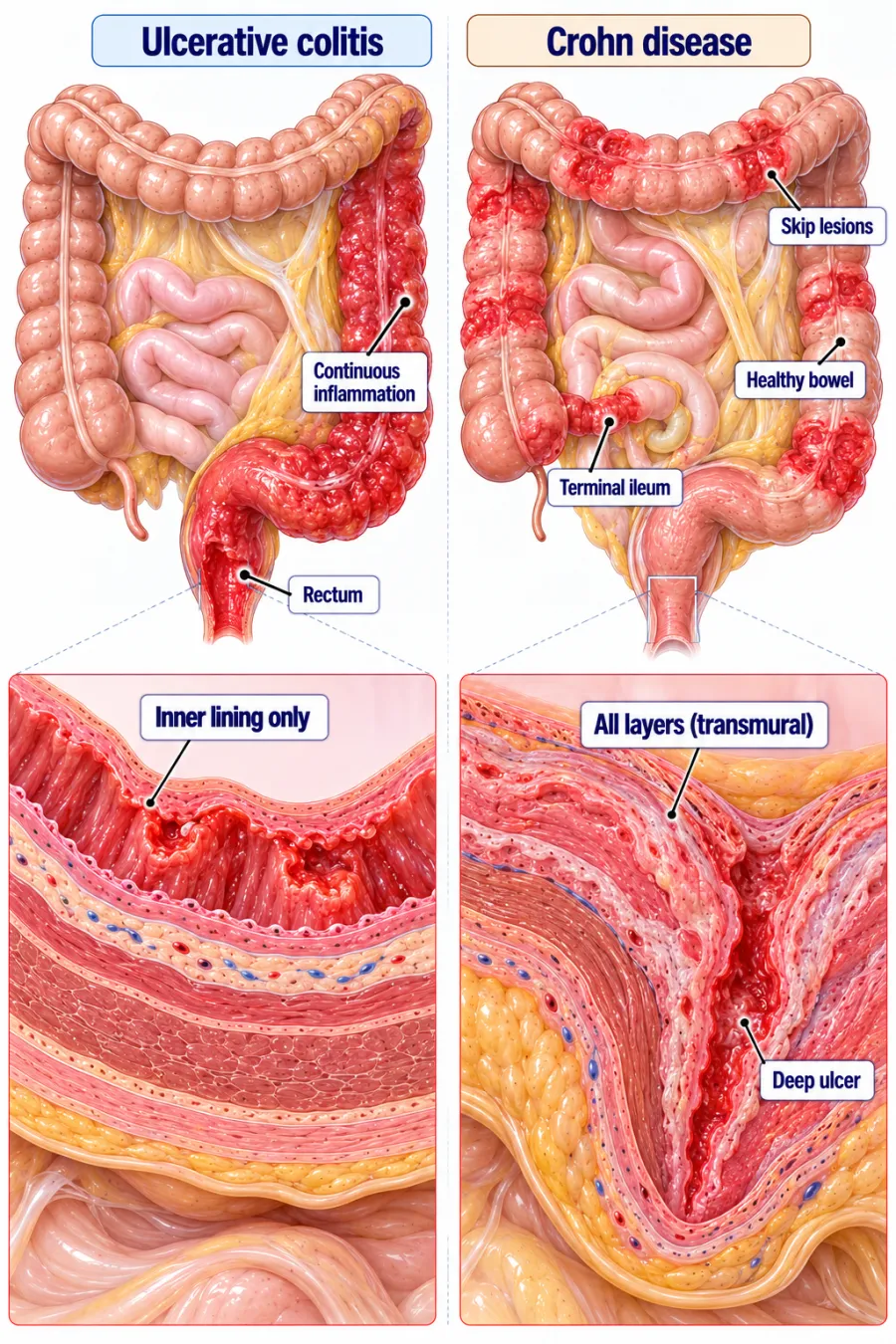
Inflammation is continuous and confined to the mucosa/submucosa of the colon and rectum.
Before you read
Test yourself first: 3 questions
Question 1 of 3
A client with ulcerative colitis is experiencing an exacerbation. Which finding is most characteristic of this condition?
Answer: B. Ulcerative colitis characteristically causes frequent bloody, mucoid diarrhea (often 10 to 20 stools per day) with lower abdominal cramping and tenesmus, because inflammation is continuous and limited to the mucosa of the colon and rectum. Right lower quadrant masses and transmural skip lesions are features of Crohn disease. Steatorrhea reflects malabsorption seen in Crohn or pancreatic disease. Chronic constipation is not typical of an active UC flare.
Question 2 of 3
The nurse is comparing Crohn disease and ulcerative colitis. Which feature is most specific to Crohn disease?
Answer: B. Crohn disease is characterized by transmural inflammation with discontinuous skip lesions that can affect any part of the GI tract from mouth to anus, often with fistula and stricture formation. Ulcerative colitis involves continuous mucosal inflammation limited to the colon and rectum and is more associated with bloody diarrhea and a higher colon cancer risk. Skip lesions with transmural involvement are the hallmark distinguishing Crohn disease.
Question 3 of 3
A nurse caring for a preterm infant being fed enterally notes a distended abdomen, bloody stools, feeding intolerance, and lethargy. Which condition is the nurse most concerned about?
Answer: B. Necrotizing enterocolitis (NEC) is a serious bowel inflammation and necrosis, most common in preterm and formula-fed infants. Warning signs include abdominal distension, increased gastric residuals, bloody stools, feeding intolerance, and systemic signs such as lethargy and temperature instability. The nurse stops enteral feeds and notifies the provider immediately.
Keep the streak going with more questions like these, each with a full rationale.
What is ulcerative colitis?
Inflammation is continuous (no skip lesions) and affects only the mucosa and submucosa, starting in the rectum and spreading proximally. The hallmark symptom is frequent bloody, mucus-filled diarrhea. Severe disease risks toxic megacolon and increases long-term colon cancer risk.
Ulcerative Colitis illustrated
Key points to remember
- Inflammation is continuous and confined to the mucosa/submucosa of the colon and rectum.
- Frequent bloody diarrhea with mucus, up to 10-20 stools per day, is the hallmark.
- Left lower quadrant cramping and urgency (tenesmus) are common.
- Weight loss, fever, anemia, and dehydration occur with active disease.
- Toxic megacolon is a life-threatening complication of severe inflammation.
- Long-standing ulcerative colitis significantly increases colorectal cancer risk.
Signs & symptoms
- LLQ pain, BLOODY diarrhea
- 10-20 stools/day, tenesmus
- wt loss, anemia, dehydration
Nursing priorities
- Monitor frequency and character of stools and assess for bleeding and dehydration.
- Administer aminosalicylates, corticosteroids, and immunomodulators as prescribed.
- Maintain fluid and electrolyte balance; replace losses from diarrhea.
- Provide bowel rest with NPO or low-residue diet during severe flares as ordered.
- Prepare patient for possible total colectomy in refractory disease, which is curative.
Labs & values
Patient teaching
- Maintain hydration and follow a low-residue diet during flares.
- Undergo regular colonoscopy screening due to elevated colon cancer risk.
- Report increasing diarrhea, blood loss, fever, or abdominal distention.
Red flags: report now
- Abdominal distention, fever, and tachycardia suggest toxic megacolon, a surgical emergency.
- Profuse bloody diarrhea with signs of hypovolemia requires immediate intervention.
- Sudden severe abdominal pain with rigidity may indicate perforation.
References
Clinical references for this topic