
Flank pain, high fever, and chills - infection may have reached the kidneys (pyelonephritis); report.
Before you read
Test yourself first: 5 questions
Question 1 of 5
An 82-year-old presents with new-onset confusion, low-grade fever, and urinary frequency. Which underlying cause should the nurse suspect first?
Answer: B. In older adults, a urinary tract infection often presents atypically with acute confusion (delirium) rather than classic dysuria. Given the fever and urinary symptoms, a UTI is the most likely cause and should be evaluated promptly.
Question 2 of 5
The nurse is assessing the frequency of a laboring client's contractions. How is contraction frequency correctly measured?
Answer: B. Contraction frequency is measured from the beginning of one contraction to the beginning of the next contraction. Duration is measured from the start to the end of a single contraction.
Question 3 of 5
A nurse is caring for a client with neutropenia related to chemotherapy and HIV. Which finding may be the only early sign of a serious infection in a severely neutropenic client?
Answer: A. In a severely neutropenic client, the usual signs of infection (purulent drainage, redness, swelling) may be blunted because there are too few neutrophils to mount an inflammatory response. A fever may be the only and earliest sign of a serious infection and must be treated as an emergency. Localized pus, robust redness, and significant swelling are often absent.
Question 4 of 5
An older adult reports new confusion, fever is absent, and the urine is cloudy and foul-smelling. Which finding most strongly suggests a urinary tract infection in this age group?
Answer: A. In older adults, acute confusion (delirium) is often the earliest and sometimes only sign of a UTI, because the typical febrile and dysuria responses are blunted with aging. Bradycardia, weight gain, and hyperreflexia are not characteristic UTI presentations.
Question 5 of 5
A client at 33 weeks gestation calls the clinic reporting a sudden gush of clear fluid from the vagina with no contractions. What is the nurse's priority instruction?
Answer: A. A sudden gush of clear fluid suggests preterm premature rupture of membranes. The priority is to have the client come in for evaluation; she should avoid inserting anything into the vagina (including tampons) and avoid intercourse to reduce infection risk. Confirming rupture and monitoring for infection and labor are essential.
Keep the streak going with more questions like these, each with a full rationale.
What is urinary tract infection?
Women are at higher risk due to a shorter urethra. It matters because untreated lower-tract infection can ascend to the kidneys (pyelonephritis) or cause urosepsis, especially in older adults.
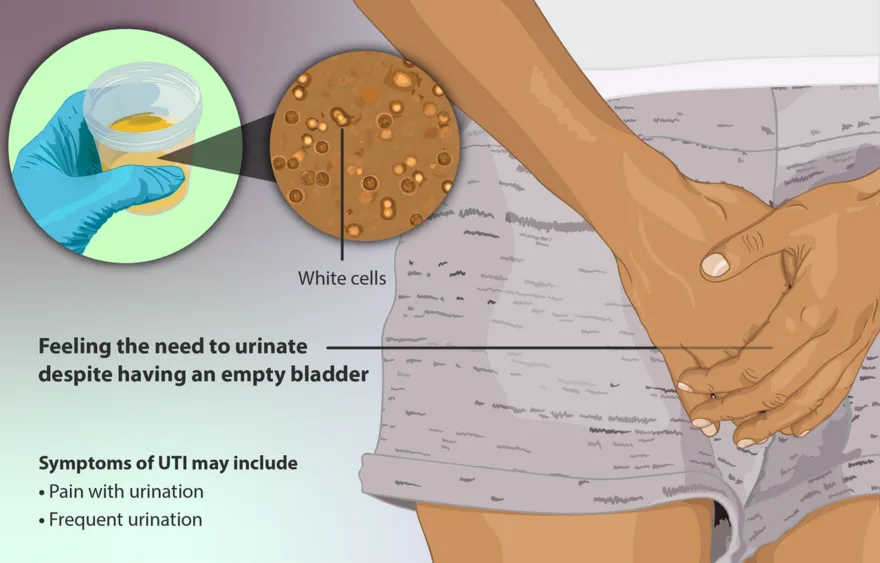
Urinary Tract Infection illustrated
Key points to remember
- Classic symptoms are dysuria (burning), urinary frequency, urgency, and suprapubic pain or pressure.
- Urine may be cloudy, dark, foul-smelling, or contain blood (hematuria).
- In older adults, new-onset confusion or behavior change is often the FIRST and only sign.
- E. coli from the GI tract is the most common causative organism.
- Indwelling catheters are a leading cause of healthcare-associated UTIs.
- Positive nitrites and leukocyte esterase on urinalysis suggest bacterial infection.
Common causes
- E. coli #1, ascending bacteria
- F > M, catheters, retention
Signs & symptoms
- dysuria, frequency, urgency
- cloudy/foul urine, suprapubic pain
- elderly: confusion = key sign
Nursing priorities
- Obtain a clean-catch or catheter urine specimen for culture BEFORE starting antibiotics.
- Administer prescribed antibiotics and encourage increased fluid intake (2-3 L/day unless contraindicated).
- Provide analgesics such as phenazopyridine for dysuria and assess pain.
- Promote perineal hygiene and remove unnecessary indwelling catheters early.
- Monitor for signs the infection is ascending (flank pain, fever).
Labs & values
Patient teaching
- Wipe front to back, void after intercourse, and avoid bubble baths and irritants.
- Drink plenty of fluids and finish the entire antibiotic course even if symptoms improve.
- Phenazopyridine turns urine reddish-orange and may stain clothing; this is harmless.
Red flags: report now
- Flank pain, high fever, and chills - infection may have reached the kidneys (pyelonephritis); report.
- New confusion in an older adult - report and evaluate for UTI/urosepsis.
- Signs of urosepsis (hypotension, tachycardia, fever) - emergency escalation.
- Do not delay obtaining the culture before antibiotics when ordered.
References
Clinical references for this topic

