Serum potassium above 6.0 mEq/L or peaked T waves, widened QRS, or bradycardia - report and treat immediately.
Before you read
Test yourself first: 5 questions
Question 1 of 5
A nurse is monitoring a client with sepsis for progression to multiple organ dysfunction syndrome (MODS). Which finding indicates acute kidney injury related to hypoperfusion?
Answer: A. Decreased urine output (oliguria, less than 0.5 mL/kg/hr) along with a rising serum creatinine and BUN reflects acute kidney injury from inadequate renal perfusion in sepsis. Increased urine output with a low creatinine, decreasing BUN, and a falling potassium are not consistent with acute kidney injury from hypoperfusion.
Question 2 of 5
The nurse reviews labs for a client with acute kidney injury. Which finding is consistent with the disorder?
Answer: A. In acute kidney injury the kidneys cannot excrete nitrogenous wastes, so BUN and creatinine rise. A rising creatinine is the hallmark of declining renal function.
Question 3 of 5
A client with a prerenal cause of acute kidney injury is most likely to have which underlying problem?
Answer: A. Prerenal AKI results from decreased perfusion to the kidneys, such as from hypovolemia, hemorrhage, dehydration, or hypotension. Restoring volume and perfusion can reverse it before intrinsic kidney damage occurs.
Question 4 of 5
A client returns from surgery with an indwelling urinary catheter. Which finding should the nurse report to the surgeon immediately?
Answer: A. Urine output of less than 30 mL per hour suggests inadequate renal perfusion or hypovolemia and must be reported, as it can signal shock or acute kidney injury. Clear yellow urine, output of 50 mL per hour, and a small amount of initial pink-tinged urine after some procedures can be expected.
Question 5 of 5
The nurse is reviewing labs for a client in the oliguric phase of acute kidney injury. Which finding is expected?
Answer: A. In the oliguric phase of AKI, the kidneys cannot excrete waste or regulate electrolytes, so BUN and creatinine rise and potassium increases (hyperkalemia). Urine output falls below 400 mL/day. A low potassium and high urine output are typical of the diuretic (recovery) phase, not the oliguric phase.
Keep the streak going with more questions like these, each with a full rationale.
What is acute kidney injury?
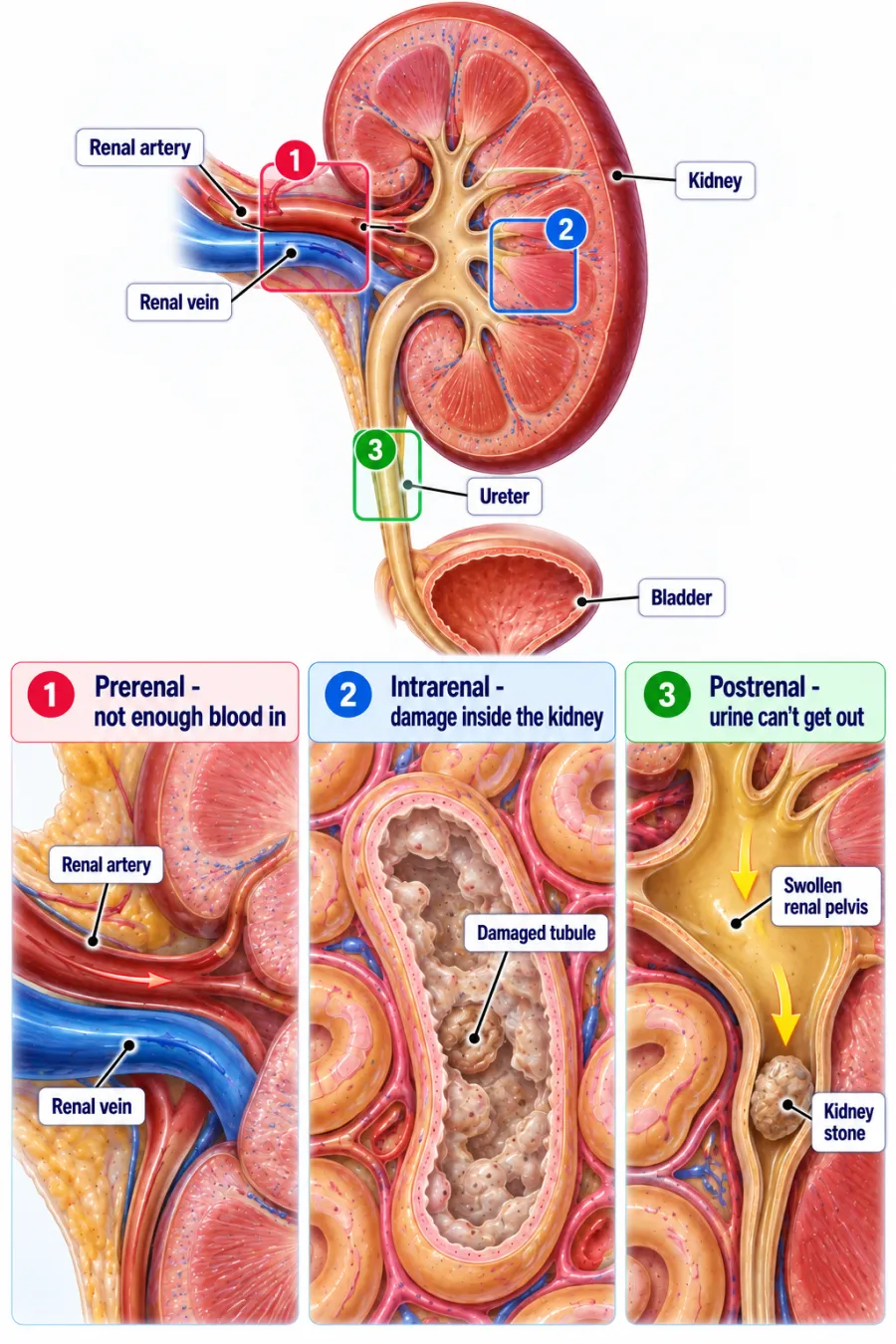
Causes are grouped as prerenal (decreased perfusion: hypovolemia, hypotension, heart failure), intrarenal (direct damage: acute tubular necrosis, nephrotoxins, contrast dye), and postrenal (obstruction: stones, BPH, tumor). It matters because rising potassium and fluid overload can be rapidly life-threatening.
Acute Kidney Injury illustrated
Key points to remember
- AKI classically progresses through four phases (onset, oliguric, diuretic, recovery) in intrinsic AKI/ATN; note that not all AKI is oliguric (non-oliguric AKI is common). Oliguric phase: urine under 400 mL/day for 1-3 weeks; diuretic phase: large urine output with risk of dehydration and hypokalemia.
- BUN and creatinine rise while urine output typically falls; creatinine is the more reliable marker of kidney function.
- Hyperkalemia is the most dangerous electrolyte change and can cause fatal dysrhythmias.
- Fluid overload causes hypertension, edema, crackles, jugular vein distention, and risk of pulmonary edema.
- Metabolic acidosis develops as the kidneys fail to excrete hydrogen ions and retain bicarbonate.
- Prerenal causes show a high BUN-to-creatinine ratio and concentrated urine because the kidneys are reabsorbing sodium and water.
Nursing priorities
- Monitor strict intake and output and daily weights (1 kg gain equals about 1 L fluid retained).
- Assess for hyperkalemia and continuous cardiac monitoring for peaked T waves and widening QRS.
- Restrict fluids, potassium, sodium, and protein as ordered; correct the underlying cause (fluids for prerenal, relieve obstruction for postrenal).
- Hold or avoid nephrotoxic agents (NSAIDs, aminoglycosides, contrast dye) and adjust drug doses.
- Prepare for dialysis if severe hyperkalemia, fluid overload, acidosis, or uremia are present.
Labs & values
Patient teaching
- Report decreased urination, swelling, or weight gain promptly.
- Avoid over-the-counter NSAIDs and herbal supplements that can harm the kidneys.
- Follow the prescribed fluid, sodium, potassium, and protein restrictions.
Red flags: report now
- Serum potassium above 6.0 mEq/L or peaked T waves, widened QRS, or bradycardia - report and treat immediately.
- Urine output less than 30 mL/hr - report; indicates inadequate perfusion or worsening failure.
- Signs of pulmonary edema (sudden dyspnea, frothy sputum, crackles) require immediate escalation.
- Never give nephrotoxic drugs or IV contrast without checking renal function first.
References
Clinical references for this topic