A silent chest with no audible wheezing plus rising PaCO2 indicates impending respiratory arrest, escalate immediately.
Before you read
Test yourself first: 3 questions
Question 1 of 3
While assessing a client with an acute asthma exacerbation, the nurse hears continuous, high-pitched, musical sounds on expiration throughout the lung fields. These sounds are most consistent with which finding?
Answer: A. Wheezes are continuous, high-pitched, musical sounds produced by air moving through narrowed airways. In asthma they are typically heard on expiration and reflect bronchoconstriction and airway inflammation.
Question 2 of 3
A client receiving an IV beta-blocker for a tachydysrhythmia has a known history of asthma. Why is this combination a concern for the nurse?
Answer: B. Nonselective beta blockers block beta-2 receptors in the bronchial smooth muscle, which can cause bronchospasm and worsen asthma or COPD. The nurse should monitor respiratory status closely and question a nonselective agent in a client with reactive airway disease. Beta blockers do not commonly cause severe hyperglycemia, increased clotting, or excessive diuresis as the primary concern in asthma.
Question 3 of 3
A client having an acute asthma attack has wheezing and uses accessory muscles. The priority intervention is to:
Answer: B. Give a short-acting bronchodilator (e.g., albuterol), high-Fowler's position, and oxygen; assess response. A SILENT chest (no wheezing) with worsening distress is ominous (severe airflow limitation).
Keep the streak going with more questions like these, each with a full rationale.
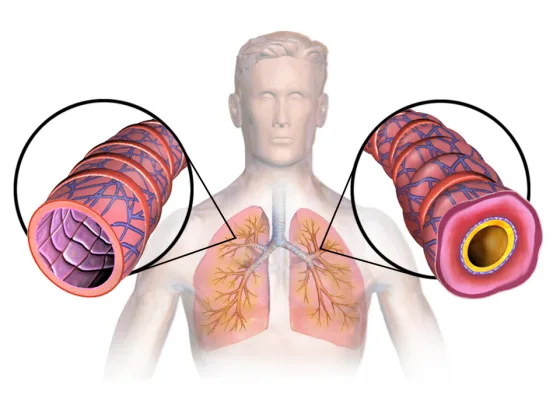
What is asthma?
It matters because severe attacks can progress to status asthmaticus, a life-threatening emergency. The classic triad is wheezing, cough, and dyspnea.
Asthma illustrated
Key points to remember
- Expiratory wheezing, chest tightness, dyspnea, and a nonproductive cough are hallmark signs.
- Air trapping during an attack prolongs the expiratory phase and can cause a barrel chest over time.
- Use of accessory muscles, nasal flaring, and tripod positioning indicate increasing respiratory effort.
- A silent chest (absence of wheezing) with severe distress signals impending respiratory failure, not improvement.
- Early in an attack respiratory alkalosis develops from hyperventilation; a rising CO2 with normalizing pH signals fatigue.
- Status asthmaticus is a severe attack unresponsive to standard bronchodilators and requires emergency care.
Signs & symptoms
- Wheeze, cough, chest tight
- Prolonged expiration, dyspnea
- ↓ peak flow, accessory muscles
Nursing priorities
- Position the patient upright (high Fowler's) to maximize lung expansion.
- Administer short-acting beta-2 agonists (albuterol) first for acute bronchospasm, then corticosteroids for inflammation.
- Apply oxygen and continuously monitor pulse oximetry and respiratory status.
- Encourage pursed-lip breathing and keep the patient calm to reduce oxygen demand.
- Monitor peak expiratory flow rate and prepare for possible intubation if the patient deteriorates.
Labs & values
Patient teaching
- Use the bronchodilator (rescue) inhaler before the corticosteroid (controller) inhaler, and rinse the mouth after steroids to prevent thrush.
- Identify and avoid personal triggers such as smoke, allergens, and cold air.
- Use a peak flow meter daily and follow the green-yellow-red zone action plan to catch worsening early.
Red flags: report now
- A silent chest with no audible wheezing plus rising PaCO2 indicates impending respiratory arrest, escalate immediately.
- Cyanosis, drowsiness, or a drop in respiratory rate with worsening distress signals decompensation.
- SpO2 below 90 percent that does not improve with oxygen and bronchodilators requires rapid intervention.
- Never give beta-blockers, which can trigger or worsen bronchospasm.
References
Clinical references for this topic