Portal hypertension causes ascites, esophageal varices, splenomegaly, and caput medusae (distended abdominal veins).
Before you read
Test yourself first: 3 questions
Question 1 of 3
A client with cirrhosis has the following lab results. Which result best reflects the liver's impaired ability to synthesize clotting factors?
Answer: B. The liver produces most clotting factors, and a prolonged prothrombin time with elevated INR reflects this impaired synthesis. This is why clients with cirrhosis are at high bleeding risk. A low platelet count contributes to bleeding but reflects splenic sequestration, not synthetic failure. Elevated ammonia reflects detoxification failure, and low albumin reflects protein synthesis but not coagulation specifically.
Question 2 of 3
A client with cirrhosis develops esophageal varices. The greatest risk is:
Answer: B. Esophageal varices can rupture and cause massive, life-threatening hemorrhage. Avoid activities that raise pressure (straining, vomiting), monitor for bleeding (hematemesis, melena), and act emergently if bleeding.
Question 3 of 3
A client with cirrhosis has ascites. A nursing intervention to promote comfort and breathing is to:
Answer: B. Position in semi-Fowler's/Fowler's to ease breathing (the distended abdomen presses on the diaphragm), monitor respiratory status and abdominal girth/weight, and restrict sodium/fluids as ordered. Lying flat worsens dyspnea.
Keep the streak going with more questions like these, each with a full rationale.
What is cirrhosis?
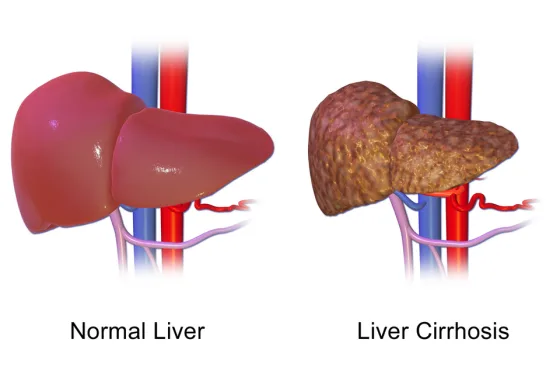
The most common causes are chronic alcohol use and viral hepatitis. Scarring obstructs blood flow, causing portal hypertension, which drives ascites, varices, and splenomegaly. Because the liver makes clotting factors, patients are at high risk for bleeding.
Cirrhosis illustrated
Key points to remember
- Portal hypertension causes ascites, esophageal varices, splenomegaly, and caput medusae (distended abdominal veins).
- Impaired bilirubin metabolism causes jaundice, dark urine, clay-colored stools, and pruritus.
- Decreased synthesis of clotting factors and low platelets produce bleeding tendency and easy bruising.
- Low albumin reduces oncotic pressure, worsening ascites and peripheral edema.
- Failure to detoxify ammonia leads to hepatic encephalopathy and confusion.
- Hyperestrogenism from poor hormone breakdown causes spider angiomas, palmar erythema, and gynecomastia.
Common causes
- Alcohol, hepatitis C, NAFLD
- Fibrosis → ↓ liver function
Signs & symptoms
- Jaundice, ascites, edema
- Spider angiomas, palmar erythema
- Caput medusae, varices, bruising
Nursing priorities
- Monitor for and manage bleeding; implement bleeding precautions due to clotting deficits.
- Measure abdominal girth and daily weight to track ascites and fluid status.
- Administer diuretics (spironolactone) and restrict sodium and fluids as ordered.
- Assess neurologic status for encephalopathy and give lactulose to lower ammonia.
- Provide skin care and antipruritics for jaundice-related itching to prevent breakdown.
Labs & values
Patient teaching
- Abstain completely from alcohol and avoid hepatotoxic drugs including acetaminophen excess.
- Follow a low-sodium diet and weigh daily, reporting rapid weight gain.
- Report increasing confusion, bleeding, or worsening abdominal swelling to the provider.
Red flags: report now
- Hematemesis or melena suggests variceal bleeding and is a life-threatening emergency.
- Worsening confusion, asterixis, or rising ammonia signals advancing hepatic encephalopathy.
- Rapidly increasing abdominal girth with respiratory distress may require paracentesis.
References
Clinical references for this topic