Classic symptom is crushing substernal chest pain or pressure that may radiate to the left arm, jaw, neck, or back and is unrelieved by rest or nitroglycerin.
Before you read
Test yourself first: 5 questions
Question 1 of 5
A client who uses cocaine arrives in the emergency department with chest pain. The nurse understands that cocaine produces which physiologic effect that explains this presentation?
Answer: A. Cocaine is a powerful stimulant that causes sympathetic activation: vasoconstriction, tachycardia, and hypertension, which increase myocardial oxygen demand while reducing supply, causing chest pain and risk of myocardial infarction. It does not cause bradycardia, vasodilation, or central nervous system depression in acute intoxication.
Question 2 of 5
A client recovering from a myocardial infarction asks why nurses encourage early, gradual ambulation. The nurse's response is based on the understanding that progressive activity:
Answer: B. Gradual, monitored activity after MI improves cardiovascular conditioning, prevents complications of immobility (such as venous thromboembolism and deconditioning), and supports recovery, while staying within the heart's tolerance. It is not done to provoke chest pain, and prolonged complete bed rest increases, rather than decreases, complications.
Question 3 of 5
A client with stable angina takes nitroglycerin for chest pain that does not resolve after three doses (5 minutes apart). The nurse teaches the client to:
Answer: B. When chest pain persists despite nitroglycerin (current guidance: as soon as the first dose fails to relieve it; here after the maximum doses), call 911 — unrelieved pain may indicate a myocardial infarction. Waiting at home risks worsening damage.
Question 4 of 5
A client is admitted with a suspected ST-elevation myocardial infarction (STEMI). The nurse anticipates that the priority goal of treatment is to:
Answer: B. In STEMI, the priority is rapid reperfusion to restore coronary blood flow and limit infarct size, achieved with percutaneous coronary intervention (PCI) or fibrinolytics within recommended time windows. Pain control and anxiety reduction matter but are secondary to reestablishing perfusion to the ischemic myocardium.
Question 5 of 5
A client recovering from a myocardial infarction frequently develops premature ventricular contractions. Which finding associated with the PVCs would most concern the nurse and require prompt provider notification?
Answer: B. Isolated occasional PVCs are common, but PVCs become dangerous when they are frequent (more than 6 per minute), occur in runs or pairs, are multifocal, or fall on the T wave (R-on-T phenomenon), because these patterns can deteriorate into ventricular tachycardia or fibrillation. A single PVC once an hour, a normal potassium, and relief of chest pain are reassuring rather than concerning.
Keep the streak going with more questions like these, each with a full rationale.
What is myocardial infarction?
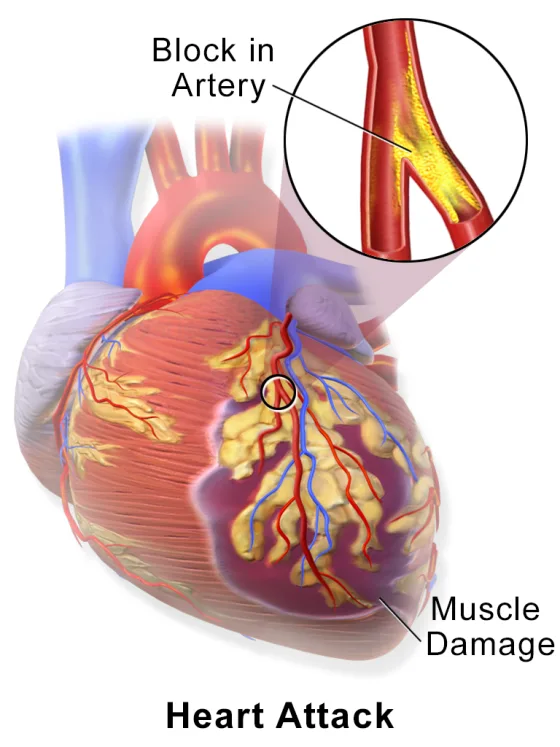
It is a life-threatening emergency because dead myocardium cannot be recovered once perfusion is lost, so the goal is to restore blood flow fast.
Myocardial Infarction illustrated
Key points to remember
- Classic symptom is crushing substernal chest pain or pressure that may radiate to the left arm, jaw, neck, or back and is unrelieved by rest or nitroglycerin.
- Associated signs include diaphoresis, nausea, dyspnea, anxiety, and a sense of impending doom.
- Women, older adults, and diabetics often present atypically with fatigue, indigestion, or shortness of breath rather than classic chest pain.
- A STEMI shows ST-segment elevation on ECG and indicates full-thickness injury; NSTEMI shows ST depression or T-wave inversion.
- Troponin is the most specific cardiac biomarker and rises within hours, staying elevated for days.
Signs & symptoms
- Crushing chest pain → arm/jaw
- Not relieved by rest/nitro
- Diaphoresis, N/V, SOB, anxiety
- Women: fatigue, atypical pain
Nursing priorities
- Obtain a 12-lead ECG within 10 minutes and draw cardiac troponin.
- Administer aspirin to chew, then nitroglycerin, oxygen if saturation is low, and morphine for unrelieved pain per protocol.
- Place the patient on continuous cardiac monitoring and establish IV access.
- Prepare for emergent reperfusion: percutaneous coronary intervention (PCI) goal door-to-balloon under 90 minutes, or fibrinolytics if PCI unavailable.
- Keep the patient on bed rest with the head of bed elevated and minimize oxygen demand.
Labs & values
Patient teaching
- Call 911 immediately for chest pain lasting more than 5 minutes that is not relieved by rest or nitroglycerin.
- Take prescribed antiplatelet, beta-blocker, statin, and ACE inhibitor medications as ordered and do not stop them abruptly.
- Adopt cardiac risk reduction: stop smoking, follow a low-fat low-sodium diet, manage weight, and follow a supervised activity plan.
Red flags: report now
- New or worsening chest pain, ST changes, or hemodynamic instability requires immediate provider notification.
- Life-threatening dysrhythmias such as ventricular tachycardia or ventricular fibrillation demand immediate defibrillation.
- Signs of cardiogenic shock (hypotension, cool clammy skin, decreased urine output) or new crackles signaling heart failure must be escalated now.
References
Clinical references for this topic