
Fever with the colic - possible infection behind an obstruction; report immediately as a urologic emergency.
Before you read
Test yourself first: 3 questions
Question 1 of 3
A client is diagnosed with a uric acid kidney stone. Which dietary modification should the nurse teach to help prevent recurrence?
Answer: A. Uric acid stones form in acidic urine and are linked to high purine intake. The client should limit high-purine foods such as organ meats, red meat, shellfish, sardines, and anchovies, and alkalinizing the urine may be recommended. Loading up on organ meats and shellfish would worsen, not prevent, uric acid stones; high fluid intake is still encouraged.
Question 2 of 3
A client reports flank pain, hematuria, and nausea. The provider suspects a renal calculus. Which urine finding supports this diagnosis?
Answer: A. Renal calculi (kidney stones) often cause hematuria as the stone irritates and abrades the urinary tract lining. Severe colicky flank pain that may radiate to the groin, along with blood in the urine, is the classic presentation.
Question 3 of 3
The nurse is teaching a client about how the body buffers acids within seconds, before the lungs and kidneys respond. Which statement reflects the fastest line of defense against pH changes?
Answer: A. Chemical buffer systems, primarily the bicarbonate-carbonic acid buffer, act within seconds as the body's first and fastest defense against pH change. The respiratory system responds within minutes, and the renal system responds over hours to days as the slowest but most powerful regulator.
Keep the streak going with more questions like these, each with a full rationale.
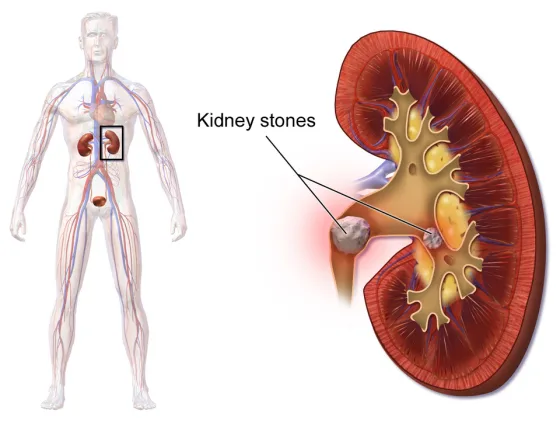
What is nephrolithiasis (kidney stones)?
Risk factors include dehydration, high intake of stone-forming substances, immobility, and certain metabolic conditions. The hallmark is severe, sudden flank pain (renal colic). It matters because stones can obstruct urine flow, causing hydronephrosis and infection.
Nephrolithiasis (kidney stones) illustrated
Key points to remember
- Severe, colicky flank pain that may radiate to the groin, testes, or labia is the classic presentation.
- Hematuria (gross or microscopic) is common from stone irritation of the urinary tract.
- Nausea, vomiting, diaphoresis, and restlessness often accompany the pain.
- Dehydration and low fluid intake are major contributing factors.
- Most stones are calcium-based; uric acid, struvite (infection-related), and cystine are other types.
- Obstruction can cause urinary urgency, frequency, and decreased output on the affected side.
Signs & symptoms
- SEVERE colicky flank pain
- radiates groin, hematuria, N/V
- restless, can't find comfort
Nursing priorities
- Manage pain aggressively - administer prescribed opioids/NSAIDs and antispasmodics promptly.
- Encourage high fluid intake (3 L/day or more) to help pass the stone unless contraindicated.
- Strain all urine to catch the stone for analysis and monitor output.
- Monitor for signs of obstruction and infection; encourage ambulation to aid passage.
- Prepare for lithotripsy or surgical removal if the stone does not pass.
Labs & values
Patient teaching
- Drink at least 3 liters of fluid daily to prevent recurrence.
- Calcium-oxalate stones: limit oxalate foods (spinach, nuts, tea, chocolate); for uric acid stones limit purines (organ meats, red meat).
- Strain urine at home and keep any stone passed for analysis.
Red flags: report now
- Fever with the colic - possible infection behind an obstruction; report immediately as a urologic emergency.
- Anuria or no output on the affected side - complete obstruction; escalate.
- Pain unrelieved by prescribed analgesia - report.
- Signs of sepsis from an obstructed, infected system - emergency.
References
Clinical references for this topic

