
Gastric ulcer pain increases with food intake; duodenal ulcer pain is relieved by food and recurs 2-3 hours after meals.
Before you read
Test yourself first: 5 questions
Question 1 of 5
A client with peptic ulcer disease suddenly develops a rigid, board-like abdomen and severe pain. The nurse suspects which complication?
Answer: A. A rigid, board-like abdomen with sudden severe pain signals perforation, allowing gastric contents to enter the peritoneum and cause peritonitis. This is a surgical emergency requiring immediate intervention.
Question 2 of 5
A client with a peptic ulcer suddenly reports severe, sharp abdominal pain that radiates to the shoulder, and the abdomen is rigid and board-like. Which complication should the nurse suspect?
Answer: B. A rigid, board-like abdomen with sudden severe pain radiating to the shoulder is the classic presentation of a perforated peptic ulcer, which spills gastric contents into the peritoneum and causes peritonitis. This is a surgical emergency. Hemorrhage typically presents with hematemesis or melena and signs of shock, not a board-like abdomen. Pyloric obstruction causes vomiting and bloating. Dumping syndrome occurs after gastric surgery with meals.
Question 3 of 5
A client reports that abdominal pain consistently worsens after eating fried or fatty foods. The nurse recognizes this pattern is most characteristic of:
Answer: A. Fatty foods stimulate cholecystokinin release, causing gallbladder contraction. In cholelithiasis or cholecystitis, this contraction against an obstructed or inflamed gallbladder produces biliary colic, so pain typically intensifies after fatty meals. This dietary trigger pattern is a hallmark of gallbladder disease rather than peptic ulcer, appendicitis, or diverticulitis.
Question 4 of 5
A client with a peptic ulcer develops sudden severe abdominal pain and a rigid board-like abdomen. The nurse suspects:
Answer: B. Sudden severe pain with a rigid abdomen suggests a perforated ulcer with peritonitis — a surgical emergency. Keep NPO, notify the provider, and prepare for emergent intervention.
Question 5 of 5
The nurse is assessing a newborn for Hirschsprung disease. Which finding in the first 48 hours of life is most suggestive of this disorder?
Answer: A. Failure to pass meconium within 24 to 48 hours of birth is a hallmark of Hirschsprung disease, caused by absence of ganglion cells in a segment of the distal colon. Frequent loose stools, projectile vomiting, and excessive meconium passage are not characteristic.
Keep the streak going with more questions like these, each with a full rationale.
What is peptic ulcer disease?
The two main causes are Helicobacter pylori infection and chronic NSAID/aspirin use. Gastric ulcer pain typically worsens with eating, while duodenal ulcer pain is relieved by eating and returns 2-3 hours later. Major complications are hemorrhage and perforation.
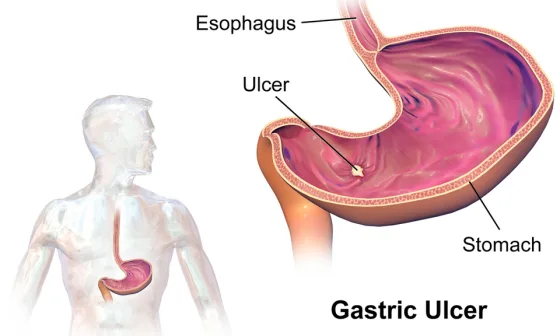
Peptic Ulcer Disease illustrated
Key points to remember
- Gastric ulcer pain increases with food intake; duodenal ulcer pain is relieved by food and recurs 2-3 hours after meals.
- Helicobacter pylori infection and NSAID/aspirin use are the leading causes.
- Burning or gnawing epigastric pain is the classic symptom.
- Bleeding ulcers cause hematemesis (coffee-ground or bright red) and melena.
- Perforation causes sudden, severe, board-like rigid abdomen with rebound tenderness.
- Duodenal ulcers are more associated with nighttime pain and weight stability; gastric ulcers with weight loss.
Common causes
- H. pylori, NSAIDs, ↑ stomach acid
- smoking, ETOH, stress, steroids
Signs & symptoms
- gastric: pain WITH food
- duodenal: pain 2-3h AFTER, relief w/ food
- epigastric burning, dyspepsia
Nursing priorities
- Administer proton pump inhibitors or H2 blockers to reduce acid and promote healing.
- Give antibiotic combination therapy for H. pylori eradication as prescribed.
- Monitor stools and emesis for occult or frank blood and watch for signs of bleeding.
- Teach avoidance of NSAIDs, aspirin, alcohol, caffeine, and smoking.
- Assess pain pattern in relation to meals to distinguish gastric from duodenal ulcers.
Labs & values
Patient teaching
- Avoid NSAIDs, aspirin, alcohol, caffeine, and smoking, which damage the mucosa.
- Complete the entire H. pylori antibiotic regimen even if symptoms improve.
- Report black tarry stools, vomiting blood, or sudden severe abdominal pain immediately.
Red flags: report now
- Sudden severe abdominal pain with a rigid board-like abdomen indicates perforation, a surgical emergency.
- Hematemesis or melena with vital sign changes signals active GI hemorrhage.
- Signs of shock (tachycardia, hypotension, cool clammy skin) require immediate intervention.
References
Clinical references for this topic

