
Spreading redness, warmth, purulent drainage, or foul odor signals infection; notify the provider.
Before you read
Test yourself first: 5 questions
Question 1 of 5
An older adult is at risk for a pressure injury. Which intervention best prevents skin breakdown?
Answer: B. Repositioning at least every 2 hours redistributes pressure over bony prominences and is the cornerstone of pressure-injury prevention. Massaging reddened bony areas can worsen tissue damage, keeping the head of bed high increases shear, and a single pillow under the heels does not reliably offload them.
Question 2 of 5
A bedbound older adult is at high risk for pressure injuries. Which intervention is most effective for prevention?
Answer: A. Repositioning at least every 2 hours, keeping skin clean and dry, and using pressure-redistribution surfaces prevent pressure injuries. Massaging reddened bony prominences and vigorous rubbing can damage tissue; a doughnut cushion concentrates pressure and is contraindicated.
Question 3 of 5
A nurse is teaching a nursing assistant about heel pressure injury prevention for a bedbound client. Which instruction is correct?
Answer: A. Floating the heels off the bed by placing a pillow lengthwise under the calves (so the heels hang free) offloads pressure from the heel, a high-risk site with little subcutaneous padding. Placing pillows directly under the heels concentrates pressure rather than relieving it.
Question 4 of 5
A home health nurse is teaching a caregiver how to reduce the risk of pressure injuries in a bedbound client. Which instruction is correct?
Answer: A. Repositioning the client at least every 2 hours relieves pressure over bony prominences and prevents pressure injuries. Massaging reddened bony areas can cause further tissue damage, donut cushions concentrate pressure, and keeping the head of the bed elevated high increases shear over the sacrum.
Question 5 of 5
A client is incontinent and on bed rest. To best prevent a pressure injury over the sacrum, the nurse:
Answer: B. Reposition at least every 2 hours, keep the skin clean/dry with a barrier, use a pressure-redistribution surface, and float the heels. Massaging reddened bony areas can worsen tissue damage.
Keep the streak going with more questions like these, each with a full rationale.
What is pressure injury (staging)?
Unrelieved pressure cuts off blood flow, leading to ischemia and tissue death. They are staged 1 through 4 by depth, plus unstageable and deep tissue injury. Prevention through repositioning is far easier than treatment, making this a key safety and quality indicator.
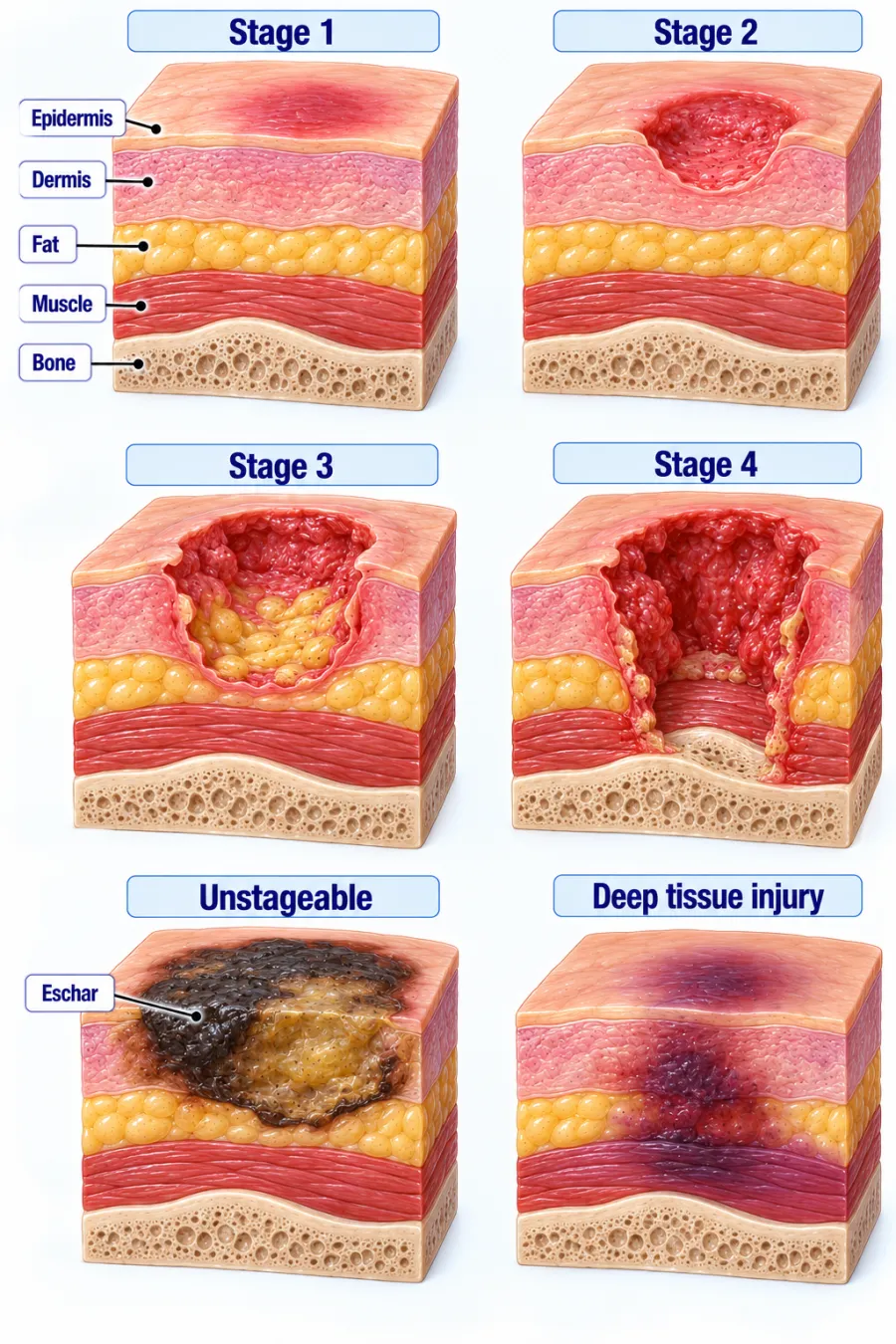
Pressure Injury (staging) illustrated
Key points to remember
- Stage 1: intact skin with nonblanchable redness; in dark skin tones look for a change in color, temperature, or firmness.
- Stage 2: partial-thickness loss with exposed dermis; appears as a shallow open ulcer or intact/ruptured blister.
- Stage 3: full-thickness loss with visible subcutaneous fat; slough may be present but bone, tendon, and muscle are not exposed.
- Stage 4: full-thickness loss with exposed bone, tendon, or muscle; high risk for osteomyelitis.
- Unstageable: full-thickness loss where the base is obscured by slough or eschar so depth cannot be determined.
- Deep tissue pressure injury: intact or non-intact skin with a persistent maroon or purple area or blood-filled blister.
- Shear, friction, moisture, immobility, poor nutrition, and incontinence are major contributing risk factors.
Nursing priorities
- Reposition immobile patients at least every 2 hours and use a turning schedule; reposition chair-bound patients hourly.
- Use a validated risk tool (Braden scale) on admission and routinely to identify at-risk patients.
- Keep skin clean and dry, manage incontinence promptly, and apply moisture barrier creams.
- Use pressure-redistribution surfaces, float the heels off the bed, and avoid massaging bony prominences.
- Optimize nutrition with adequate protein, calories, vitamin C, and zinc to support tissue repair.
Labs & values
Patient teaching
- Shift weight every 15 minutes when sitting and inspect the skin daily, using a mirror for hard-to-see areas.
- Eat protein-rich foods and stay hydrated to keep skin healthy.
- Keep skin moisturized but dry in skin folds, and report any new red or open areas early.
Red flags: report now
- Spreading redness, warmth, purulent drainage, or foul odor signals infection; notify the provider.
- Exposed bone or a sinus tract suggests possible osteomyelitis; escalate for imaging and culture.
- Never massage reddened bony areas or position the patient directly on an existing pressure injury.
- Do not elevate the head of bed above 30 degrees longer than needed; it increases sacral shear.
- Never reverse-stage a healing wound: a healing stage 4 is documented as a healing stage 4, not as a stage 2.
References
Clinical references for this topic

