Water retention causes dilutional hyponatremia with concentrated urine and dilute, low-volume serum.
Before you read
Test yourself first: 5 questions
Question 1 of 5
A client with syndrome of inappropriate antidiuretic hormone (SIADH) is admitted. Which set of findings does the nurse expect?
Answer: B. SIADH causes water retention and dilutional hyponatremia: low serum sodium, low serum osmolality, concentrated (high osmolality) urine, and high urine sodium. Fluid is retained, not lost, so the client is euvolemic to hypervolemic without edema in many cases.
Question 2 of 5
A client with a pituitary tumor develops syndrome of inappropriate antidiuretic hormone (SIADH). Which finding does the nurse expect?
Answer: A. In SIADH, excess ADH causes water retention, producing dilutional hyponatremia, low serum osmolality, concentrated urine with high urine osmolality, and fluid overload. Serum sodium falls, and the client may show weight gain without edema and neurologic changes from cerebral edema.
Question 3 of 5
A client with a pituitary tumor develops syndrome of inappropriate antidiuretic hormone (SIADH). Which laboratory and clinical findings does the nurse expect?
Answer: A. SIADH causes excess ADH, leading to water retention and dilutional hyponatremia. Findings include low serum sodium, low serum osmolality, concentrated urine, and fluid retention without edema. Treatment includes fluid restriction.
Question 4 of 5
A client with small cell lung cancer develops hyponatremia, concentrated urine, and confusion. The nurse recognizes this as which oncologic complication?
Answer: B. Syndrome of inappropriate antidiuretic hormone (SIADH) is a paraneoplastic syndrome commonly associated with small cell lung cancer. Excess ADH causes water retention, dilutional hyponatremia, concentrated urine, and neurologic changes. Management includes fluid restriction and treating the underlying tumor.
Question 5 of 5
A client with a head injury develops SIADH (syndrome of inappropriate antidiuretic hormone). Which laboratory and assessment finding does the nurse expect?
Answer: A. SIADH causes water retention with dilutional hyponatremia: low serum sodium, low serum osmolality, concentrated urine with high specific gravity, and decreased urine output. This is the opposite of diabetes insipidus. Severe hyponatremia from SIADH can worsen cerebral edema and cause seizures.
Keep the streak going with more questions like these, each with a full rationale.
What is siadh (syndrome of inappropriate antidiuretic hormone)?
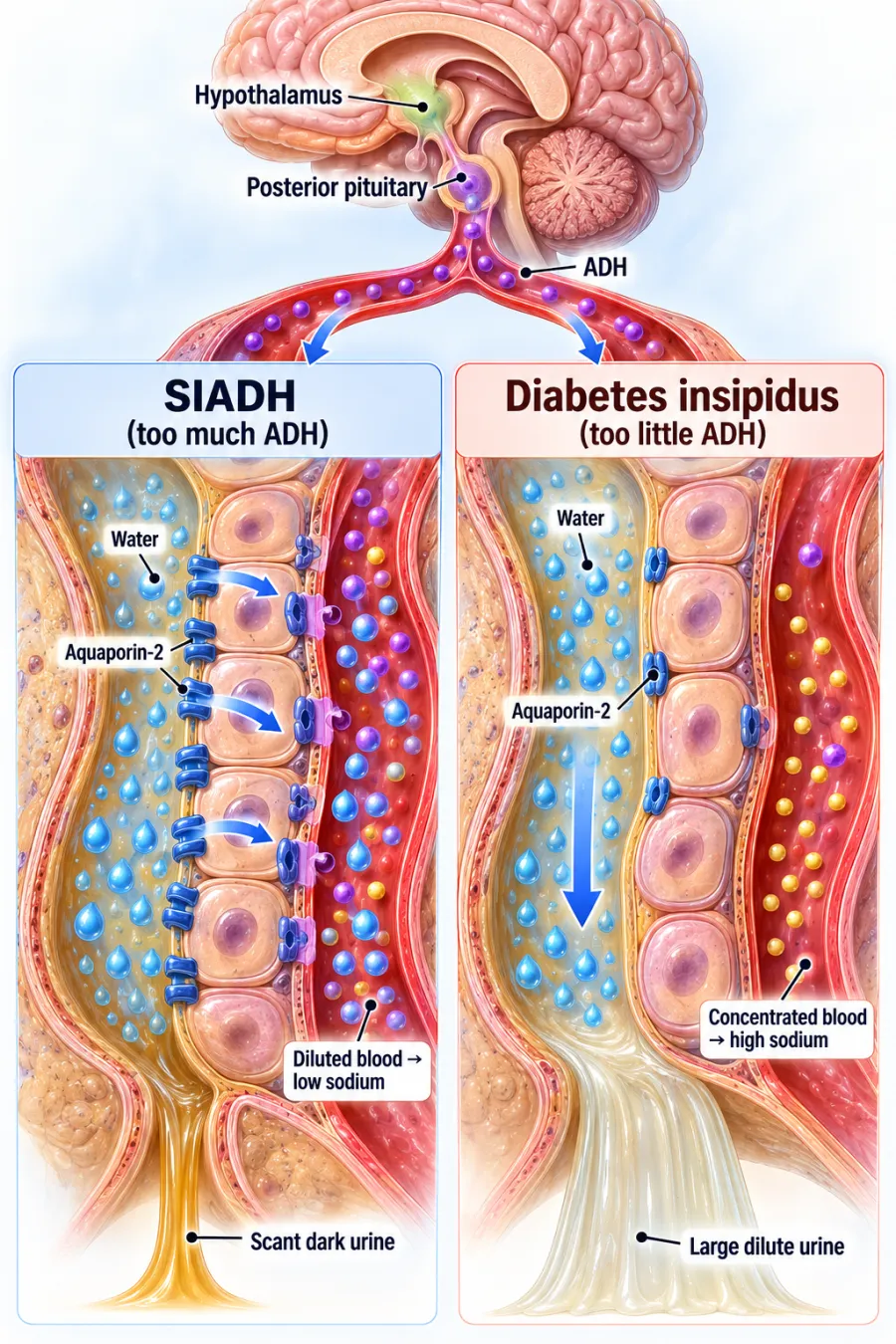
Common causes include small cell lung cancer, CNS disorders, certain medications, and surgery. The body holds onto water it should excrete, leading to fluid overload and low sodium. Memory aid: SIADH = 'Soaked Inside' (too much water held in); it is the mirror image of diabetes insipidus.
SIADH (Syndrome of Inappropriate Antidiuretic Hormone) illustrated
Key points to remember
- Water retention causes dilutional hyponatremia with concentrated urine and dilute, low-volume serum.
- Patients have fluid overload but typically without obvious edema; weight gain occurs without thirst.
- Urine output is low and urine is highly concentrated with high specific gravity and high urine sodium.
- Neurologic symptoms of low sodium include headache, confusion, lethargy, muscle cramps, and seizures.
- Serum osmolality is low while urine osmolality is inappropriately high.
Signs & symptoms
- Wt gain, NO edema, ↓ urine
- Headache, confusion, seizures
Nursing priorities
- Restrict fluids (often 500-1000 mL/day) as the primary intervention and monitor strict intake and output.
- Monitor serum sodium, neurologic status, and daily weights closely.
- Administer hypertonic 3% saline cautiously and only for severe symptomatic hyponatremia, correcting sodium slowly.
- Institute seizure precautions and maintain a safe, low-stimulation environment.
- Administer ADH antagonists (vaptans) or demeclocycline as ordered.
Labs & values
Patient teaching
- Follow the prescribed fluid restriction carefully and measure all intake.
- Report headache, confusion, nausea, or muscle weakness, which may indicate worsening low sodium.
- Weigh yourself daily and report rapid weight gain.
Red flags: report now
- Rapid sodium correction can cause osmotic demyelination (central pontine myelinolysis); raise sodium slowly.
- Report seizures, marked decline in level of consciousness, or worsening confusion immediately.
- Report sodium below 120 mEq/L or a rapidly falling sodium level.
References
Clinical references for this topic