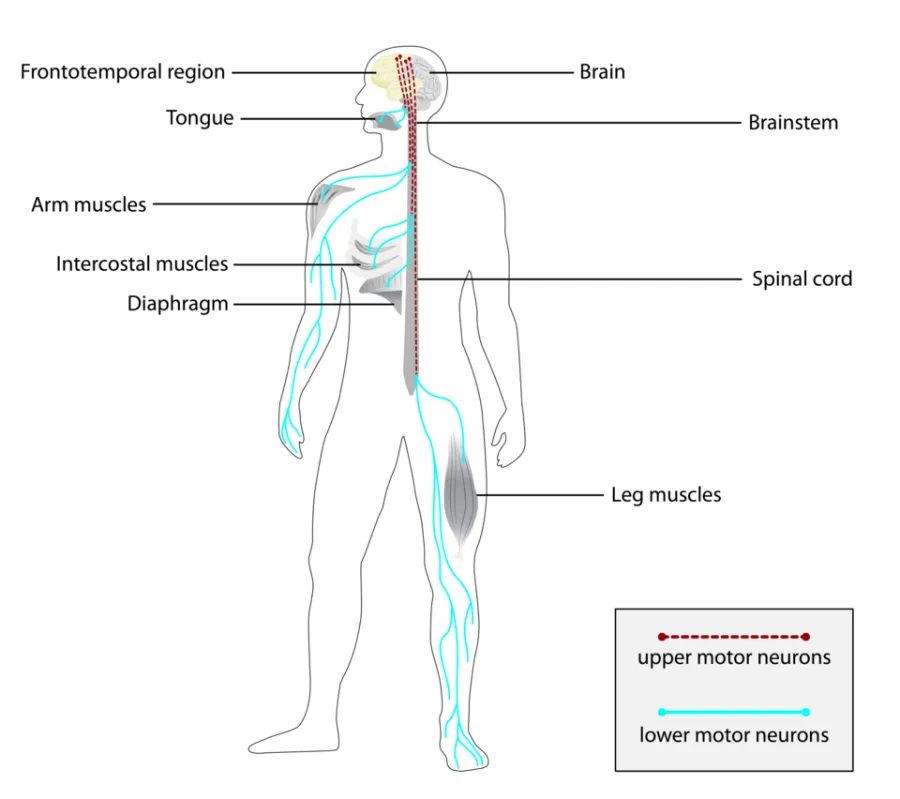
Progressive muscle weakness, atrophy, fasciculations (twitching), and spasticity occur as motor neurons die.
Before you read
Test yourself first: 5 questions
Question 1 of 5
A nurse reviews the clinical picture of a client with amyotrophic lateral sclerosis (ALS). Which combination of findings is consistent with this disorder?
Answer: A. ALS is a progressive degeneration of both upper and lower motor neurons, producing muscle weakness, atrophy, fasciculations, and spasticity while sensation and cognition usually remain intact. Loss of sensation, relapsing-remitting vision changes, and a resting tremor are not characteristic of ALS.
Question 2 of 5
A nurse assesses pupils in a client with rising ICP. Which pupillary finding most strongly suggests uncal herniation compressing cranial nerve III?
Answer: A. Compression of the oculomotor nerve (CN III) from uncal herniation produces a unilateral fixed, dilated (blown) pupil on the side of the lesion. Bilateral pinpoint pupils suggest pontine or opioid effects; equal reactive pupils are normal; bilateral fixed dilated pupils are a very late, ominous brainstem sign.
Question 3 of 5
A client develops a deep vein thrombosis (DVT) in the right calf. Which assessment findings does the nurse most likely observe?
Answer: A. DVT classically presents with unilateral calf swelling, warmth, redness, tenderness, and possibly a palpable cord. Bilateral cool, pale feet suggest arterial disease, and symmetric pulselessness or dry gangrene does not fit a unilateral venous clot.
Question 4 of 5
A chest x-ray of a client with suspected ARDS is reviewed. Which finding is most consistent with this diagnosis?
Answer: B. ARDS produces diffuse bilateral infiltrates often described as a white-out or ground-glass appearance, reflecting widespread alveolar flooding. A unilateral lobar consolidation suggests pneumonia, and a deviated trachea suggests tension pneumothorax.
Question 5 of 5
A nurse checks pupillary response in a client with a head injury. The right pupil is fixed and dilated while the left reacts normally. What does this finding most likely indicate?
Answer: B. A unilateral fixed and dilated pupil suggests compression of the oculomotor nerve (CN III) on that side, often from an expanding mass or herniation, and warrants immediate notification of the provider.
Keep the streak going with more questions like these, each with a full rationale.
What is amyotrophic lateral sclerosis?
Sensation, cognition, and eye movement are typically preserved, so the patient remains mentally aware throughout. There is no cure; death usually results from respiratory failure. Care is supportive and focused on maintaining function, safety, and dignity.
Amyotrophic Lateral Sclerosis illustrated
Key points to remember
- Progressive muscle weakness, atrophy, fasciculations (twitching), and spasticity occur as motor neurons die.
- Mental status, intelligence, and sensation remain intact, while voluntary muscle control is lost.
- Dysphagia and dysarthria develop as bulbar muscles weaken, increasing aspiration risk.
- Respiratory muscle weakness progresses to respiratory failure, the usual cause of death.
- The disease is relentlessly progressive with no cure; riluzole may modestly slow progression.
Signs & symptoms
- Progressive muscle weakness/atrophy
- Fasciculations, spasticity, cramps
- Dysphagia, dysarthria late
Nursing priorities
- Monitor respiratory function closely and support ventilation as the disease advances.
- Assess swallowing and implement aspiration precautions; anticipate enteral feeding as dysphagia worsens.
- Provide a communication method (boards, devices) as speech declines, since cognition stays intact.
- Prevent complications of immobility with repositioning, skin care, and range-of-motion exercises.
- Discuss and document advance directives and end-of-life wishes while the patient can communicate.
Patient teaching
- The mind stays sharp even as the body weakens, so maintaining communication tools is important.
- Plan early for advance directives, ventilation decisions, and feeding-tube preferences.
- Use assistive and communication devices, energy conservation, and support services to maintain quality of life.
Red flags: report now
- Increasing respiratory distress or declining vital capacity signals respiratory failure, the leading cause of death.
- Choking, coughing, or inability to manage secretions indicates high aspiration risk, hold oral intake.
- Aspiration pneumonia from dysphagia is a frequent and dangerous complication.
References
Clinical references for this topic