Diminished or absent breath sounds and crackles over the affected area are typical.
Before you read
Test yourself first: 3 questions
Question 1 of 3
A nurse assesses a client several hours after surgery and finds a temperature of 100.2 F. What does the nurse understand about this finding?
Answer: A. A mild temperature elevation in the first 24 to 48 hours after surgery is most often related to atelectasis and the inflammatory response to surgery. Encouraging deep breathing, coughing, and incentive spirometry is appropriate. Persistent or higher fevers later may indicate infection.
Question 2 of 3
Eight hours after surgery, a client's blood pressure has dropped from 124/78 to 92/56 mm Hg, heart rate is 118, and the dressing is saturated with bright red blood. What does the nurse suspect?
Answer: A. Falling blood pressure, rising heart rate, and an actively bleeding saturated dressing indicate hemorrhage and early hypovolemic shock. The nurse applies pressure, notifies the surgeon, and prepares for fluids. These signs are not consistent with infection, atelectasis, or a normal stress response.
Question 3 of 3
A preterm newborn at 30 weeks gestation develops tachypnea, grunting, nasal flaring, and retractions shortly after birth with a chest film showing a ground-glass pattern. The nurse recognizes the underlying cause as:
Answer: B. Respiratory distress syndrome (RDS) in the preterm infant results from a deficiency of surfactant, which is needed to lower alveolar surface tension and prevent atelectasis. Without surfactant, alveoli collapse, producing the classic ground-glass appearance and increased work of breathing. Treatment includes exogenous surfactant and respiratory support.
Keep the streak going with more questions like these, each with a full rationale.
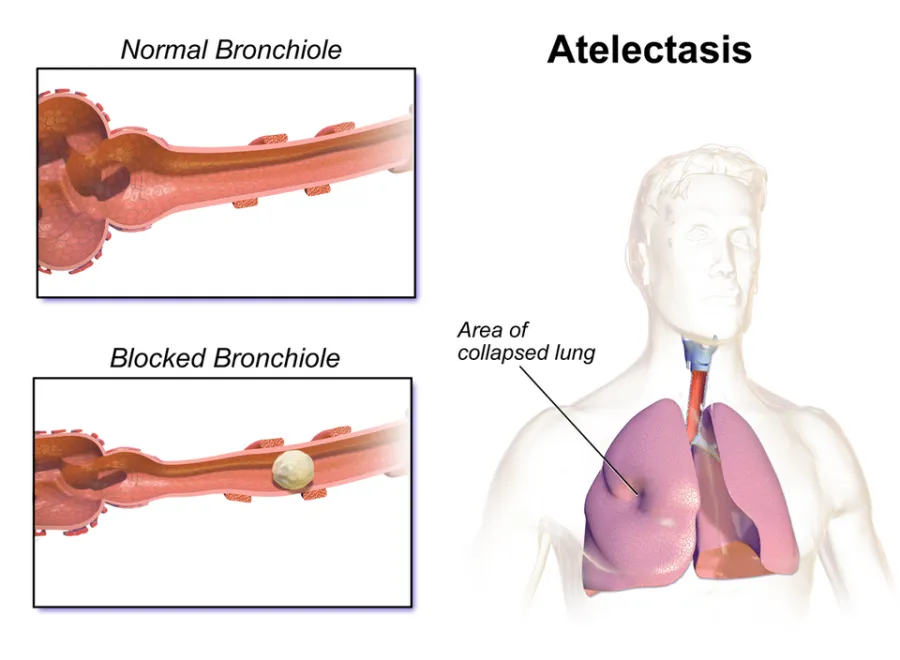
What is atelectasis?
It is most often caused by shallow breathing after surgery or anesthesia, retained secretions, or airway obstruction, and is a leading cause of postoperative fever in the first 24 to 48 hours. It matters because untreated atelectasis can progress to pneumonia and hypoxemia.
Atelectasis illustrated
Key points to remember
- Diminished or absent breath sounds and crackles over the affected area are typical.
- Dyspnea, tachypnea, and decreased chest expansion on the affected side occur with larger collapse.
- Low-grade fever within the first 24 to 48 hours after surgery is classically linked to atelectasis.
- Hypoxemia, increased work of breathing, and a nonproductive cough may develop.
- Immobility, postoperative shallow breathing, and retained secretions are the most common causes.
- A chest x-ray shows areas of increased density and volume loss in the affected lung region.
Common causes
- Post-op #1 → shallow breaths, mucus
- Mucus plug, tumor, foreign body
- Immobility, no deep breathing
Signs & symptoms
- ↓ breath sounds, dull percussion
- Dyspnea, tachypnea, ↓ SpO2
- Tracheal shift toward collapse
Nursing priorities
- Encourage incentive spirometry every 1 to 2 hours while awake.
- Promote deep breathing, coughing, and frequent repositioning to re-expand alveoli.
- Encourage early ambulation after surgery to prevent and reverse collapse.
- Provide adequate pain control so the patient can breathe deeply and cough effectively.
- Encourage fluids and use chest physiotherapy or suctioning to mobilize secretions.
Labs & values
Patient teaching
- Use the incentive spirometer 10 times every hour while awake to keep the alveoli open.
- Splint the incision with a pillow when coughing to reduce pain after surgery.
- Get up and walk as soon as permitted and reposition frequently in bed.
Red flags: report now
- Worsening hypoxemia, increasing dyspnea, or new fever with productive sputum may signal progression to pneumonia.
- A sudden large area of absent breath sounds with respiratory distress requires immediate evaluation.
- Failure to respond to deep breathing and spirometry warrants provider notification.
References
Clinical references for this topic