Stop the transfusion immediately for fever, chills, back pain, hypotension, dyspnea, or hives.
Before you read
Test yourself first: 5 questions
Question 1 of 5
A client receiving a blood transfusion suddenly reports dyspnea, develops crackles, distended neck veins, and a bounding pulse. The nurse suspects which complication?
Answer: C. These signs indicate transfusion-associated circulatory overload (TACO), in which the volume and rate of the transfusion exceed the client's cardiovascular capacity. The nurse slows or stops the transfusion, places the client upright, and anticipates an order for a diuretic. This differs from a hemolytic reaction (fever, flank pain, hemoglobinuria) or an allergic reaction (urticaria, itching).
Question 2 of 5
A client with a febrile nonhemolytic transfusion reaction develops fever and chills without hemolysis. Which nursing action and future measure are appropriate?
Answer: A. Febrile nonhemolytic reactions are caused by recipient antibodies against donor white blood cells and present with fever and chills. The nurse stops the transfusion to rule out a hemolytic reaction, gives an antipyretic such as acetaminophen as ordered, and for future transfusions leukocyte-reduced (leukocyte-poor) blood products are used to prevent recurrence. Aspirin is generally avoided for fever in clients at bleeding risk.
Question 3 of 5
Fifteen minutes into a packed red blood cell transfusion, a client develops fever, chills, flank pain, and dark urine. What is the nurse's first action?
Answer: B. These signs suggest an acute hemolytic transfusion reaction, the most dangerous type, usually from ABO incompatibility. The first and most important action is to STOP the transfusion immediately to prevent further hemolysis, then keep the line open with normal saline using new tubing and notify the provider and blood bank. Slowing the rate or giving an antipyretic does not stop the ongoing reaction.
Question 4 of 5
A nurse begins a blood transfusion. During which period should the nurse stay with the client and monitor most closely?
Answer: A. Most severe transfusion reactions, including acute hemolytic reactions, occur early. The nurse remains with the client and monitors vital signs closely during the first 15 minutes and infuses slowly during that time. If no reaction occurs, the rate can be increased per protocol. Staying for only the first minute or leaving immediately would miss the highest-risk window.
Question 5 of 5
A client involved in a major trauma is hypotensive and the team initiates a massive transfusion protocol. The nurse monitors closely for which electrolyte complication associated with rapid transfusion of citrated blood?
Answer: A. Citrate in stored blood binds calcium, so rapid massive transfusion can cause hypocalcemia, which may impair clotting and cardiac function. Hyperkalemia from stored blood and hypothermia from cold products are also concerns, but citrate-induced hypocalcemia is the classic electrolyte complication monitored during massive transfusion.
Keep the streak going with more questions like these, each with a full rationale.
What is blood transfusion reaction?
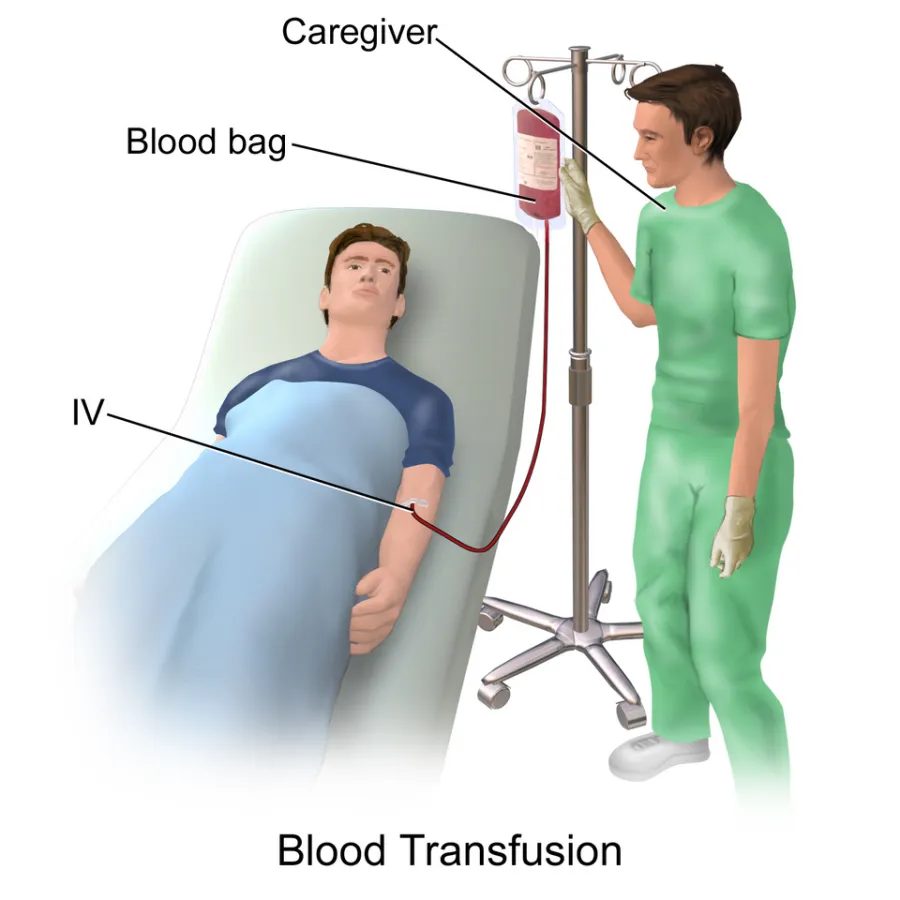
The most dangerous is an acute hemolytic reaction from ABO incompatibility, usually caused by a clerical/identification error. It matters because reactions can be life-threatening within minutes, and the nurse's verification and early-monitoring steps are the key safeguard.
Blood Transfusion Reaction illustrated
Key points to remember
- Acute hemolytic reaction (ABO incompatibility) presents with fever, chills, low back/flank pain, hypotension, and dark/red urine.
- Most reactions begin within the first 15 minutes, so the nurse stays with the patient during this period.
- Febrile nonhemolytic reactions cause fever and chills and are the most common reaction.
- Allergic reactions cause urticaria, itching, and flushing; severe ones cause anaphylaxis.
- Transfusion-associated circulatory overload (TACO) causes dyspnea, crackles, hypertension, and distended neck veins.
- Two licensed nurses must verify patient identity, blood type, and unit at the bedside before starting.
Nursing priorities
- At the first sign of any reaction, STOP the transfusion immediately.
- Keep the IV line open with normal saline using new tubing; do not flush the blood through.
- Stay with the patient, assess vital signs, and notify the provider and blood bank.
- Return the blood bag, tubing, and a blood/urine sample to the blood bank for analysis.
- Verify the patient and unit identification to detect a clerical error and document the reaction.
Labs & values
Patient teaching
- Report any chills, itching, back pain, shortness of breath, or feeling of unease during a transfusion immediately.
- Understand the transfusion will be monitored closely, especially in the first 15 minutes.
Red flags: report now
- Stop the transfusion immediately for fever, chills, back pain, hypotension, dyspnea, or hives.
- Report signs of acute hemolytic reaction (flank pain, dark urine, hypotension) as a life-threatening emergency.
- Report respiratory distress with crackles, suggesting circulatory overload (TACO) or TRALI.
References
Clinical references for this topic