Signs of lymphedema or infection in the affected arm (swelling, redness, warmth) require prompt reporting.
Before you read
Test yourself first: 3 questions
Question 1 of 3
A breastfeeding client returns on postpartum day 10 with a red, warm, tender wedge-shaped area on one breast, fever, and flu-like body aches. What does the nurse suspect?
Answer: A. A localized, warm, reddened, often wedge-shaped tender area on one breast with fever and flu-like symptoms is characteristic of mastitis, usually occurring during weeks 2 to 4 of breastfeeding. Treatment includes antibiotics, continued breastfeeding or pumping, and analgesia.
Question 2 of 3
A nurse is assessing a client who is 4 days postpartum and reports a tender, hard, reddened area on the outer aspect of the left breast with a temperature of 38.6 C (101.5 F) and flu-like aches. Which complication does the nurse suspect?
Answer: A. Mastitis is a localized breast infection typically appearing in the second to fourth week (but possible earlier), presenting with a firm, reddened, tender, warm area usually in one breast, fever of 38 C or higher, and flu-like symptoms. Engorgement is bilateral and not associated with fever or a localized red wedge. Endometritis causes uterine tenderness and foul lochia; a plugged duct lacks systemic fever.
Question 3 of 3
A nurse is teaching a postpartum client about breast engorgement that occurs around day 3 to 5. For a client who is breastfeeding, which intervention should the nurse recommend to relieve engorgement?
Answer: A. For a breastfeeding mother, the priority is to keep milk moving: nurse frequently (every 2 to 3 hours), use warm compresses or a warm shower before feeding to promote let-down, and apply cold compresses between feedings for comfort. Binding the breasts, restricting fluids, and avoiding emptying the breast worsen engorgement and are advised only for mothers who are not breastfeeding (with snug support, not nursing).
Keep the streak going with more questions like these, each with a full rationale.
What is breast cancer?
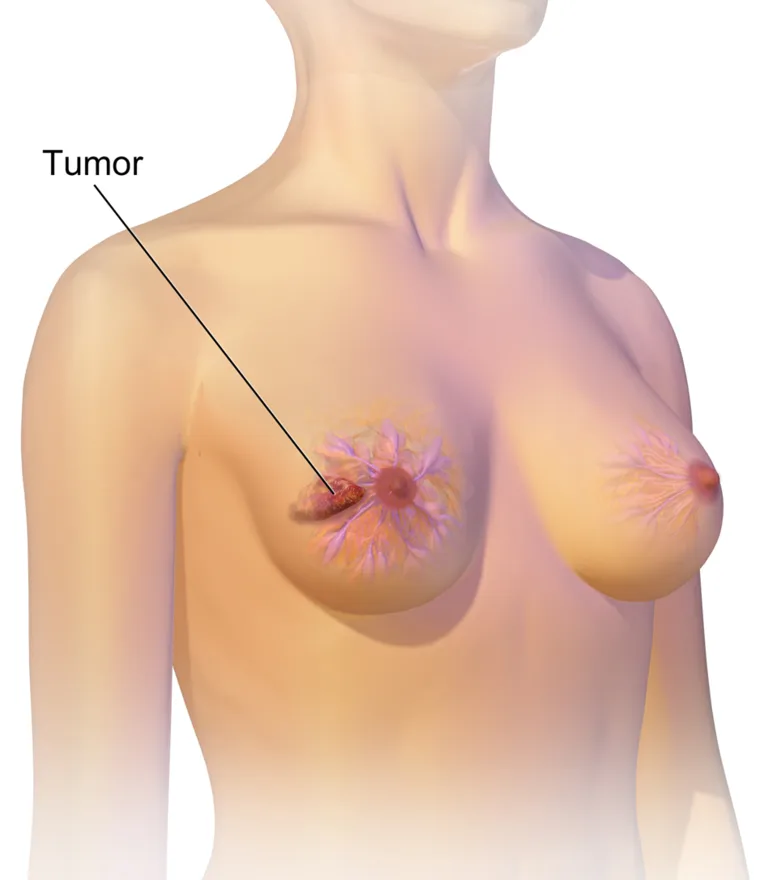
The classic presentation is a painless, hard, fixed, irregular lump, most often in the upper outer quadrant. Risk rises with age, family history, BRCA1/BRCA2 mutations, prolonged estrogen exposure, and obesity. Early detection through screening and self-awareness improves survival.
Breast Cancer illustrated
Key points to remember
- The classic sign is a single, hard, painless, fixed, irregular lump, frequently in the upper outer quadrant.
- Other signs include nipple retraction, skin dimpling, peau d'orange (orange-peel skin), and bloody or clear nipple discharge.
- Risk factors include female sex, increasing age, BRCA1/BRCA2 mutations, family history, early menarche/late menopause, nulliparity, and prolonged estrogen exposure.
- Hormone receptor (ER/PR) and HER2 status guide therapy; ER-positive tumors respond to tamoxifen or aromatase inhibitors.
- Treatment may include lumpectomy or mastectomy, sentinel lymph node biopsy, radiation, chemotherapy, and targeted/hormonal therapy.
- After axillary lymph node dissection, the affected arm is at risk for lymphedema.
Signs & symptoms
- Hard fixed painless lump, upper-outer
- Skin dimpling, peau d'orange, nipple retraction
- Bloody/clear unilateral nipple discharge
Nursing priorities
- After mastectomy, position the affected arm elevated on a pillow to promote lymph drainage.
- Protect the affected arm: no BP measurements, venipunctures, or injections on that side.
- Encourage progressive arm exercises as ordered to restore range of motion and prevent contractures.
- Provide emotional support and address body image and sexuality concerns.
- Monitor the surgical site and drains for bleeding, infection, and excessive output.
Labs & values
Patient teaching
- Protect the affected arm: avoid blood draws, BP, injections, heavy lifting, tight clothing/jewelry, and cuts on that side.
- Perform prescribed arm exercises and report any swelling, redness, or signs of lymphedema or infection.
- Follow recommended screening: mammography and clinical exams per guidelines; report any new lump or change.
- Practice monthly breast self-awareness and know normal versus abnormal findings.
- For hormonal therapy like tamoxifen, report leg pain/swelling or abnormal vaginal bleeding (clot and endometrial cancer risk).
Red flags: report now
- Signs of lymphedema or infection in the affected arm (swelling, redness, warmth) require prompt reporting.
- Never take blood pressure, draw blood, or give injections in the arm on the operative/lymph node dissection side.
- Sudden severe arm swelling, chest pain, or shortness of breath needs immediate evaluation.
References
Clinical references for this topic