Airway is the top priority; singed nasal hair, carbonaceous sputum, hoarseness, and facial burns signal inhalation injury and impending airway edema.
Before you read
Test yourself first: 5 questions
Question 1 of 5
A client with metastatic prostate cancer reports sudden, severe back pain with new leg weakness and difficulty voiding. The nurse recognizes the priority concern as which oncologic emergency?
Answer: A. These findings suggest spinal cord compression from metastatic disease, an oncologic emergency. New or worsening back pain with motor weakness, sensory changes, or bowel and bladder dysfunction requires immediate evaluation and treatment (corticosteroids, radiation) to prevent permanent paralysis.
Question 2 of 5
A client with acute coronary syndrome is having chest pain and receives sublingual nitroglycerin. After the first tablet, the pain persists. What is the nurse's appropriate action?
Answer: B. For ongoing chest pain, the standard teaching is to give one sublingual nitroglycerin tablet every 5 minutes for up to 3 doses, checking blood pressure between doses because nitroglycerin causes vasodilation and hypotension. If pain is unrelieved, emergency care or provider notification is needed. Giving all three at once, waiting 30 minutes, or doubling the dose are unsafe.
Question 3 of 5
A client with a head injury shows a widening pulse pressure, bradycardia, and irregular respirations. The nurse recognizes:
Answer: B. Cushing's triad (bradycardia, irregular respirations, widening pulse pressure) is a LATE sign of dangerously increased intracranial pressure — a neurosurgical emergency. Notify immediately.
Question 4 of 5
A client with a head injury develops bradycardia, a widening pulse pressure, and irregular respirations. The nurse recognizes:
Answer: B. This is Cushing's triad — a LATE sign of dangerously increased intracranial pressure and a neurologic emergency. Notify the provider immediately.
Question 5 of 5
A nurse is assessing a client who sustained a burn to the forearm. The area is red, painful, blanches with pressure, and has no blisters. How does the nurse classify this burn?
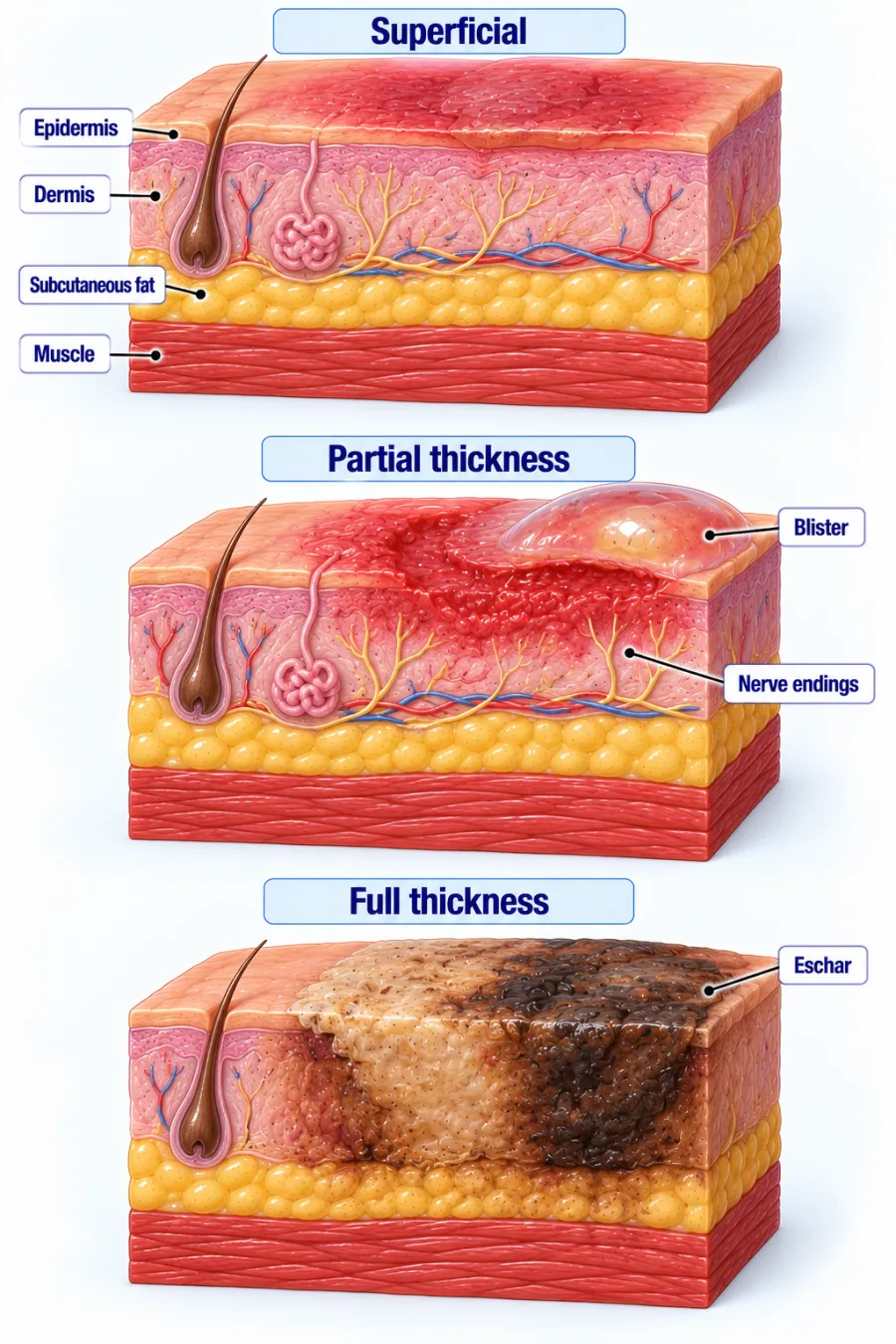
Answer: A. A superficial (first-degree) burn involves only the epidermis. It appears red and dry, blanches with pressure, is painful, and has no blisters. A superficial partial-thickness burn would have moist blisters. Deep partial-thickness and full-thickness burns extend into or through the dermis; full-thickness burns are often painless because nerve endings are destroyed.
Keep the streak going with more questions like these, each with a full rationale.
What is burns emergency care?
Airway compromise from inhalation injury and fluid loss are the leading early killers. Airway, breathing, and fluid resuscitation take priority over wound care in the first hours.
Burns Emergency Care illustrated
Key points to remember
- Airway is the top priority; singed nasal hair, carbonaceous sputum, hoarseness, and facial burns signal inhalation injury and impending airway edema.
- The Parkland formula guides fluid resuscitation: 4 mL lactated Ringer's per kg per percent TBSA, with half given in the first 8 hours from time of injury.
- Urine output of 0.5 mL/kg/hr in adults (or 30-50 mL/hr) indicates adequate fluid resuscitation.
- The rule of nines estimates total body surface area burned in adults for fluid calculation.
- Major fluid shifts and hypovolemia dominate the first 24-48 hours (emergent phase), followed by fluid mobilization.
- Circumferential burns can cause compartment syndrome and may require escharotomy.
Nursing priorities
- Stop the burning process and assess and secure the airway, giving 100% oxygen for suspected inhalation or carbon monoxide exposure.
- Calculate and start lactated Ringer's fluid resuscitation using the Parkland formula.
- Monitor hourly urine output as the primary marker of resuscitation adequacy.
- Remove clothing, jewelry, and constricting items and cover burns with clean dry dressings.
- Provide IV opioid analgesia and maintain strict infection control.
Labs & values
Patient teaching
- Cool minor burns with room-temperature running water, not ice.
- Do not apply butter, ointments, or toothpaste to burns.
- Keep burns clean and watch for signs of infection such as increasing redness, drainage, or fever.
- Install smoke detectors and set water heaters below 120 degrees F to prevent scalds.
Red flags: report now
- Hoarseness, stridor, or singed nasal hairs indicate inhalation injury - secure the airway before edema closes it.
- Urine output dropping below 0.5 mL/kg/hr signals inadequate resuscitation.
- Never apply ice or cold immersion to large burns, as it worsens tissue injury and hypothermia.
- Report circumferential chest or limb burns with tightness, numbness, or loss of pulses.
References
Clinical references for this topic