
Red flag to remember
Sudden sharp eye pain, increasing redness, or purulent drainage after surgery suggests infection or rising IOP; report immediately.
What is cataracts?
It is most often age-related but can result from trauma, diabetes, steroid use, or congenital factors. Surgical removal of the cloudy lens with insertion of an intraocular lens is the definitive, highly successful treatment. It is one of the most common causes of vision loss in older adults.
Cataracts illustrated
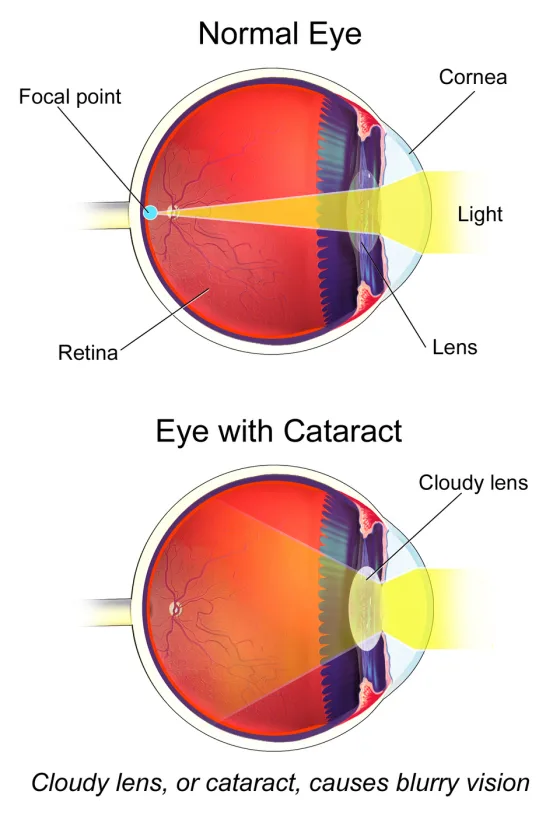
Key points to remember
- Hallmark signs are gradual, painless blurring of vision, glare and halos around lights, and faded color vision.
- Patients often report difficulty with night driving and improved near vision in early stages.
- The lens looks cloudy or whitish, and the red reflex may be absent on exam.
- Cataracts are not painful and do not cause eye redness; pain or redness suggests another problem.
- Surgery is typically outpatient, removing the lens and implanting an intraocular lens implant.
Signs & symptoms
- Cloudy/blurred vision, no pain
- Glare, halos, faded colors
- Lens opacity = cause
Nursing priorities
- Prepare the patient for outpatient lens-removal surgery and administer prescribed mydriatic/cycloplegic drops preoperatively.
- Postoperatively, instruct the patient to avoid bending, lifting over 10 to 15 pounds, straining, and coughing that raise IOP.
- Teach the patient to wear an eye shield, especially at night, to protect the operative eye.
- Administer postoperative antibiotic and anti-inflammatory eye drops as ordered.
- Position the patient on the non-operative side and provide a safe, uncluttered environment.
Patient teaching
- Avoid bending at the waist, heavy lifting, straining, and rubbing the eye after surgery.
- Wear sunglasses outdoors and the protective eye shield as instructed.
- Report sudden pain, vision loss, flashes, floaters, or increasing redness right away.
Red flags: report now
- Sudden sharp eye pain, increasing redness, or purulent drainage after surgery suggests infection or rising IOP; report immediately.
- A sudden decrease in vision, flashes of light, or floaters may indicate retinal detachment; emergency.
- Bleeding or a sensation of pressure in the eye should be reported promptly.
- Do not let the patient rub or apply pressure to the operative eye.
References
Clinical references for this topic

Study Cataracts in the app4,000+ NCLEX questions with a rationale on every answer, NGN case studies and timed mock exams.See how CinnaRN works
Start free Want more Physiological Adaptation questions?We'll email you a free set on Cataracts. No account needed.
Was this helpful?