
Right upper quadrant pain that may radiate to the right shoulder or scapula, often after a high-fat meal.
Before you read
Test yourself first: 3 questions
Question 1 of 3
A client with cholecystitis is most likely to report pain that:
Answer: A. Cholecystitis pain is in the right upper quadrant, often radiating to the right shoulder/scapula, worse after a fatty meal, with nausea. Left-sided crushing chest pain points to cardiac causes.
Question 2 of 3
A client reports steady, dull right upper quadrant pain that worsens after fatty meals, along with nausea. The nurse recognizes these as classic signs of which disorder?
Answer: A. Right upper quadrant pain that worsens after fatty meals, with nausea, is characteristic of cholecystitis or cholelithiasis (gallbladder disease). Bile is needed to digest fat, so fatty meals trigger pain.
Question 3 of 3
A client reports that abdominal pain consistently worsens after eating fried or fatty foods. The nurse recognizes this pattern is most characteristic of:
Answer: A. Fatty foods stimulate cholecystokinin release, causing gallbladder contraction. In cholelithiasis or cholecystitis, this contraction against an obstructed or inflamed gallbladder produces biliary colic, so pain typically intensifies after fatty meals. This dietary trigger pattern is a hallmark of gallbladder disease rather than peptic ulcer, appendicitis, or diverticulitis.
Keep the streak going with more questions like these, each with a full rationale.
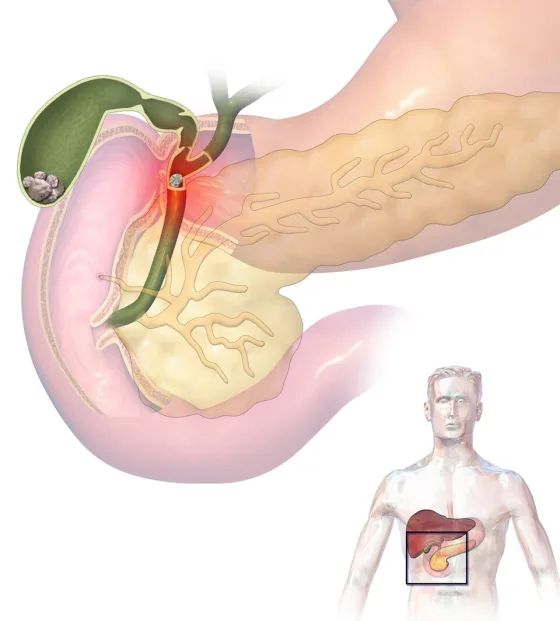
What is cholecystitis?
Risk factors are summarized by the 4 F's: Female, Forty, Fat, and Fertile. Pain typically follows a fatty meal because fat triggers gallbladder contraction. Bile obstruction can back up and cause jaundice and clay-colored stools.
Cholecystitis illustrated
Key points to remember
- Right upper quadrant pain that may radiate to the right shoulder or scapula, often after a high-fat meal.
- Murphy sign is positive: pain and inspiratory arrest when the RUQ is palpated during deep breath.
- Nausea, vomiting, fever, and indigestion (dyspepsia) are common.
- Obstruction of bile flow causes jaundice, dark amber urine, clay-colored stools, and pruritus.
- Bile is needed to absorb fat-soluble vitamins, so deficiency of A, D, E, and K may occur.
- The classic risk profile is the 4 F's: female, forty, fat (obese), and fertile.
Common causes
- Gallstones block cystic duct
- Fat, female, forty, fertile
Signs & symptoms
- RUQ pain → right shoulder
- Murphy's sign +, worse w/ fatty
- N/V, fever, clay stool, jaundice
Nursing priorities
- Keep the patient NPO during acute attacks to rest the gallbladder.
- Administer prescribed analgesics and antiemetics; provide IV fluids as ordered.
- Prepare and educate the patient for cholecystectomy, often laparoscopic.
- Monitor for signs of bile duct obstruction such as worsening jaundice and pale stools.
- Administer fat-soluble vitamin supplements and vitamin K if bile flow is impaired, as ordered.
Labs & values
Patient teaching
- Eat a low-fat diet and avoid greasy, fried foods that trigger attacks.
- After cholecystectomy, gradually reintroduce fats and report fever, increasing pain, or jaundice.
- Report persistent RUQ pain, fever, or yellowing of the skin and eyes.
Red flags: report now
- Fever, severe RUQ pain, and jaundice may indicate ascending cholangitis or sepsis requiring urgent care.
- Signs of gallbladder rupture or peritonitis (rigid abdomen, rebound tenderness) need immediate escalation.
- Clay-colored stools with dark urine and worsening jaundice signal complete bile obstruction.
References
Clinical references for this topic

