The hallmark sign is severe, deep, throbbing pain out of proportion to the injury and unrelieved by opioids.
Before you read
Test yourself first: 3 questions
Question 1 of 3
A client has circumferential full-thickness burns to the entire right arm. The nurse notes the fingers are cool, pale, and the radial pulse is now difficult to palpate. Which complication does the nurse suspect, and what intervention is anticipated?
Answer: B. Circumferential full-thickness burns form inelastic eschar that, with progressive edema, acts like a tourniquet and compromises circulation distal to the burn (a compartment-syndrome-like process). Loss of distal pulses, pallor, coolness, and paresthesia are warning signs. An escharotomy, a surgical incision through the eschar, relieves the pressure and restores perfusion.
Question 2 of 3
A client with a newly applied long-leg plaster cast reports increasing, deep, unrelenting pain in the calf that is not relieved by prescribed opioids. Which action should the nurse take FIRST?
Answer: C. Pain that is severe, deep, and unrelieved by opioids is the earliest and most reliable sign of compartment syndrome. The priority is to notify the provider so the cast can be bivalved or removed to relieve pressure; delay risks irreversible ischemia and tissue necrosis.
Question 3 of 3
After a long-bone fracture and cast, a client reports severe, unrelieved pain and numbness in the toes. The nurse suspects:
Answer: B. Unrelieved pain out of proportion, paresthesia, pallor, pulselessness, and paralysis (the 5 Ps) suggest compartment syndrome — a surgical emergency. Notify the provider immediately; do not elevate above the heart or apply ice.
Keep the streak going with more questions like these, each with a full rationale.
What is compartment syndrome?
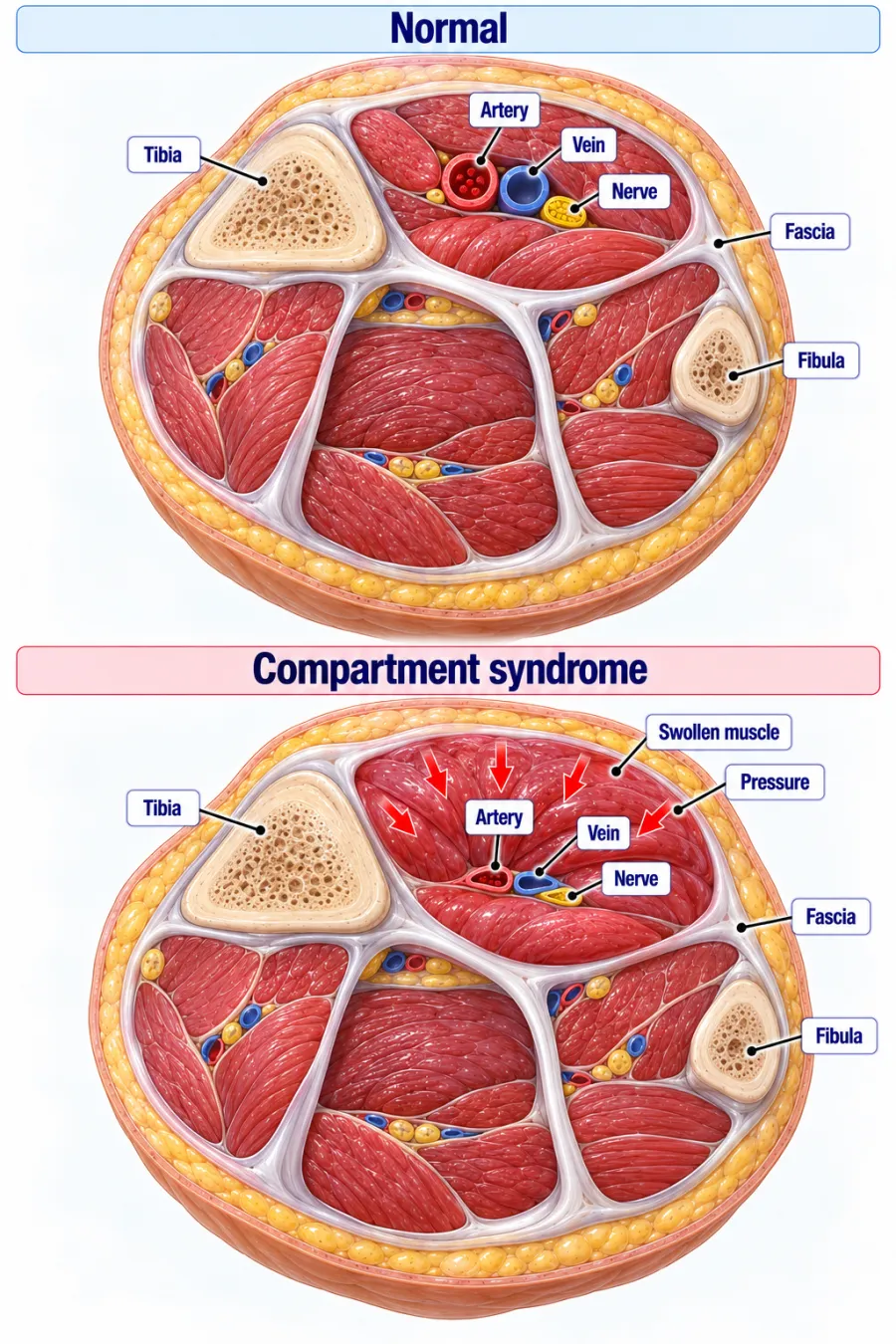
It is a surgical emergency most often seen after fractures, crush injuries, tight casts, or burns. Permanent muscle and nerve damage (and possible amputation) can occur within 4 to 6 hours, so early recognition is critical.
Compartment Syndrome illustrated
Key points to remember
- The hallmark sign is severe, deep, throbbing pain out of proportion to the injury and unrelieved by opioids.
- Pain on passive stretch of the muscles is one of the earliest and most reliable findings.
- The 6 P's are pain, paresthesia, pallor, pulselessness, paralysis, and poikilothermia (coolness).
- Pulselessness and paralysis are LATE signs; waiting for them risks permanent damage.
- Compartment pressure above 30 mmHg or within 30 mmHg of diastolic pressure indicates the syndrome.
- Muscle breakdown releases myoglobin, which can cause acute kidney injury (rhabdomyolysis).
Signs & symptoms
- PAIN out of proportion, ↑w/ stretch
- unrelieved by opioids = KEY
- paresthesia, pallor, pulselessness
Nursing priorities
- Notify the provider immediately at the first sign of escalating, unrelievable pain.
- Loosen or bivalve a constricting cast or remove restrictive dressings as ordered.
- Keep the extremity at heart level, NOT elevated, to maintain arterial perfusion.
- Stop applying ice, which causes vasoconstriction and worsens ischemia.
- Prepare the patient for an emergency fasciotomy to relieve pressure.
Labs & values
Patient teaching
- Report any increasing pain, numbness, tingling, or a sensation of tightness immediately.
- Understand that a fasciotomy wound may be left open temporarily to relieve pressure.
Red flags: report now
- Pain unrelieved by opioids plus pain on passive stretch is compartment syndrome until proven otherwise.
- Never elevate the limb above the heart or apply ice; both reduce blood flow and worsen ischemia.
- Dark, tea-colored urine signals rhabdomyolysis and impending kidney failure; report at once.
- Loss of pulse or movement means tissue death is imminent and surgery cannot wait.
References
Clinical references for this topic