Report uncontrolled or worsening bleeding from multiple sites and signs of hypovolemic shock.
Before you read
Test yourself first: 5 questions
Question 1 of 5
A nurse reviews labs for a client suspected of having disseminated intravascular coagulation (DIC). Which set of findings is most consistent with DIC?
Answer: B. DIC consumes clotting factors and platelets through widespread microthrombi, then triggers fibrinolysis. The classic pattern is decreased platelets, decreased fibrinogen, prolonged PT and PTT, and markedly elevated D-dimer (a fibrin degradation product). High fibrinogen with normal platelets would not fit a consumptive coagulopathy.
Question 2 of 5
A nurse is caring for a client with sepsis who is at risk for disseminated intravascular coagulation (DIC). Which laboratory finding would support this complication?
Answer: A. DIC produces widespread clotting that consumes platelets and clotting factors, then triggers fibrinolysis. Characteristic findings include a low platelet count, prolonged PT and PTT, low fibrinogen, and elevated D-dimer. A normal platelet count with low D-dimer would argue against DIC.
Question 3 of 5
A client is diagnosed with disseminated intravascular coagulation (DIC). Which set of findings is consistent with this disorder?
Answer: A. DIC involves widespread clotting that consumes platelets and clotting factors, leading to simultaneous clotting and bleeding. Labs show low platelets, low fibrinogen, prolonged PT/aPTT, and elevated D-dimer, with the client bleeding from multiple sites.
Question 4 of 5
A client with a significant placental abruption is at risk for a serious clotting complication. The nurse monitors for which condition?
Answer: A. A large placental abruption can trigger disseminated intravascular coagulation (DIC) due to the release of thromboplastin from the disrupted placenta, consuming clotting factors. The nurse monitors for bleeding from IV sites, gums, and abnormal coagulation studies.
Question 5 of 5
A client develops disseminated intravascular coagulation (DIC). The nurse expects:
Answer: B. DIC causes simultaneous clotting and bleeding — widespread clotting consumes clotting factors/platelets, leading to bleeding from multiple sites (IV sites, gums, urine). Monitor for bleeding and treat the cause.
Keep the streak going with more questions like these, each with a full rationale.
What is disseminated intravascular coagulation (dic)?
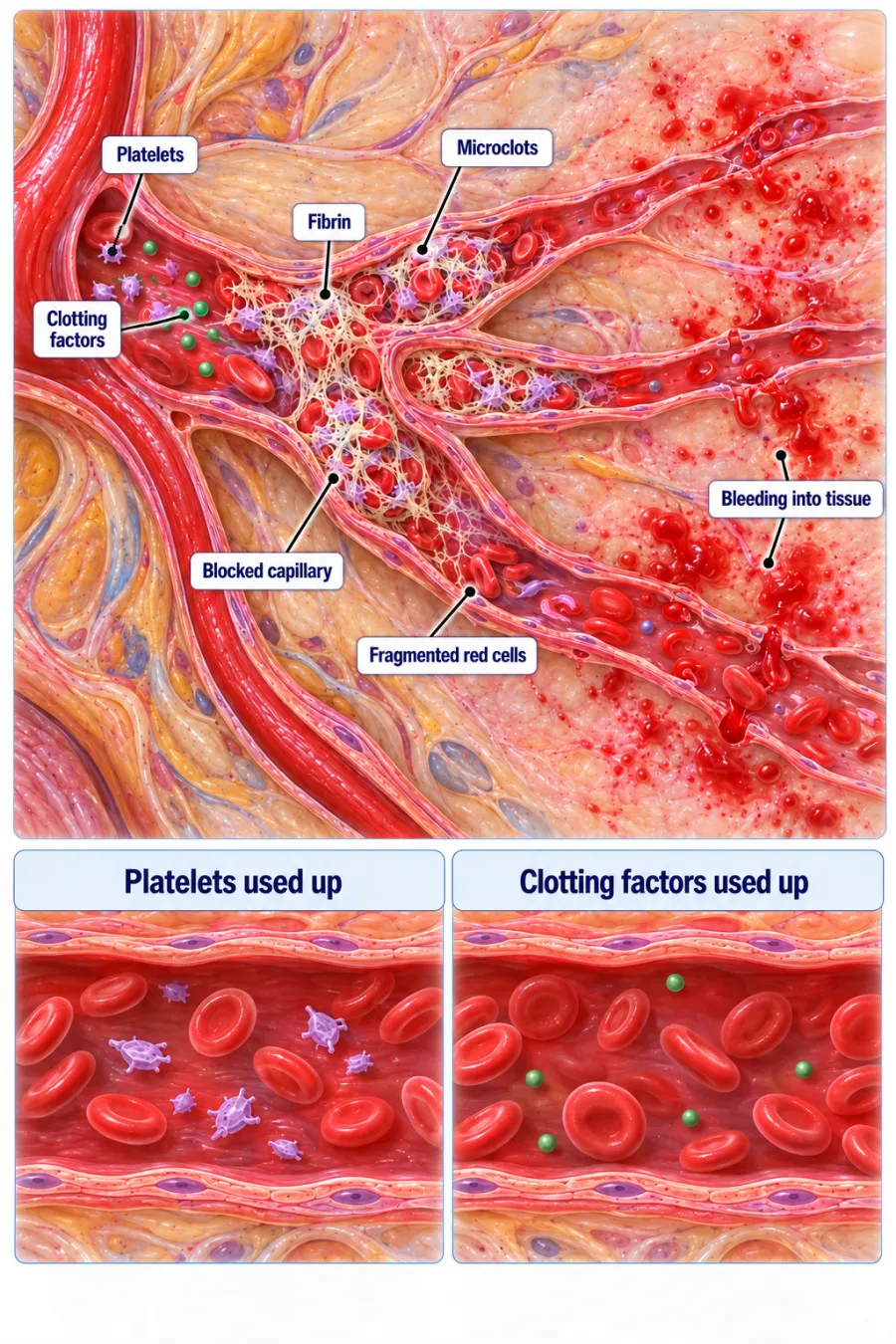
It is always secondary to another trigger such as sepsis, obstetric complications, massive trauma, or cancer. It matters because the patient simultaneously clots (organ ischemia) and bleeds (hemorrhage), and mortality is high.
Disseminated Intravascular Coagulation (DIC) illustrated
Key points to remember
- Diffuse microclotting consumes platelets and clotting factors, then causes uncontrolled bleeding.
- DIC is always secondary; common triggers are sepsis, obstetric emergencies, trauma, and malignancy.
- Bleeding appears from multiple sites at once: IV sites, gums, incisions, and mucous membranes.
- Microclots cause organ ischemia, seen as cool, mottled, or cyanotic extremities and decreased urine output.
- D-dimer and fibrin degradation products are elevated while fibrinogen and platelets fall.
- Both PT and aPTT are prolonged.
Signs & symptoms
- bleeding from EVERY site
- oozing IV/incision, petechiae
- cyanotic digits (microclots)
Nursing priorities
- Identify and treat the underlying cause (e.g., antibiotics for sepsis, delivery for obstetric triggers).
- Monitor for bleeding from all sites and assess perfusion to extremities and organs.
- Administer prescribed blood products: platelets, fresh frozen plasma, and cryoprecipitate.
- Protect the patient from injury and avoid invasive procedures and IM injections.
- Monitor vital signs, urine output, and neurologic status for shock and organ failure.
Labs & values
Red flags: report now
- Report uncontrolled or worsening bleeding from multiple sites and signs of hypovolemic shock.
- Report signs of organ ischemia: decreasing urine output, change in level of consciousness, or cyanotic/mottled limbs.
- Report a falling fibrinogen and platelet count with rising D-dimer, indicating worsening DIC.
References
Clinical references for this topic