Weakness and paralysis are symmetric and typically ascend from the legs upward.
Before you read
Test yourself first: 3 questions
Question 1 of 3
A nurse cares for a client with Guillain-Barre syndrome who develops a rapid heart rate, then bradycardia, and labile blood pressure. The nurse recognizes these findings as evidence of which complication?
Answer: A. Guillain-Barre syndrome can affect the autonomic nervous system, causing dysautonomia with fluctuating heart rate and blood pressure, arrhythmias, and orthostatic changes. These require close cardiac monitoring. The findings are not signs of infection, a normal stress response, or a medication allergy.
Question 2 of 3
A nurse is performing discharge teaching for a client recovering from Guillain-Barre syndrome. Which statement about recovery is accurate for the nurse to share?
Answer: A. Recovery from Guillain-Barre syndrome usually occurs in the reverse order of symptom onset (descending recovery) over weeks to months, and most clients recover, though some have residual weakness. Recovery is generally gradual, not immediate. It is not a relapsing-remitting disease like MS, and most clients do not remain permanently paralyzed.
Question 3 of 3
A nurse is caring for a client with Guillain-Barre syndrome. Which assessment is the priority during the acute phase?
Answer: B. Guillain-Barre syndrome causes an ascending flaccid paralysis that can affect the muscles of respiration. Monitoring respiratory status, including vital capacity and breathing effort, is the priority because respiratory failure is the most life-threatening complication. Bowel sounds, skin integrity, and pain are important but secondary to airway and breathing.
Keep the streak going with more questions like these, each with a full rationale.
What is guillain-barre syndrome?
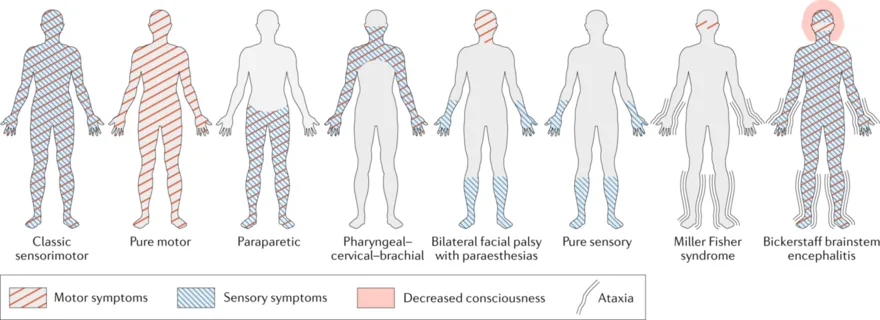
It classically begins in the lower extremities and ascends symmetrically upward, often following a recent respiratory or GI infection. The greatest danger is ascending paralysis reaching the respiratory muscles. Most patients recover, with weakness then resolving in descending order.
Guillain-Barre Syndrome illustrated
Key points to remember
- Weakness and paralysis are symmetric and typically ascend from the legs upward.
- Symptoms often appear 1 to 3 weeks after a viral respiratory or GI infection.
- Diminished or absent deep tendon reflexes, paresthesias, and pain are common.
- Ascending paralysis can reach the diaphragm and intercostal muscles, causing respiratory failure.
- Autonomic dysfunction may cause labile blood pressure, tachycardia or bradycardia, and arrhythmias.
Signs & symptoms
- Ascending symmetric weakness
- Starts feet → moves up
- Paresthesias, ↓ DTRs, autonomic
Nursing priorities
- Continuously monitor respiratory status (vital capacity, rate, depth) as respiratory failure is the leading cause of death.
- Keep intubation and mechanical ventilation equipment ready at the bedside.
- Administer plasmapheresis or IV immunoglobulin (IVIG) as prescribed to shorten the course.
- Monitor for autonomic instability: watch blood pressure and cardiac rhythm closely.
- Prevent complications of immobility with DVT prophylaxis, repositioning, and range-of-motion exercises.
Labs & values
Patient teaching
- Recovery is usually gradual and may take weeks to months; most patients regain function.
- Participate in physical and occupational therapy to rebuild strength and prevent contractures.
- Report any returning weakness, breathing difficulty, or swallowing trouble immediately.
Red flags: report now
- Declining vital capacity, shallow breathing, or difficulty clearing secretions signals impending respiratory failure, an emergency.
- Wide swings in blood pressure or heart rate from autonomic dysfunction require immediate attention.
- Difficulty swallowing or weakening cough indicates the paralysis is reaching cranial/bulbar muscles.
References
Clinical references for this topic