Ptosis (drooping eyelids) and diplopia (double vision) are often the earliest signs.
Before you read
Test yourself first: 3 questions
Question 1 of 3
A nurse cares for a client with myasthenia gravis. Which statement best describes the underlying pathophysiology the nurse should understand?
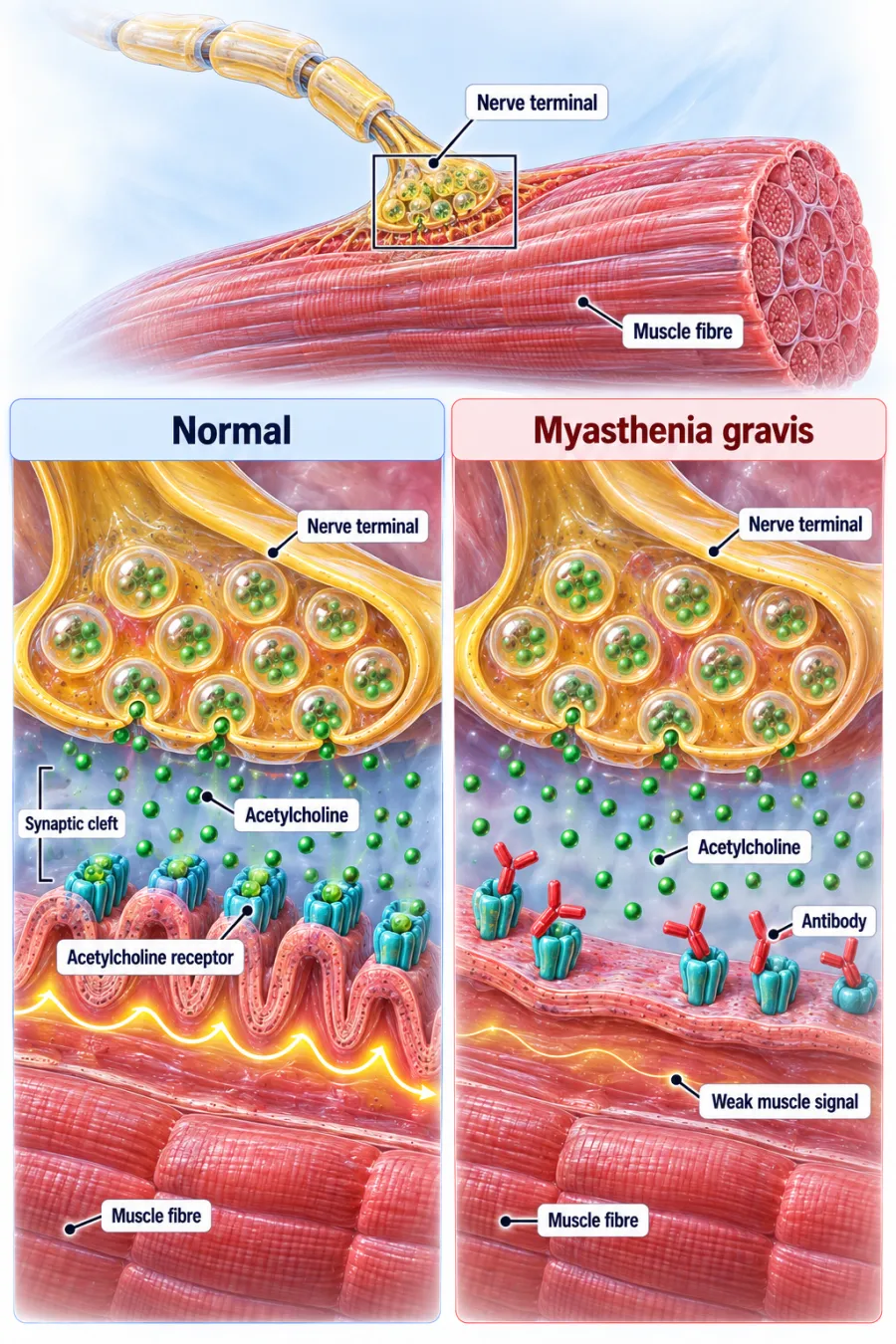
Answer: B. Myasthenia gravis is an autoimmune disorder in which antibodies attack acetylcholine receptors at the neuromuscular junction, impairing nerve-to-muscle transmission and causing fluctuating, fatigable muscle weakness. It is not caused by dopamine deficiency, demyelination of central neurons, or motor neuron degeneration.
Question 2 of 3
A nurse evaluates a client suspected of myasthenia gravis. The provider orders an edrophonium (Tensilon) test. A positive result that supports the diagnosis is indicated by which finding?
Answer: A. In the edrophonium (Tensilon) test, a short-acting anticholinesterase is given. In myasthenia gravis, muscle strength temporarily improves, confirming the diagnosis. Worsening weakness would suggest cholinergic crisis rather than myasthenic crisis. Changes in pupil size or blood pressure alone are not the diagnostic indicator.
Question 3 of 3
A nurse reviews findings for a client with suspected multiple sclerosis. Which diagnostic result best supports the diagnosis?
Answer: A. MS is supported by MRI showing demyelinating plaques (white matter lesions) in the brain and spinal cord, and by oligoclonal bands in cerebrospinal fluid. A resting tremor, elevated acetylcholine receptor antibodies, and albuminocytologic dissociation in CSF point to other neurologic conditions (Parkinson, myasthenia gravis, and Guillain-Barre respectively).
Keep the streak going with more questions like these, each with a full rationale.
What is myasthenia gravis?
The hallmark is muscle weakness that worsens with activity and improves with rest. It commonly affects the eyes, face, throat, and breathing muscles, and is treated with anticholinesterase drugs like pyridostigmine. Remember: weakness gets worse as the day goes on.
Myasthenia Gravis illustrated
Key points to remember
- Ptosis (drooping eyelids) and diplopia (double vision) are often the earliest signs.
- Muscle weakness worsens with repeated use/exertion and improves with rest.
- Bulbar involvement causes difficulty chewing, swallowing, and speaking, raising aspiration risk.
- Respiratory muscle weakness can progress to respiratory failure (myasthenic crisis).
- Myasthenic crisis is undermedication (worsening weakness); cholinergic crisis is overmedication (excess acetylcholine effects like salivation, GI cramping, and bradycardia).
Signs & symptoms
- Ptosis, diplopia = early
- Dysphagia, weak chewing, slurred
- Weakness improves with rest
Nursing priorities
- Monitor respiratory status closely (rate, depth, vital capacity) as respiratory failure is the greatest danger.
- Assess swallowing and implement aspiration precautions; time meals for periods of peak medication effect and energy.
- Administer anticholinesterase medication (pyridostigmine) on time, exactly as scheduled, before meals.
- Plan activities to conserve energy and schedule rest periods to reduce fatigue-related weakness.
- Keep emergency airway and suction equipment available; have atropine ready as the antidote for cholinergic crisis.
Patient teaching
- Take anticholinesterase medication exactly on schedule; even a slight delay can cause dangerous weakness.
- Conserve energy by planning demanding activities for early in the day after medication and resting frequently.
- Avoid infection, stress, extreme temperatures, and certain drugs (some antibiotics, sedatives) that can worsen weakness, and wear a medical alert bracelet.
Red flags: report now
- Increasing respiratory distress, declining vital capacity, or inability to clear secretions signals impending crisis, an emergency.
- Difficulty swallowing or managing oral secretions indicates high aspiration risk.
- Excess salivation, sweating, abdominal cramping, and bradycardia suggest cholinergic crisis (overmedication), notify the provider.
References
Clinical references for this topic