Productive cough with rust-colored, green, or purulent sputum, fever, chills, and pleuritic chest pain are classic.
Before you read
Test yourself first: 3 questions
Question 1 of 3
A nurse reviews the chest x-ray report of a client admitted with pneumonia. Which finding is most consistent with this diagnosis?
Answer: A. Pneumonia typically produces areas of consolidation or infiltrates on chest x-ray as alveoli fill with inflammatory exudate. Hyperinflation with flattened diaphragms suggests COPD, a small pneumothorax shows a lung edge with absent markings, and a completely clear field would not explain pneumonia.
Question 2 of 3
A nurse is evaluating a client with pneumonia. Which finding indicates the client's condition is improving?
Answer: A. Clearing of breath sounds with decreasing crackles and improving oxygen saturation indicates resolving consolidation and effective treatment. Worsening confusion, rising temperature, and increasing dyspnea would all indicate deterioration rather than improvement.
Question 3 of 3
A chest x-ray of a client with suspected ARDS is reviewed. Which finding is most consistent with this diagnosis?
Answer: B. ARDS produces diffuse bilateral infiltrates often described as a white-out or ground-glass appearance, reflecting widespread alveolar flooding. A unilateral lobar consolidation suggests pneumonia, and a deviated trachea suggests tension pneumothorax.
Keep the streak going with more questions like these, each with a full rationale.
What is pneumonia?
It is a leading cause of death in older adults and the immunocompromised. Aspiration, immobility, and ventilators are common precipitating risks.
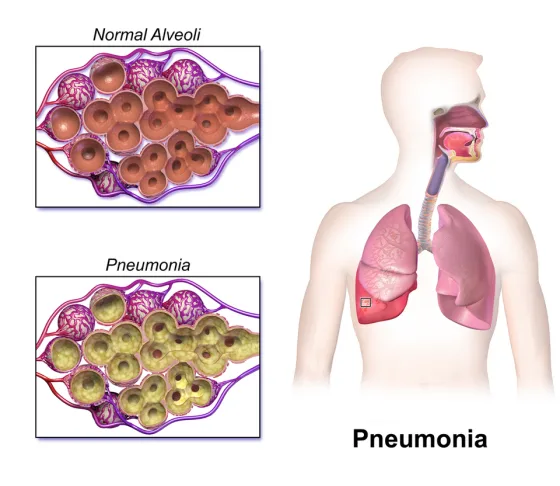
Pneumonia illustrated
Key points to remember
- Productive cough with rust-colored, green, or purulent sputum, fever, chills, and pleuritic chest pain are classic.
- Crackles (rales), bronchial breath sounds, and dullness to percussion occur over areas of consolidation.
- Tachypnea, dyspnea, and increased fremitus reflect impaired gas exchange and consolidation.
- In older adults, confusion and altered mental status may be the only early sign rather than fever.
- A chest x-ray showing infiltrates or consolidation confirms the diagnosis.
- Hypoxemia results from the ventilation-perfusion mismatch in consolidated lung segments.
Signs & symptoms
- Fever, productive cough, chills
- Crackles, ↓ breath sounds
- Pleuritic chest pain, ↑ RR
- Elders: confusion, ↓ O₂
Nursing priorities
- Obtain sputum culture before starting antibiotics, then give antibiotics promptly and on schedule.
- Administer oxygen and position in high Fowler's to improve ventilation.
- Encourage coughing, deep breathing, incentive spirometry, and increased fluids to mobilize secretions.
- Monitor temperature, oxygen saturation, and respiratory status, and provide rest periods.
- Implement aspiration precautions and reposition immobile patients to prevent atelectasis.
Labs & values
Patient teaching
- Complete the entire prescribed antibiotic course even after feeling better.
- Get the pneumococcal and annual influenza vaccines, especially if older than 65 or chronically ill.
- Stop smoking, increase fluids, and use deep breathing and coughing to clear the lungs.
Red flags: report now
- Worsening hypoxemia, confusion, or hypotension can indicate progression to sepsis or respiratory failure.
- New or increasing dyspnea with falling SpO2 despite oxygen requires escalation.
- Sudden pleuritic chest pain with decreased breath sounds may signal a complicating empyema or effusion.
References
Clinical references for this topic