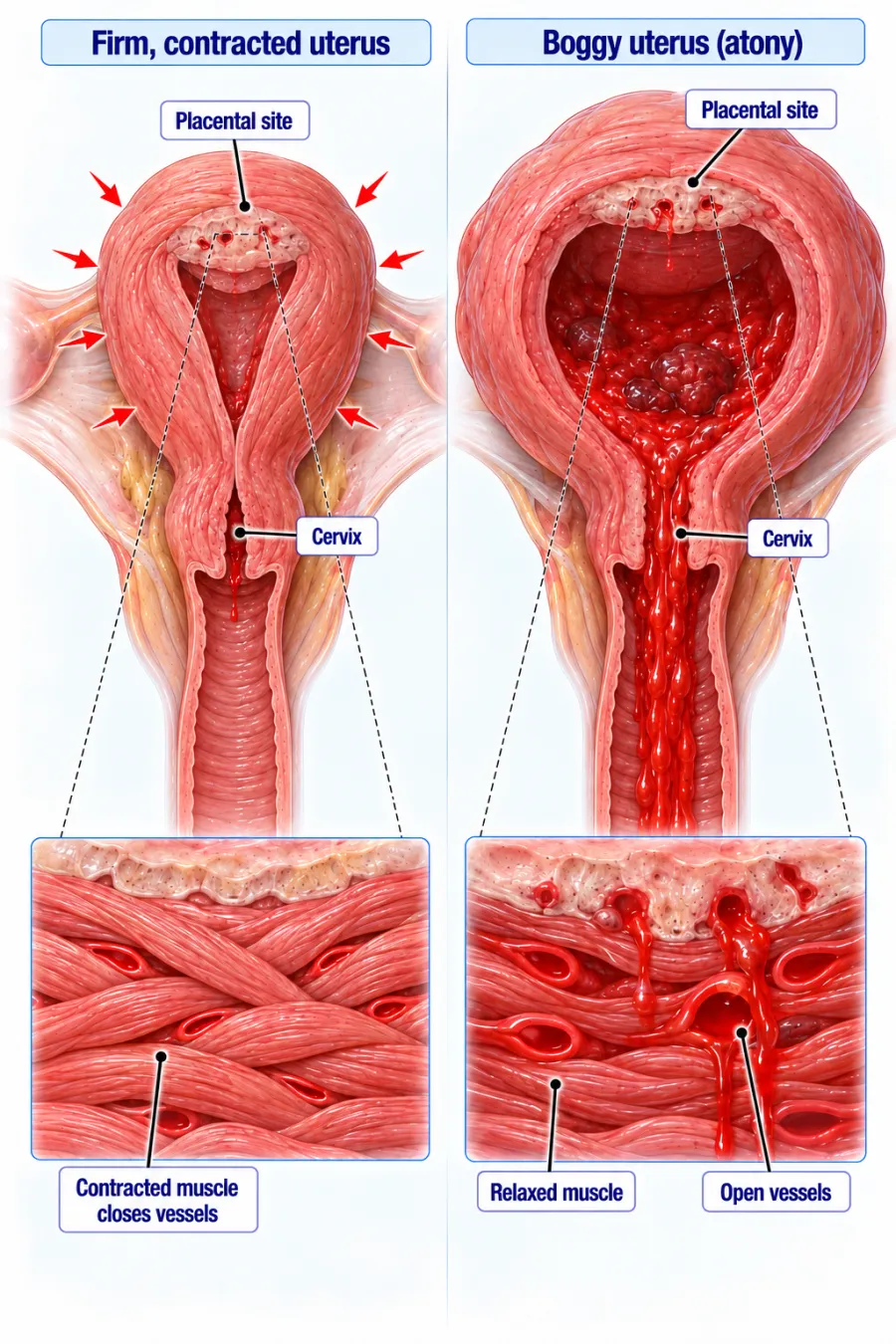
Uterine atony is the number-one cause; the fundus feels soft, boggy, and may be displaced above and to the side of midline (often from a full bladder).
Before you read
Test yourself first: 5 questions
Question 1 of 5
A postpartum client is diagnosed with early postpartum hemorrhage. The nurse identifies that the most common cause of early postpartum hemorrhage is which condition?
Answer: A. Uterine atony (failure of the uterus to contract) accounts for the majority of early (within 24 hours) postpartum hemorrhages. Retained placental fragments, lacerations of the genital tract, and coagulation disorders also cause bleeding but are far less common than atony.
Question 2 of 5
A nurse is teaching a postpartum client about warning signs to report after discharge. Which sign of secondary postpartum hemorrhage should the nurse emphasize?
Answer: A. Secondary (late) postpartum hemorrhage occurs more than 24 hours up to 12 weeks after birth, commonly from retained placental fragments or subinvolution. A sudden return of bright red, heavy bleeding after lochia had lightened is a key sign the client should report.
Question 3 of 5
A nurse is monitoring a postpartum client immediately after a precipitous delivery. Which complication is this client at greatest risk for?
Answer: B. Precipitous labor (delivery within about 3 hours of onset) and the resulting rapid, forceful contractions increase the risk of postpartum hemorrhage from uterine atony and genital tract lacerations. Prolonged labor risks infection, but the precipitous course specifically predisposes to atony and trauma.
Question 4 of 5
A nurse is caring for a client who delivered a macrosomic infant after a prolonged second stage of labor. Two hours postpartum the client has saturated two perineal pads, the fundus is boggy, and the blood pressure is 96/58 mm Hg with a pulse of 112. What is the nurse's first action?
Answer: A. With signs of early postpartum hemorrhage from uterine atony (boggy fundus, heavy bleeding, tachycardia, falling blood pressure), the immediate first action is to firmly massage the fundus to stimulate contraction and control bleeding while calling for help. Establishing IV access, giving uterotonics, and notifying the provider follow quickly, but fundal massage is the first, fastest bedside intervention for atony.
Question 5 of 5
Two hours after a vaginal delivery, a postpartum client has saturated a perineal pad within 15 minutes. What is the nurse's priority action?
Answer: A. Saturating a pad in 15 minutes or less signals postpartum hemorrhage. The first nursing action is to assess and massage the fundus, since uterine atony is the most common cause and a boggy uterus that firms with massage confirms it. Other interventions follow after the fundus is addressed.
Keep the streak going with more questions like these, each with a full rationale.
What is postpartum hemorrhage?
The most common cause is uterine atony (a boggy, non-contracting uterus). Other causes follow the 4 T's memory aid: Tone (atony), Trauma (lacerations), Tissue (retained placenta), and Thrombin (clotting defects). It is a leading cause of maternal death and demands rapid recognition.
Postpartum Hemorrhage illustrated
Key points to remember
- Uterine atony is the number-one cause; the fundus feels soft, boggy, and may be displaced above and to the side of midline (often from a full bladder).
- A boggy uterus with steady bright-red bleeding or large clots signals atony.
- Bright-red bleeding with a firm, well-contracted uterus suggests a laceration of the birth canal.
- Early signs of hypovolemia include tachycardia and narrowed pulse pressure; hypotension is a late sign.
- Retained placental fragments prevent the uterus from contracting and cause continued bleeding.
Nursing priorities
- Perform fundal massage first for a boggy uterus to stimulate contraction and control bleeding.
- Empty the bladder (encourage voiding or catheterize) so the uterus can contract down.
- Administer uterotonics as ordered (oxytocin first-line; also methylergonovine, carboprost, or misoprostol).
- Establish IV access, give fluids, monitor vital signs, and prepare for blood replacement.
- Quantify ongoing blood loss by weighing pads and count clots while monitoring for shock.
Labs & values
Patient teaching
- Report soaking a pad in an hour, passing large clots, or feeling dizzy or weak after going home.
- Empty your bladder regularly so the uterus can stay firm.
- Learn how to check and gently massage your own fundus if instructed.
Red flags: report now
- A boggy fundus that does not firm with massage, or saturation of a pad within 15 minutes, is an emergency.
- Report rising heart rate, falling blood pressure, restlessness, or pallor, which indicate hemorrhagic shock.
- Do not give methylergonovine to a patient with hypertension; do not give carboprost to a patient with asthma.
- Report a uterus that remains boggy despite massage and uterotonics; surgical intervention may be needed.
References
Clinical references for this topic