High-potassium foods include bananas, oranges, potatoes, tomatoes, spinach, avocado, and salt substitutes.
Before you read
Test yourself first: 5 questions
Question 1 of 5
A client in DKA is receiving an IV insulin infusion. The nurse reviews the labs and notes a serum potassium of 3.2 mEq/L. Which action is the priority?
Answer: B. Insulin drives potassium into cells, and DKA treatment can cause dangerous hypokalemia. With a potassium of 3.2 mEq/L (below normal 3.5 to 5.0), the nurse should hold or delay the insulin and notify the provider so potassium can be replaced first. Giving insulin into a hypokalemic state can precipitate lethal dysrhythmias.
Question 2 of 5
A client receiving IV potassium and digoxin has a potassium level of 2.8 mEq/L. Why is this finding a concern?
Answer: B. Hypokalemia increases the risk of digoxin toxicity because low potassium enhances digoxin binding to cardiac cells, predisposing to dysrhythmias even at normal digoxin levels. The nurse should report the low potassium and monitor for toxicity.
Question 3 of 5
A client in DKA is receiving an IV insulin infusion. The latest potassium level is 3.2 mEq/L. What is the priority nursing action?
Answer: A. Insulin drives potassium into cells, so it can dangerously lower an already low serum potassium. With a potassium of 3.2 mEq/L, the nurse should hold or delay insulin and notify the provider so potassium can be replaced first, preventing life-threatening hypokalemia and arrhythmias. Increasing the insulin rate would worsen the hypokalemia.
Question 4 of 5
A client with HHS is being treated with IV fluids and insulin. The nurse monitors closely for which electrolyte imbalance during treatment?
Answer: A. As in DKA, fluid and insulin therapy in HHS drives potassium back into cells and dilutes serum potassium, so hypokalemia is a key risk to monitor. Potassium is replaced as needed and cardiac rhythm is watched. Sodium is also followed, but the most immediately dangerous, closely monitored shift during insulin therapy is the drop in potassium.
Question 5 of 5
A client in acute kidney injury has a potassium of 6.5 mEq/L. The nurse anticipates which dietary instruction?
Answer: B. Restrict dietary potassium (avoid bananas, oranges, potatoes, salt substitutes) and treat the hyperkalemia. High-potassium foods would worsen it.
Keep the streak going with more questions like these, each with a full rationale.
What is potassium-modified diet?
Low-potassium diets are used in kidney disease and hyperkalemia, while high-potassium diets support patients on potassium-wasting diuretics. Because potassium is critical to heart rhythm, both very high and very low levels can be life-threatening.
Key points to remember
- High-potassium foods include bananas, oranges, potatoes, tomatoes, spinach, avocado, and salt substitutes.
- Low-potassium choices include apples, berries, rice, pasta, and well-leached vegetables.
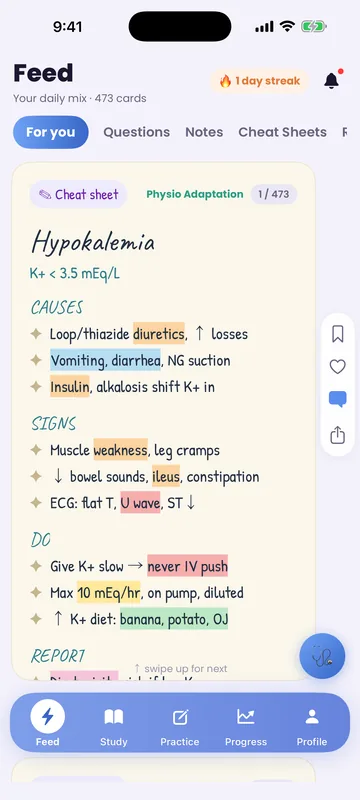
- Potassium-wasting loop and thiazide diuretics can cause hypokalemia and may warrant added potassium.
- Potassium-sparing diuretics and ACE inhibitors raise potassium and require restriction.
- Both hyperkalemia and hypokalemia cause dangerous cardiac dysrhythmias and muscle weakness.
Nursing priorities
- Monitor serum potassium and the ECG for dysrhythmias.
- Teach the patient which high-potassium foods to seek or avoid based on the prescribed direction.
- Reinforce avoiding potassium-based salt substitutes when restriction is ordered.
- Assess for muscle weakness, cramps, and palpitations.
- Coordinate diuretic therapy and potassium supplementation with the provider.
Labs & values
Patient teaching
- Learn your high-potassium foods and follow whether you should limit or include them.
- Avoid salt substitutes if you are told to restrict potassium.
- Soaking and boiling vegetables lowers their potassium content.
- Report palpitations, muscle weakness, or cramping to your provider.
Red flags: report now
- Potassium above 5.0 or below 3.5 mEq/L with ECG changes is a medical emergency.
- Peaked T waves or widened QRS suggest hyperkalemia and must be reported immediately.
- Never give potassium supplements or salt substitutes to a hyperkalemic or renal patient.
References
Clinical references for this topic