Report worsening grunting, retractions, apnea, or cyanosis indicating respiratory failure.
Before you read
Test yourself first: 5 questions
Question 1 of 5
A nurse cares for a newborn of a diabetic mother. Beyond hypoglycemia, which additional complication is this infant at increased risk for and should be monitored for?
Answer: A. Infants of diabetic mothers are at increased risk for respiratory distress syndrome (delayed surfactant production), hypocalcemia, hyperbilirubinemia/polycythemia, and birth injury from macrosomia, in addition to hypoglycemia. Monitoring for respiratory distress is essential.
Question 2 of 5
A preterm newborn at 30 weeks gestation develops tachypnea, grunting, nasal flaring, and retractions shortly after birth with a chest film showing a ground-glass pattern. The nurse recognizes the underlying cause as:
Answer: B. Respiratory distress syndrome (RDS) in the preterm infant results from a deficiency of surfactant, which is needed to lower alveolar surface tension and prevent atelectasis. Without surfactant, alveoli collapse, producing the classic ground-glass appearance and increased work of breathing. Treatment includes exogenous surfactant and respiratory support.
Question 3 of 5
What is the expected range for a healthy term newborn's resting respiratory rate?
Answer: C. A normal newborn respiratory rate is 30-60 breaths per minute, counted for a full minute because newborn breathing is irregular. A rate over 60 (tachypnea) or under 30, or apnea longer than 20 seconds, is abnormal and warrants evaluation.
Question 4 of 5
Immediately after delivery, the priority nursing intervention to prevent heat loss and support transition in a healthy term newborn is to:
Answer: B. Drying the newborn and placing skin-to-skin with the mother (or under a radiant warmer) prevents evaporative and conductive heat loss, which is the leading cause of cold stress. Cold stress increases oxygen and glucose consumption and can lead to hypoglycemia and respiratory distress. Bathing is delayed until the temperature is stable.
Question 5 of 5
A newborn is large for gestational age (LGA) with a plethoric (ruddy, deep-red) appearance and a central venous hematocrit of 68 percent. The nurse recognizes this finding as:
Answer: B. Polycythemia is defined as a central venous hematocrit greater than 65 percent. It causes a plethoric appearance and increases blood viscosity, raising the risk of poor perfusion, respiratory distress, hypoglycemia, and hyperbilirubinemia. It is more common in LGA infants, infants of diabetic mothers, and those with delayed cord clamping; management includes hydration and monitoring.
Keep the streak going with more questions like these, each with a full rationale.
What is respiratory distress syndrome (newborn)?
It primarily affects preterm infants and worsens over the first hours of life. Antenatal corticosteroids given to the mother and postnatal surfactant replacement are the cornerstones of prevention and treatment.
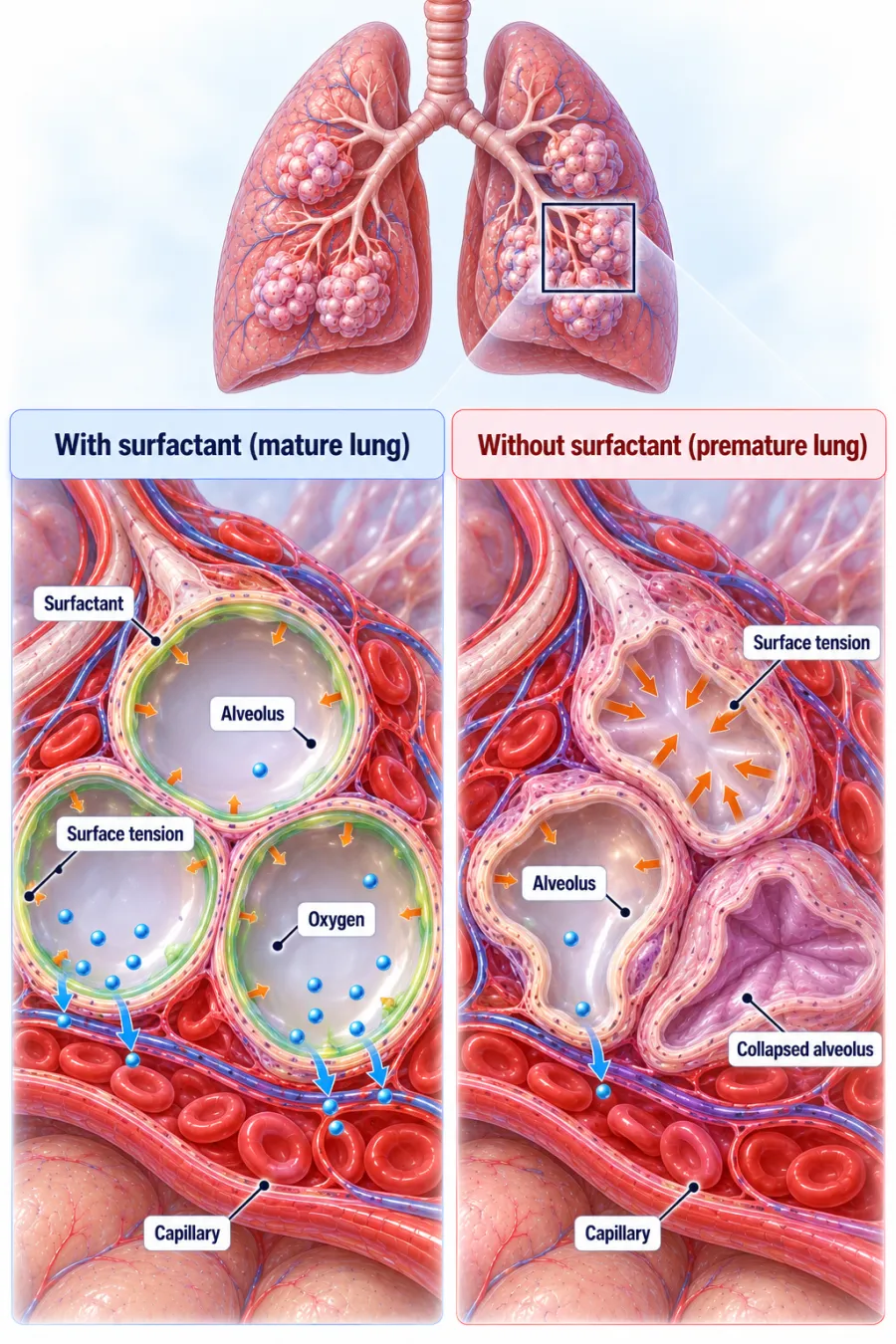
Respiratory Distress Syndrome (newborn) illustrated
Key points to remember
- Surfactant lowers alveolar surface tension; without it alveoli collapse on expiration (atelectasis).
- Signs include tachypnea, nasal flaring, grunting, intercostal/substernal retractions, and cyanosis worsening over time.
- Prematurity is the chief risk factor; surfactant production reaches maturity near 34-36 weeks.
- Antenatal betamethasone or dexamethasone given to the mother accelerates fetal lung maturity.
- Exogenous surfactant is administered via the endotracheal tube to replace the missing surfactant.
- An L/S ratio of at least 2:1 and presence of phosphatidylglycerol indicate fetal lung maturity.
Signs & symptoms
- Tachypnea, grunting, nasal flaring
- Retractions, cyanosis, ↓ O2 sat
- Apnea → respiratory failure
Nursing priorities
- Maintain a patent airway and support oxygenation with prescribed oxygen/CPAP or mechanical ventilation.
- Administer surfactant via ETT as ordered and monitor respiratory response.
- Cluster care and maintain a neutral thermal environment to reduce oxygen consumption.
- Continuously monitor oxygen saturation, respiratory effort, and blood gases.
- Support the family and explain interventions to reduce anxiety.
Labs & values
Patient teaching
- Explain to parents that antenatal steroids help the baby's lungs mature before birth.
- Describe that surfactant replacement helps the lungs stay open and improves breathing.
- Reassure parents about the purpose of CPAP/ventilator support and monitoring.
Red flags: report now
- Report worsening grunting, retractions, apnea, or cyanosis indicating respiratory failure.
- Report falling oxygen saturation or rising CO2 despite oxygen support.
- Avoid excessive oxygen administration that can contribute to retinopathy of prematurity; titrate to ordered targets.
References
Clinical references for this topic