A sudden severe 'worst headache of my life,' decreasing LOC, or vomiting suggests hemorrhage or rising ICP, report immediately.
Before you read
Test yourself first: 3 questions
Question 1 of 3
A client recovering from a left-hemisphere stroke shows the expected behavioral pattern. Which finding is the nurse MOST likely to observe?
Answer: A. Left-hemisphere strokes commonly produce aphasia (the left side usually controls language) and a slow, cautious, anxious behavioral style, along with right-sided weakness. Right-hemisphere strokes more often cause impulsiveness, poor judgment of abilities, and left-sided neglect. Therefore slow, cautious behavior with language deficits is most consistent with a left-hemisphere stroke.
Question 2 of 3
A client is admitted with a hemorrhagic stroke. Which intervention should the nurse anticipate to help control intracranial pressure?
Answer: B. For hemorrhagic stroke, blood pressure is lowered carefully and the head of the bed is elevated to about 30 degrees with the head midline to promote venous drainage and reduce intracranial pressure. Thrombolytics and anticoagulants are contraindicated because they would worsen bleeding. Trendelenburg position increases intracranial pressure.
Question 3 of 3
A client with a right-hemisphere stroke neglects the left side of the body and bumps into objects on the left. Which term BEST describes this finding?
Answer: A. Unilateral neglect (hemineglect) is common with right-hemisphere strokes; the client ignores stimuli on the affected (left) side. Homonymous hemianopsia is loss of half the visual field, which may coexist but is a visual deficit. Agnosia is failure to recognize objects, and apraxia is inability to perform purposeful movement.
Keep the streak going with more questions like these, each with a full rationale.
What is stroke (cva)?
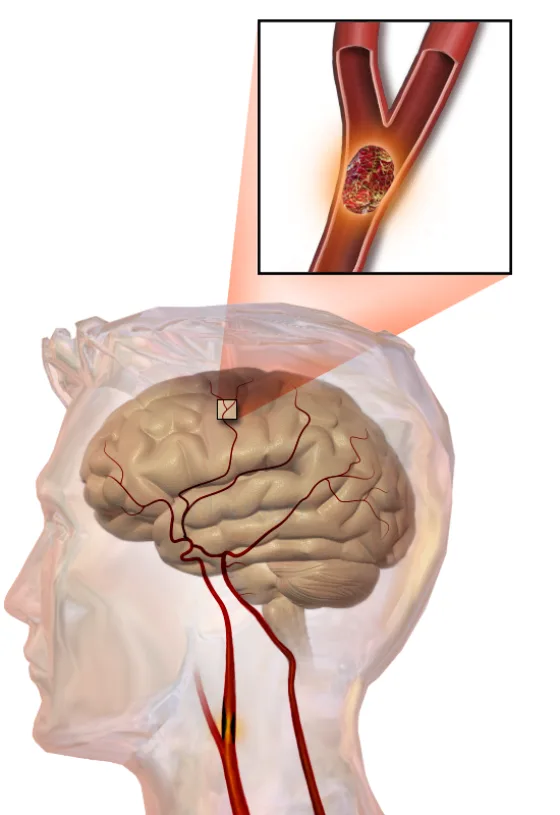
Ischemic strokes (most common, ~85%) come from a clot; hemorrhagic strokes come from a ruptured vessel, often from uncontrolled hypertension. Time is brain, so rapid recognition and treatment preserve neurons. Use BE FAST: Balance, Eyes, Face droop, Arm weakness, Speech, Time.
Stroke (CVA) illustrated
Key points to remember
- Symptoms are usually sudden and one-sided: facial droop, arm/leg weakness, and slurred or garbled speech.
- Deficits appear on the side of the body OPPOSITE the affected brain hemisphere.
- Left-brain stroke commonly causes aphasia and a slow, cautious behavior style; right-brain stroke causes spatial-perceptual deficits and impulsiveness.
- Ischemic stroke is treated with tPA if within the window; hemorrhagic stroke must NEVER receive tPA or anticoagulants.
- Homonymous hemianopsia (loss of half the visual field) and unilateral neglect are common and increase fall and injury risk.
Signs & symptoms
- Face droop, arm drift, speech
- Hemiparesis, aphasia, hemianopia
- Right brain → left side weakness
Nursing priorities
- Assess and protect the airway first; position to prevent aspiration and keep the head of bed elevated unless contraindicated.
- Determine the exact time of symptom onset (last known well) immediately, as it dictates tPA eligibility.
- Obtain a stat noncontrast CT scan to distinguish ischemic from hemorrhagic before any clot-busting therapy.
- Perform frequent neuro checks (NIH Stroke Scale, pupils, level of consciousness) and monitor blood pressure.
- Implement aspiration precautions and a dysphagia (swallow) screen before giving any food, fluids, or oral meds.
Labs & values
Patient teaching
- Recognize stroke warning signs and call 911 immediately, do not wait or drive yourself.
- Control blood pressure, cholesterol, diabetes, and stop smoking to prevent recurrence.
- Approach a patient with neglect from the unaffected side and place objects within their intact visual field.
Red flags: report now
- A sudden severe 'worst headache of my life,' decreasing LOC, or vomiting suggests hemorrhage or rising ICP, report immediately.
- Never give tPA, aspirin, or anticoagulants until a CT has ruled out bleeding.
- Bleeding from gums, IV sites, or in urine/stool after tPA signals hemorrhage, stop the infusion and notify the provider.
- A new decline in neuro status or fixed/dilated pupil is a neurologic emergency.
References
Clinical references for this topic