Coffee-ground emesis indicates blood altered by gastric acid; bright red hematemesis indicates active, brisk bleeding.
Before you read
Test yourself first: 5 questions
Question 1 of 5
A home care nurse reviews the chart of a client receiving warfarin. The most recent INR is 5.8. What is the nurse's PRIORITY action?
Answer: B. A therapeutic INR for most indications is about 2 to 3. An INR of 5.8 is critically high and places the client at serious risk for bleeding, so the nurse must withhold the dose and notify the provider. Continuing the dose or adding aspirin would increase bleeding risk.
Question 2 of 5
A nurse assesses a postpartum client and notes a firm fundus midline at the umbilicus, yet there is a steady trickle of bright red blood from the vagina. What does the nurse suspect as the most likely cause of the bleeding?
Answer: A. When the uterus is firm and well contracted but bright red bleeding continues, the source is most likely a laceration of the cervix, vagina, or perineum rather than atony. Uterine atony would produce a soft, boggy uterus. Retained placenta typically causes a boggy uterus and subinvolution; a full bladder displaces the fundus rather than causing a firm midline fundus with bleeding.
Question 3 of 5
A client at 9 weeks gestation reports painless, bright red vaginal bleeding with no cramping; on examination the cervix is closed. Which type of spontaneous abortion does the nurse recognize?
Answer: A. A threatened abortion presents with vaginal bleeding and a closed cervical os; the pregnancy may continue. An inevitable abortion has a dilated cervix, an incomplete abortion has partial passage of products with bleeding, and a missed abortion involves fetal demise retained without bleeding.
Question 4 of 5
A client with cirrhosis is at risk for bleeding primarily because the liver:
Answer: B. The failing liver produces fewer clotting factors (and a low platelet count from splenic sequestration), increasing bleeding risk — monitor for bleeding and check coagulation studies.
Question 5 of 5
A client with hemophilia A is admitted with a swollen, painful knee after a minor injury. Which is the priority nursing action?
Answer: A. Hemophilia A is a deficiency of clotting factor VIII causing prolonged bleeding; hemarthrosis (bleeding into a joint) is common. Priority care is to control bleeding by administering the prescribed factor VIII replacement, immobilizing and elevating the joint, and applying ice. Aspirin is contraindicated because it impairs platelet function. Vigorous range of motion would worsen joint bleeding.
Keep the streak going with more questions like these, each with a full rationale.
What is upper gi bleed?
Common causes are peptic ulcers, esophageal varices, gastritis, and Mallory-Weiss tears. It is a potential emergency because rapid blood loss leads to hypovolemic shock. Hallmark signs are hematemesis (bright red or coffee-ground emesis) and melena (black, tarry stools).
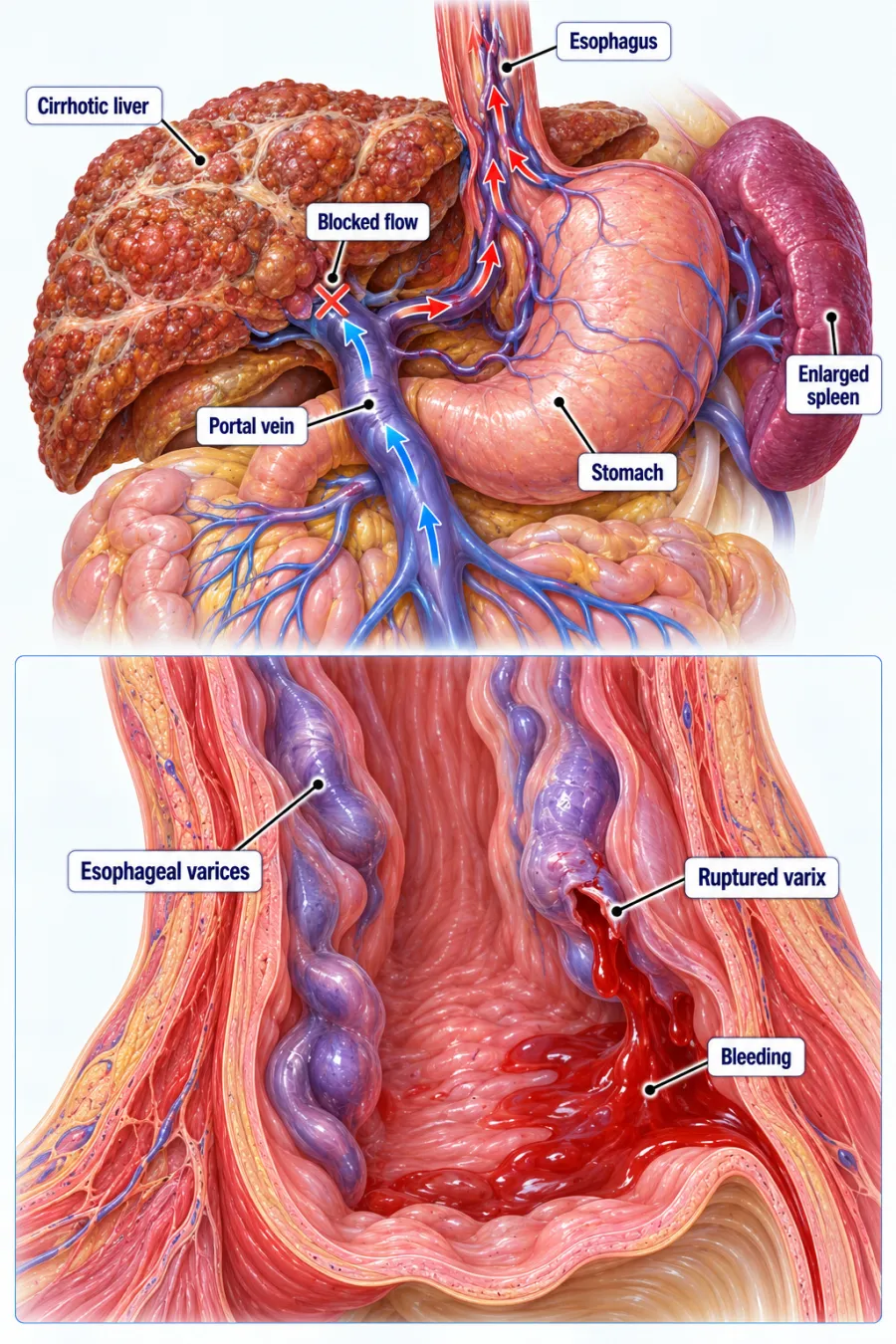
Upper GI Bleed illustrated
Key points to remember
- Coffee-ground emesis indicates blood altered by gastric acid; bright red hematemesis indicates active, brisk bleeding.
- Melena (black, tarry, foul-smelling stool) signals blood that has been digested in the upper GI tract.
- Early shock signs include tachycardia, hypotension, cool clammy skin, restlessness, and decreased urine output.
- A rising BUN with normal creatinine reflects digestion and absorption of blood protein in the gut.
- Esophageal varices from portal hypertension can produce massive, rapidly fatal hemorrhage.
- Hemoglobin and hematocrit may initially appear normal and drop only after fluid shifts or resuscitation.
Common causes
- PUD #1, varices, gastritis
- NSAIDs, ASA, alcohol, stress
Signs & symptoms
- Hematemesis (coffee-ground/bright)
- Melena = black tarry stool
- ↓ BP, ↑ HR, ↓ H&H = shock
Nursing priorities
- Assess airway, breathing, and circulation; establish two large-bore IV lines for fluid and blood replacement.
- Administer isotonic IV fluids and prepare to transfuse packed red blood cells per orders.
- Keep the patient NPO and prepare for endoscopy (EGD) to locate and treat the bleed.
- Monitor vital signs, level of consciousness, and intake/output frequently for signs of ongoing loss.
- Administer ordered proton pump inhibitors; for varices give octreotide first-line (vasopressin is largely outdated due to ischemic complications).
Labs & values
Patient teaching
- Avoid NSAIDs, aspirin, alcohol, and smoking, which irritate the GI lining and worsen bleeding.
- Report black tarry stools, vomiting blood, dizziness, or weakness immediately.
- Take prescribed acid-suppressing medications as directed and complete any H. pylori treatment.
Red flags: report now
- Hypotension, tachycardia, and altered mental status indicating hypovolemic shock require immediate intervention.
- Bright red hematemesis or large-volume bleeding signals active hemorrhage and need for rapid escalation.
- Sudden drop in hemoglobin/hematocrit with worsening vitals must be reported and treated immediately.
References
Clinical references for this topic